Can massage chairs or a vibrating mouse prevent computer-related injuries?
December 12, 2007
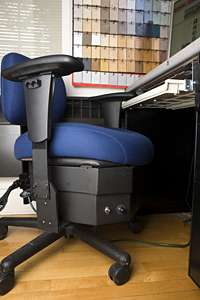
This chair with an undulating seat is a prototype of one of the ergonomic products Professor Alan Hedge studies to determine what kinds of products would prevent back and other problems caused by sitting in front of a computer all day. Lindsay France/University Photography
A chair that undulates, a mouse that vibrates, a monitor suspended over a desk on a movable arm. These are some of the kinds of newfangled ergonomic products that Alan Hedge, international authority on office ergonomics, studies to see if they can prevent repetitive motion injuries among the estimated 100 million people who now use computers in the United States.
"One-third to one-half of all compensatory injuries are repetitive-motion injuries associated with office-type work," says Hedge, professor of design and environmental analysis in Cornell's College of Human Ecology.
Back injuries also account for one-third of all workplace injuries. A decade ago most of these were associated with heavy lifting. Today they are mostly caused by people sitting for longer periods of time -- often in front of a computer.
The younger onset of computer use makes the current rate of compensatory damage claims the canary in the coal mine. There is typically a 10- to 15-year latency before injuries start to develop, Hedge has found. In the early 1990s he showed that the average age of workers reporting carpal tunnel syndrome was late 30s to early 40s; last year, he found the average age of onset had dropped to the mid-20s and even younger for some people.
"Now kids are using computers at age 2, so by the time they enter the workforce they'll already be primed for injuries," Hedge says. "This is very serious because an injury can become life-changing; carpal tunnel, for example, is not curable. They'll have to manage this chronic condition for the rest of their lives."
To better determine how design concepts can prevent such injuries, Hedge's Cornell Human Factors and Ergonomics Research Group studies innovative products. Among his recent projects:
• Vibrating mouse: To see if a vibrating mouse could prevent upper extremity musculoskeletal disorders in computer users by signaling people to take their hand off the mouse to avoid overuse, Hedge and graduate student Chris Moe reported at the Human Factors and Ergonomics Society Annual Meeting in October 2007 that although subjects do remove their hands more often with a vibrating mouse than with a conventional mouse, they tended to hold their hand just above the mouse.
"This position is potentially more detrimental because of a potential increase in static muscle activity required to hover the hand," Hedge says, concluding that people should rest their hands on a flat surface when they feel the vibration.
• Undulating chairs: Another study examined whether a seat that made a continuous massaging, wavelike movement at an adjustable rate would alleviate back pain in people whose pain increases when they are seated. Although his findings were mixed, Hedge and graduate student Erin Lawler concluded that the movable seat was a concept with promise, particularly for individuals with back problems.
• Movable arms for monitors: A third study looked at how suspending a flat panel computer monitor on a movable arm affects people's comfort, posture and preference. Hedge and graduate student Kathryn Boothroyd found that people unanimously liked the monitor arm because they could adjust their LCD screen, and it gave them more room on their desktop for documents.
"We saw fewer complaints about neck problems and about the workstation because people had more space," says Hedge. He was surprised, however, that users liked the versatility of the movable arm to show others what was on their screen. "This simple design change in screen adjustability has many potential benefits associated with it," Hedge concludes.
"Everything we do can be summed up in the phrase: Good ergonomics is great economics," Hedge says. "More than 90 percent of a company's costs are people costs, so making small investments in improving the workplace by using good ergonomic products pays huge dividends."
Source: By Metta Winter, Cornell University
-
Tiny molecule slows progression of Lou Gehrig's disease in mice
Dec 10, 2009 |
not rated yet |
0
-
Engineers build first sub-10-nm carbon nanotube transistor
Feb 01, 2012 |
4.9 / 5 (33) |
30
-
Something old, something new: Evolution and the structural divergence of duplicate genes
Jan 31, 2012 |
4.6 / 5 (7) |
1
-
The hidden nanoworld of ice crystals: Revealing the dynamic behavior of quasi-liquid layers
Jan 30, 2012 |
5 / 5 (4) |
1
-
Stock market network reveals investor clustering
Jan 27, 2012 |
3.9 / 5 (23) |
8
-
Of microchemistry and molecules: Electronic microfluidic device synthesizes biocompatible probes
Jan 26, 2012 |
5 / 5 (2) |
0
-
Classical and Quantum Mechanics via Lie algebras
Apr 15, 2011
- More from Physics Forums - Independent Research
More news stories
Overeating may double risk of memory loss
New research suggests that consuming between 2,100 and 6,000 calories per day may double the risk of memory loss, or mild cognitive impairment (MCI), among people age 70 and older. The study was released today and will be ...
Medicine & Health / Neuroscience
1 hour ago |
5 / 5 (1) |
0
|
Injured boomers beware: Know when to see doctor
(AP) -- It happened to nurse Jane Byron years after an in-line skating fall, business owner Haralee Weintraub while doing "men's" push-ups, and avid cyclist Gene Wilberg while lifting a heavy box.
6 hours ago |
5 / 5 (1) |
0
Starve a virus, feed a cure? Findings show how some cells protect themselves against HIV
A protein that protects some of our immune cells from the most common and virulent form of HIV works by starving the virus of the molecular building blocks that it needs to replicate, according to research published online ...
5 hours ago |
5 / 5 (1) |
0
|
FDA-approved drug rapidly clears amyloid from the brain, reverses Alzheimer's symptoms in mice
Neuroscientists at Case Western Reserve University School of Medicine have made a dramatic breakthrough in their efforts to find a cure for Alzheimer's disease. The researchers' findings, published in the journal Science, show t ...
Medicine & Health / Neuroscience
Feb 09, 2012 |
4.9 / 5 (58) |
15
|
Green tea found to reduce disability in the elderly
(Medical Xpress) -- A lot of research has been done over the past several years looking into the health benefits of green tea. As a result, scientists have found that regular consumption of the beverage leads ...
Google might launch Drive for cloud storage soon
(PhysOrg.com) -- Google's next big move, according to the Wall Street Journal, is a cloud storage service called Drive. Hardly first to the plate, Google is simply catching up to introducing its cloud reposi ...
Scientists discover molecular secrets of 2,000-year-old Chinese herbal remedy
For roughly two thousand years, Chinese herbalists have treated Malaria using a root extract, commonly known as Chang Shan, from a type of hydrangea that grows in Tibet and Nepal. More recent studies suggest that halofuginone, ...
New method to examine batteries -- MRI from the inside
There is an ever-increasing need for advanced batteries for portable electronics, such as phones, cameras, and music players, but also to power electric vehicles and to facilitate the distribution and storage of energy derived ...
Lab study raises questions over nano-particle impact
Tests involving chickens have raised questions about the impact on health from engineered nano-particles, the ultra-fine grains commonly used in drugs and processed foods, scientists said on Sunday.
A mitosis mystery solved: How chromosomes align perfectly in a dividing cell
Although the process of mitotic cell division has been studied intensely for more than 50 years, Whitehead Institute researchers have only now solved the mystery of how cells correctly align their chromosomes during symmetric ...
Researchers find extensive RNA editing in human transcriptome
In a new study published online in Nature Biotechnology, researchers from BGI, the world's largest genomics organization, reported the evidence of extensive RNA editing in a human cell line by analysis of RNA-seq data, demons ...