Gliese 581: one planet might indeed be habitable
December 13th, 2007 Gliese 581: one planet might indeed be habitable

Enlarge

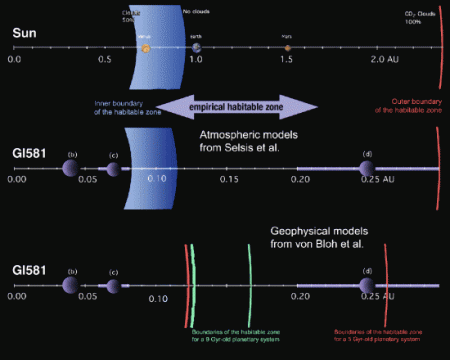
Figure 1. Illustration of the habitable zone (HZ) boundaries as obtained by the two teams. The upper part of the figure shows the HZ of the Sun (at its present age). The red curve shows only the most extreme outer limit of the HZ. The actual outer boundary is indeed located somewhere between 1.7 and 2.4 AU. The green limits show the boundaries of the photosynthetic zone as computed with the model by von Bloh et al. The middle part of the figure shows the limits of the HZ of Gliese 581 computed with the atmospheric models from Selsis et al. The lower part illustrates the boundaries of the photosynthetic zone computed with the geophysical models from von Bloh et al. The boundaries are shown for several possible ages (5, 7, and 9 Gyr-old) of the Gliese 581 planetary system. Following the latest estimation, Gliese 581 would be 7 Gyr-old. The purple bars surrounding planets Gliese 581 c and d illustrate the variable distance to the star caused by the eccentricity of the orbits. Copyright Astronomy & Astrophysics.

More than 10 years after the discovery of the first extrasolar planet, astronomers have now discovered more than 250 of these planets. Until a few years ago, most of the newly discovered exoplanets were Jupiter-mass, probably gaseous, planets. Recently, astronomers have announced the discovery of several planets that are potentially much smaller, with a minimum mass lower than 10 Earth masses: the now so-called super-Earths.

In April, a European team announced in Astronomy & Astrophysics the discovery of two new planets orbiting the M star Gliese 581 (a red dwarf), with masses of at least 5 and 8 Earth masses. Given their distance to their parent star, these new planets (now known as Gliese 581c and Gliese 581d) were the first ever possible candidates for habitable planets.

Contrary to Jupiter-like giant planets that are mainly gaseous, terrestrial planets are expected to be extremely diverse: some will be dry and airless, while others will have much more water and gases than the Earth. Only the next generation of telescopes will allow us to tell what these new worlds and their atmospheres are made of and to search for possible indications of life on these planets. However, theoretical investigations are possible today and can be a great help in identifying targets for these future observations.

In this framework, Astronomy & Astrophysics now publishes two theoretical studies of the Gliese 581 planetary system. Two international teams, one led by Franck Selsis and the other by Werner von Bloh, investigate the possible habitability of these two super-Earths from two different points of view. To do so, they estimate the boundaries of the habitable zone around Gliese 581, that is, how close and how far from this star liquid water can exist on the surface of a planet.

F. Selsis and his colleagues compute the properties of a planet’s atmosphere at various distances from the star. If the planet is too close to the star, the water reservoir is vaporized, so Earth-like life forms cannot exist. The outer boundary corresponds to the distance where gaseous CO2 is then unable to produce the strong greenhouse effect required to warm a planetary surface above the freezing point of water. The major uncertainty for the precise location of the habitable zone boundaries comes from clouds that cannot currently be modeled in detail. These limitations also occur when one looks at the Sun’s case: climate studies indicate that the inner boundary is located somewhere between 0.7 and 0.9 AU, and the outer limit is between 1.7 and 2.4 AU. Figure 1 illustrates the Sun’s habitable zone boundaries, compared to the case for Gliese 581 as computed both by Selsis and von Bloh.

W. von Bloh and his colleagues study a narrower region of the habitable zone where Earth-like photosynthesis is possible. This photosynthetic biomass production depends on the atmospheric CO2 concentration, as much as on the presence of liquid water on the planet. Using a thermal evolution model for the super-Earths, they have computed the sources of atmospheric CO2 (released through ridges and volcanoes) and its sinks (the consumption of gaseous CO2 by weathering processes). The main aspect of their model is the persistent balance (that exists on Earth) between the sink of CO2 in the atmosphere-ocean system and its release through plate-tectonics. In this model, the ability to sustain a photosynthetic biosphere strongly depends on the age of the planet, because a planet that is too old might not be active anymore, that is, would not release enough gaseous CO2. In this case, the planet would no longer be habitable. To compute the boundaries of the habitable zone as illustrated by Figure 1, von Bloh assumed a CO2 level of 10 bars.

Figure 1 illustrates the boundary of the habitable zone as computed using both models and, for comparison, the boundary of the Sun’s habitable zone. Both teams found that, while Gliese 581 c is too close to the star to be habitable, the planet Gliese 581 d might be habitable. However, the environmental conditions on planet d might be too harsh to allow complex life to appear. Planet d is tidally locked, like the Moon in our Earth-Moon system, meaning that one side of the planet is permanently dark. Thus, strong winds may be caused by the temperature difference between the day and night sides of the planet. Since the planet is located at the outer edge of the habitable zone, life forms would have to grow with reduced stellar irradiation and a very peculiar climate.

Figure 1 also illustrates that the distance of planets c and d to the central star has strong variations due to the eccentricity of their orbits. In addition, being close to the star, their orbital periods are short: 12.9 days for planet c and 83.6 days for planet d. Figure 1 shows that planet d might temporarily leave and re-enter the habitable zone during its journey. However, even under these strange conditions, it might still be habitable if its atmosphere is dense enough. In any case, habitable conditions on planet d should be very different from what we encounter on Earth.

Last but not least, the possible habitability of one of these planets is particularly interesting because of the central star, which is a red dwarf, M-type star. About 75% of all stars in our Galaxy are M stars. They are long-lived (potentially tens of billion years), stable, and burn hydrogen. M stars have long been considered as poor candidates for harboring habitable planets: first because planets located in the habitable zone of M stars are tidally locked, with a permanent dark side, where the atmosphere is likely to condense irreversibly. Second, M stars have an intense magnetic activity associated with violent flares and high X and extreme UV fluxes, during their early stage that might erode planetary atmospheres. Theoretical studies have recently shown that the environment of M stars might not prevent these planets from harboring life. M stars have then become very interesting for astronomers because habitable planets orbiting them are easier to detect by using the radial-velocity and transit techniques than are the habitable planets around Sun-like stars.

Both studies definitely confirm that Gliese 581c and Gliese 581d will be prime targets for the future ESA/NASA space mission Darwin/Terrestrial Planet Finder (TPF), dedicated to the search for life on Earth-like planets. These space observatories will make it possible to determine the properties of their atmospheres.

A third paper on the Gliese 581 planetary system has recently been accepted for publication in Astronomy & Astrophysics. In this paper, H. Beust and his team study the dynamical stability of the Gliese 581 planetary system. Such studies are very interesting in the framework of the potential habitability of these planets because the long-term evolution of the planetary orbits may regulate the climate of these planets. Mutual gravitational perturbations between different planets are present in any planetary system with more than one planet. In our solar system, under the influence of the other planets, the Earth's orbit periodically evolves from purely circular to slightly eccentric.

This is actually enough to trigger the alternance of warm and glacial eras. More drastic orbital changes could well have prevented the development of life. Beust and his colleagues computed the orbits of the Gliese 581 system over 100 Myr and find that the system appears dynamically stable, showing periodic orbital changes that are comparable to those of the Earth. The climate on the planets is expected to be stable, so it at least does not prevent life from developing, although it does not prove it happened either.

Source: Astronomy & Astrophysics


print this article email this article download pdf blog this article bookmark this article     Digg this Stumble it share on Facebook share on Reddit add to delicious save to Yahoo! bookmarks
4.5/5 after 45 votes

Rank Filter

Move the slider to adjust rank threshold, so that you can hide some of the comments.


Display comments: newest first

  • BigTone - Dec 13, 2007
    • Rank: 4.7 / 5 (3)
    Quit it with the damn Goldilocks Zone or habitable zone or whatever you want to call it. Extremeophiles have clearly demonstrated abilities to thrive outside these outdated conditions that are allegedly needed to support life. This trend of breaking the old school boundaries for life continues.

    When is the scientific community going to say enough is enough - we simply do not know enough to make claims about what habitats are suitable for life...
  • quantum_flux - Dec 13, 2007
    • Rank: 4 / 5 (2)
    Well, this is the best system we've got for finding life, as we know that it absolutely works in Earth's case.

    However, methane can, in my halfothesis of opinion, take the place of water if it is in liquid form (at much cooler temperatures and/or at higher pressures than here on earth).
  • weewilly - Dec 13, 2007
    • Rank: 4 / 5 (1)
    Great point but what is the question. Why don't we just wait until we can get closer and obtain more data, information, knowledge or even a "hands on" with another habital planet that might have a lifeform we do not know of as of yet?
  • legendmoth - Dec 19, 2007
    • Rank: not rated yet
    "Theoretical studies have recently shown that the environment of M stars might not prevent these planets from harboring life." Has anyone read any of these theories? It sounds like wishful thinking. "These are the systems that we can see most easily, so let's not rule out the possibility that they could have life?"
  • MBlueD - Jan 07, 2008
    • Rank: not rated yet
    I think that the point of this research is to find life similar to ours, hence the criteria listed for a 'habitable zone'. It's true that we don't have enough knowledge to rule out the existence of life based on different conditions than the ones we know (e.g. methane instead of water, as quantum flux mentioned).
    It (this kind of research) could also be used to find planets that have habitat-ability similar to our own Earth, thus a higher chance of being successfully colonized and then strip mined...
  • superhuman - Feb 25, 2008
    • Rank: not rated yet
    Our life is made of biomolecules which interact mostly via electromagnetic forces. Just as some random carbon atom forms a part of life just by being a part of protein in your brain so our Sun could be a part of some "molecule" of cosmic life form which lives at the scale comparable to observable universe.

    Just as a microbe in your gut doesn't have a clue that it lives in another life form so can we be ignorant about some other forms of cosmic life.

December 13th, 2007 all stories
Space & Earth / Astronomy

Comments: 6
Rank: 4.5/5 after 45 votes

  • Stumble this up

  • Digg this

  • Share it:
  • share on Facebook
  • share on MySpace
  • share on Slashdot
  • rss-newsfeed
  • share on Google
  • share on Reddit
  • add to delicious
  • save to Yahoo! bookmarks
  • share on Windows Live
  • Add to Mixx!
Rating: 4.5/5 after 45 votes

  • Related Stories

  • Scientists predict greater longevity for planets with life
    created Jun 13, 2009 | popularity not rated yet | comments 0
  • The search for ET just got easier
    created Jun 10, 2009 | popularity not rated yet | comments 0
  • New definition could further limit habitable zones around distant suns
    created Jun 10, 2009 | popularity not rated yet | comments 0
  • Meteorite bombardment may have made Earth more habitable
    created Jun 01, 2009 | popularity not rated yet | comments 0
  • A serious search for extraterrestrial life
    created May 26, 2009 | popularity not rated yet | comments 0

Tags


  • Physicists Demonstrate Quantum Memory with Matter Qubits
    Physicists Demonstrate Quantum Memory with Matter Qubits
    Physics / General Physics
    created Jul 03, 2009 | popularity 4.4 / 5 (16) | comments 1
  • 'Holey' Nanosheets for Wastewater Dye Removal
    Nanotechnology / Nanomaterials
    created Jul 01, 2009 | popularity 5 / 5 (5) | comments 1
  • Jellyfish Robot Swims Like its Biological Counterpart
    Jellyfish Robot Swims Like its Biological Counterpart
    Electronics / Robotics
    created Jun 26, 2009 | popularity 4.4 / 5 (7) | comments 1
  • Could Maxwell's Demon Exist in Nanoscale Systems?
    Could Maxwell's Demon Exist in Nanoscale Systems?
    Physics / General Physics
    created Jun 24, 2009 | popularity 4.4 / 5 (18) | comments 29
  • Living Safely with Robots, Beyond Asimov's Laws
    Living Safely with Robots, Beyond Asimov's Laws
    Electronics / Robotics
    created Jun 22, 2009 | popularity 4.6 / 5 (52) | comments 40
  • Other News

    Forty years ago man first walked on the moon

    Space & Earth / Space Exploration

    created 3 hours ago | popularity 5 / 5 (2) | comments 0

    Forty years ago on July 20, 1969, American astronaut Neil Armstrong realized the oldest dream of human civilizations when he became the first man to walk on the moon.


    The least sea ice in 800 years

    The least sea ice in 800 years

    Space & Earth / Earth Sciences

    created Jul 01, 2009 | popularity 4.3 / 5 (59) | comments 52

    New research, which reconstructs the extent of ice in the sea between Greenland and Svalbard from the 13th century to the present indicates that there has never been so little sea ice as there is now. The ...


    Gas around young galaxy

    Intense heat killed the Universe's would-be galaxies, researchers say

    Space & Earth / Astronomy

    created Jul 01, 2009 | popularity 3.2 / 5 (19) | comments 25

    (PhysOrg.com) -- Our Milky Way galaxy only survived because it was already immersed in a large clump of dark matter which trapped gases inside it, scientists led by Durham University's Institute for Computational ...


    Scientists' Drill Hits Magma: Only Third Time on Record

    Scientists' Drill Hits Magma: Only Third Time on Record

    Space & Earth / Earth Sciences

    created Jun 29, 2009 | popularity 4.7 / 5 (20) | comments 19

    (PhysOrg.com) -- Scientists drilling a borehole deep into Iceland’s rocky crust to explore new methods of using geothermal energy hit a major roadblock on Thursday: Their drill ran into molten rock at a depth ...


    NASA manager pitches a cheaper return-to-moon plan

    Space & Earth / Space Exploration

    created Jun 30, 2009 | popularity 4 / 5 (7) | comments 18

    (AP) -- Like a car salesman pushing a luxury vehicle that the customer no longer can afford, NASA has pulled out of its back pocket a deal for a cheaper ride to the moon.