Light Source Lasts 12 Years - No Electricity Needed
December 13th, 2007 by Lisa Zyga Litroenergy

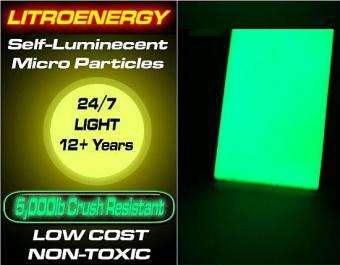
A company called MPK is designing a light source that will glow continuously for more than 12 years without any additional energy.

The material, dubbed "Litrosphere," can cover a standard sheet of paper for a cost of about 35 cents, and comes in a variety of colors. It´s also flexible, and can take the form of either paint or injection-molded plastic. The material is not affected by the heat or cold, can withstand 5,000 pounds, and stays on constantly.

According to the company's patent, the material is based on betavoltaics and uses the radioactive gas tritium as the power source. The beta particles from the tritium radiation can be safely contained by phosphor-coated microspheres. Tritium has a half-life of about 12 years.

MPK specializes in glow-in-the-dark paint and other glow products, although the new material does not need to be exposed to light in order to work. The company predicts that the technology could be used for light safety tape, lighted life rafts/flotation equipment, toys, sports/camping equipment, and bikes.

"This has potential to save billions in energy costs world-wide," said Steve Stark, MPK engineer. "Litroenergy surpasses all known available lighting options for cost/durability/reliability and safety."

Litroenergy has recently been added to the New Energy Congress' (NEC) list of Top 100 Technologies (rank pending). However, its use will likely be limited to applications that don´t require a great deal of light.

"The intensity is not very strong," noted NEC member Richard P. George. "This is good enough for night illumination of rifle scopes, watches, and emergency signs, but it is not going to come anywhere close to matching the light output of or replace electric light bulbs (incandescent, fluorescent, LED, etc.) or kerosene lanterns."

There are also rumors that MPK may use similar technology as a power source in the future.

"It´s not something the company is ready to talk publicly about yet, but they do have battery technology that would be of the same ilk: betavoltaic technology allowing continuous power for years in all battery applications, including automobiles," said NEC member Sterling D. Allan. "They think they will be able to win the DoD [Department of Defense] contest for the $1 million prize for backpack battery tech."

More information: Litroenergy at Wiki Directory
Litroenergy Patent


print this article email this article download pdf blog this article bookmark this article     Digg this Stumble it share on Facebook share on Reddit add to delicious save to Yahoo! bookmarks
4.5/5 after 93 votes

Rank Filter

Move the slider to adjust rank threshold, so that you can hide some of the comments.


Display comments: newest first

  • LearmSceince - Dec 13, 2007
    • Rank: 5 / 5 (1)
    I had a tritium backlight on a wristwatch about 25 years ago.
  • Gush10 - Dec 13, 2007
    • Rank: 3 / 5 (4)
    The tritium that was used is wristwatches in the past had severe health effects on the laborers who made the watches. Specifically, mouth cancer. This sounds safer...but who knows.
  • out7x - Dec 14, 2007
    • Rank: 1 / 5 (1)
    Beta radiation from tritium has charge and mass of electrons.
  • nilbud - Dec 14, 2007
    • Rank: 5 / 5 (1)
    Gush10 you are wrong, you probably mean radium but who knows.
  • BigTone - Dec 14, 2007
    • Rank: 5 / 5 (1)
    I am personally in favor of radioactive derived electric energy. Those idiots with an across the board absoloutist opinion that oppose RTGs for use in space are just plain silly to me. If we improved and developed many forms of battery technology with different types of this fuel source... I think we would find tons of applicability within improved safety requirements over current forms of energy.

    I would rather drive a car that may leak a little radiation if some horrific accident occurred then die immediately in a ball of flames from gasoline combustion.
  • gopher65 - Dec 14, 2007
    • Rank: 5 / 5 (1)
    Yeah Big Tone. Although cars very rarely explode (more people die from injuries sustained when they are yanked from a car than from cars exploding by a long long long way. Idiotic passerbys have watched too many action flicks and think cars just go boom whenever they crash or catch fire. It just doesn't happen that way), I suspect that the death rate from a crashed RTG powered car (if that is practical) would be lower than from a gasoline powered car.

    People just freak over nuclear powered stuff for some reason. Yet they gladly breath sulfur dioxide from coal plants and strap themselves into cars powered by highly flammable liquid fuel:P. Smart. (And as a side note, because of the small amounts of uranium and thorium and such things that exist in all coal, all coal plants actually produce more radioactivity per watt generated than the most inefficient nuclear plant in the world.)
  • SDMike - Dec 18, 2007
    • Rank: 5 / 5 (1)
    Give me some plutonium-238 for a basement RTG. It will fill much of my electrical needs. I'll use the waste heat to warm the house in winter, cool it in summer, and make hot water. An attached sterling engine can pump water from my well. My family could be off the grid for many, many years. Of course, the initial investment is a bit "spendy."
  • mninventor - Oct 24, 2008
    • Rank: not rated yet
    The 2007 NASA Tech Brief's Grand Prize award winning light source from MPK CO. was just disclosed in this years contest to create electricity when applied to solar cells.

    Versatile, abundant and low cost electrical energy - this can power micro devices, electric car, homes, etc. for 20 years. Green Tech the world needs today!

    The technology aims to replace batteries, generating low-cost electricity for everything from micro devices to utility applications has groundbreaking implications and potential to turn the battery business upside down.

    Litroenergy is made from litrospheres, which are self-illuminating micro particles that, when they are placed on or sandwiched between solar cells, generate electricity. The light-emitting micro particles are not affected by heat or cold and can be used in sheet form for easy application on solar cells.

    %u201CThe many novel, versatile and far reaching applications/benefits for low cost on-going durable, solid state power generation without using any additional resources and being extremely environmentally friendly has ground breaking implications for our energy consuming world.%u201D

    See NASA Tech Brief's Contest site or Litroenergy.com web site for more information on this technology.

    Sincerely,
    Steve Stark

December 13th, 2007 all stories
Physics / Condensed Matter

Comments: 8
Rank: 4.5/5 after 93 votes

  • Stumble this up

  • Digg this

  • Share it:
  • share on Facebook
  • share on MySpace
  • share on Slashdot
  • rss-newsfeed
  • share on Google
  • share on Reddit
  • add to delicious
  • save to Yahoo! bookmarks
  • share on Windows Live
  • Add to Mixx!
Rating: 4.5/5 after 93 votes

  • Related Stories

  • Plants' internal clock can improve climate-change models
    created Jul 02, 2009 | popularity not rated yet | comments 0
  • Panasonic Develops High Efficiency CRT Recycling Technology Using Laser
    created Jul 02, 2009 | popularity not rated yet | comments 0
  • Natural compound stops retinopathy
    created Jul 02, 2009 | popularity not rated yet | comments 0
  • Researchers unite to distribute quantum keys
    created Jul 02, 2009 | popularity not rated yet | comments 0
  • Astronomer's new guide to the galaxy: Largest map of cold dust revealed
    created Jul 01, 2009 | popularity not rated yet | comments 0

Tags


  • Physicists Demonstrate Quantum Memory with Matter Qubits
    Physicists Demonstrate Quantum Memory with Matter Qubits
    Physics / General Physics
    created Jul 03, 2009 | popularity 4.4 / 5 (17) | comments 1
  • 'Holey' Nanosheets for Wastewater Dye Removal
    Nanotechnology / Nanomaterials
    created Jul 01, 2009 | popularity 5 / 5 (5) | comments 1
  • Jellyfish Robot Swims Like its Biological Counterpart
    Jellyfish Robot Swims Like its Biological Counterpart
    Electronics / Robotics
    created Jun 26, 2009 | popularity 4.4 / 5 (8) | comments 1
  • Could Maxwell's Demon Exist in Nanoscale Systems?
    Could Maxwell's Demon Exist in Nanoscale Systems?
    Physics / General Physics
    created Jun 24, 2009 | popularity 4.4 / 5 (18) | comments 29
  • Living Safely with Robots, Beyond Asimov's Laws
    Living Safely with Robots, Beyond Asimov's Laws
    Electronics / Robotics
    created Jun 22, 2009 | popularity 4.6 / 5 (52) | comments 40
  • Other News

    Scientists create first electronic quantum processor

    Scientists create first electronic quantum processor

    Physics / General Physics

    created Jun 28, 2009 | popularity 4.8 / 5 (53) | comments 39

    A team led by Yale University researchers has created the first rudimentary solid-state quantum processor, taking another step toward the ultimate dream of building a quantum computer.


    Science journals

    How to Spot an Influential Paper Based on its Citations

    Physics / General Physics

    created Jul 04, 2009 | popularity 4 / 5 (9) | comments 5

    (PhysOrg.com) -- At first it may seem that the number of citations received by a published scientific paper is directly related to that paper's quality of content. The higher the quality, the more people read ...


    Fermilab's CDF observes Omega-sub-b baryon

    Fermilab's CDF observes Omega-sub-b baryon

    Physics / General Physics

    created Jun 29, 2009 | popularity 4.7 / 5 (16) | comments 7

    (PhysOrg.com) -- At a recent physics seminar at the Department of Energy’s Fermi National Accelerator Laboratory, Fermilab physicist Pat Lukens of the CDF experiment announced the observation of a new particle, ...


    New insights, and a new angle, on high-temperature superconductivity

    New insights, and a new angle, on high-temperature superconductivity

    Physics / Superconductivity

    created Jun 29, 2009 | popularity 4.8 / 5 (13) | comments 6

    (PhysOrg.com) -- A Princeton-led research team has revealed surprising information about how electron behavior influences the conduction of electricity in a class of high-temperature superconductors. An increased ...


    The art of invisibility and the perfect cat's eye

    The art of invisibility and the perfect cat's eye

    Physics / Optics & Photonics

    created Jun 30, 2009 | popularity 4 / 5 (8) | comments 6

    (PhysOrg.com) -- In recent years scientists have explored the impossible by developing invisibility or 'cloaking' devices, but can the same technology also help make things more visible?