Sshhh, it's listening: totally new computer interfaces
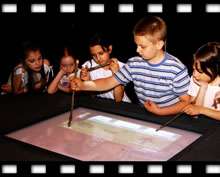
Keyboards are a necessary part of today’s computers, right? Maybe not for much longer. A group of European scientists have used acoustic sensors to turn wooden tabletops and even three-dimensional objects into a new type of computer interface.
Sound vibrating a windowpane or through a tabletop is something most people experience daily. Sound waves travel well through most solid materials. Now, European researchers have exploited the excellent propagation of sound waves through solids to turn everyday objects – including 3D objects – into a new kind of computer interface.
By attaching sensors to solid materials, researchers from TAI-CHI, a project working with Tangible Acoustic Interfaces for Computer-Human Interaction, were able to locate exactly and track acoustic vibrations. Tapping on discrete areas of a whiteboard could generate musical notes on a computer. Tracking the sound of a finger scrawling words on a sheet of hardboard could translate, in real time, into handwriting on a computer screen. There is no need for overlays or intrusive devices.
Sensing vibrations in a solid and converting them to electrical pulses is the easy bit. Exactly locating the source of that vibration in a solid material is where it gets complicated. The problem is that the complex structures of solids make wave propagation difficult to model. Wood knots in a desktop, for instance, will alter how acoustic vibrations disperse.
Reading the signals
The TAI-CHI team investigated four main technologies. Time Delay of Arrival (TDOA) uses three or more sensors and compares the difference in arrival times of an acoustic wave at each of the sensors to establish location. In fact, the concept of TDOA has been around for about 100 years. Provided you know the propagation velocity of acoustic waves through the solid material, TDOA provides a very practical, if rather expensive, solution.
Time reversal, on the other hand, needs only a single sensor. It works on the notion that each location on the surface of a solid generates a unique impulse response which can be recorded and used to calibrate the object. Time reversal works on 3D objects just as well as flat surfaces.
MUlti-Sensor Tracking through the Reversal of Dispersion (MUST-RD) requires a deep understanding of the wave-dispersion properties of the solid. The dispersion curve of acoustic waves moving through the material under test is compared to a database of dispersion curves for common materials. From the comparison, the location of the vibration source can be calculated. (MUST-RD can also be used to give a crude estimation of a material type.)
Finally, TAI-CHI researchers worked with in-solid acoustic holography. Using sound pressure, sound intensity or particle velocity to calculate position and time, a sound source can be mapped and visualised in much the same way as an infrared camera can map heat sources. Some of the TAI-CHI researchers also experimented with a combination of acoustic localisation and Doppler tracking to locate and track sound sources moving through the air.
The range of researchers brought together by the project, part-funded by the European Commission – in Germany, France, Italy, England, Wales and Switzerland – was an important factor in its success, according to TAI-CHI coordinator, Dr Ming Yang of the University of Cardiff.
Specialist solution
Tangible acoustic interfaces like this are not going to replace keyboards and computer mice in the near future, says Dr Ming Yang. But in specific environments where keyboards are impractical – perhaps in very dirty environments or in hospitals where a keyboard might be a hiding place for bugs – TAIs could provide an elegant solution.
“Time reversal is a beautiful technology,” he says. “Unlike TDOA, it works with any object and it does not require special materials. Because it needs only a single sensor and a normal computer, it is very simple and cost-effective. One spin-off company from the University of Paris is working on commercial applications for this.”
Other technologies, such as acoustic holography, show great promise but are not ready for commercialisation.
CeTT, a Swiss member of the consortium, has put together a TAI-CHI Developer’s Kit, comprising algorithms developed during the project, software and hardware, as a one-stop-shop for application developers looking to build on TAI-CHI breakthroughs.
Other applications include a wireless sensor using Bluetooth technology that Dr Ming Yang would like to develop with commercial partners.
The time-reverse technology is the project’s major breakthrough, according to Dr Ming Yang. “Before, people were only working on easy materials. We have developed it for metal, plastic and board. We have a really interactive interface.”
Source: ICT Results


