Coral Reefs Unlikely to Survive in Acid Oceans
December 13, 2007 Coral Reefs Unlikely to Survive in Acid Oceans

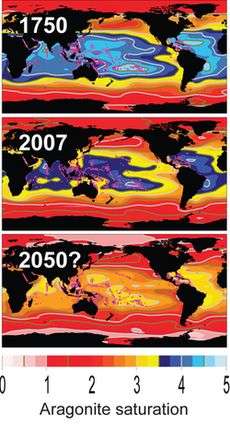
Coral reefs (magenta dots) grow in optimal conditions with aragonite saturation greater than 3.5 (blue colors). Such water is rapidly disappearing and will be gone in several decades if current carbon dioxide emission trends continue. Atmospheric CO2 levels are 380 ppm and 550 ppm for years 2007 and 2050, respectively. Credit: Carnegie Institution of Washington

Carbon emissions from human activities are not just heating up the globe, they are changing the ocean’s chemistry. This could soon be fatal to coral reefs, which are havens for marine biodiversity and underpin the economies of many coastal communities.

Scientists from the Carnegie Institution’s Department of Global Ecology have calculated that if current carbon dioxide emission trends continue, by mid-century 98% of present-day reef habitats will be bathed in water too acidic for reef growth. Among the first victims will be Australia’s Great Barrier Reef, the world’s largest organic structure.

Chemical oceanographers Ken Caldeira and Long Cao are presenting their results in a multi-author paper in the December 14 issue of Science and at the annual meeting of American Geophysical Union in San Francisco on the same date. The work is based on computer simulations of ocean chemistry under levels of atmospheric CO2 ranging from 280 parts per million (pre-industrial levels) to 5000 ppm. Present levels are 380 ppm and rapidly rising due to accelerating emissions from human activities, primarily the burning of fossil fuels.

“About a third of the carbon dioxide put into the atmosphere is absorbed by the oceans,” says Caldeira, “which helps slow greenhouse warming, but is a major pollutant of the oceans.” The absorbed CO2 produces carbonic acid, the same acid that gives soft drinks their fizz, making certain minerals called carbonate minerals dissolve more readily in seawater. This is especially true for aragonite, the mineral used by corals and many other marine organisms to grow their skeletons.

“Before the industrial revolution, over 98% of warm water coral reefs were bathed with open ocean waters 3.5 times supersaturated with aragonite, meaning that corals could easily extract it to build reefs,” says Cao. “But if atmospheric CO2 stabilizes at 550 ppm -- and even that would take concerted international effort to achieve -- no existing coral reef will remain in such an environment.” The chemical changes will impact some regions sooner than others. At greatest risk are the Great Barrier Reef and the Caribbean Sea.

Carbon dioxide’s chemical effects on the ocean are largely independent of its effects on climate, so measures to mitigate warming short of reducing emissions will be of little help in slowing acidification, the researchers say. In fact, impending chemical changes may require emissions cuts even more drastic than those for climate alone.

“These changes come at a time when reefs are already stressed by climate change, overfishing, and other types of pollution,” says Caldeira, “so unless we take action soon there is a very real possibility that coral reefs — and everything that depends on them —will not survive this century.”

Source: Carnegie Institution of Washington


print this article email this article download pdf blog this article bookmark this article     Stumble it Digg this share on Facebook retweet share on Reddit add to delicious
Rate this story - 3.2 /5 (22 votes)

Rank Filter

Move the slider to adjust rank threshold, so that you can hide some of the comments.


Display comments: newest first

  • rubberman - Dec 13, 2007
    • Rank: 3.8 / 5 (4)
    So, despite the"controversy" over the cause or causes of global climate change, it would seem that human generated emissions are harmful to the environment in other ways......never saw that one coming.
  • kcasey415 - Dec 13, 2007
    • Rank: 2 / 5 (4)
    more doom and gloom...new species of coral and fish will take their place...the earth will survive...time to get in my SUV and drive 1/4 mile to the store...later
  • dachpyarvile - Dec 14, 2007
    • Rank: 3 / 5 (5)
    Garbage! Coral Reefs have existed from times when CO2 levels in the atmosphere were in the 1000s ppm and they did just fine. Life adapts. More gloom and doom...
  • gopher65 - Dec 14, 2007
    • Rank: 4.5 / 5 (2)
    You're quite right dachpy arvile. If most of the Coral Reefs died, 5 million years from now new, different ones will have popped back up in their place. But that doesn't do much for us in the meantime does it? 5000000 years is a long freaking time for someone like me who will only live 80 years.
  • p1ll - Dec 14, 2007
    • Rank: 2.3 / 5 (3)
    doom and gloom! Let's hault forward progress then, I suppose. Maybe if we have a worldwide carbon tax on everyone, that will fix everything :)
  • dachpyarvile - Jun 13, 2009
    • Rank: not rated yet
    gopher 65,

    If the coral reefs died off there would be no coral reefs in the future. Just as life adapted and survived oceans with higher acidity that higher levels of CO2 than present to produce the offspring that became today's corals, so today's corals will adapt and produce the children of the future.

    By the way, what do you think colors the corals? That's right! Algae and cyanobacteria! Algae and cyanobacteria love higher CO2 levels.

    I suggest looking at human-dumped toxins as the cause of coral bleaching and death rather than CO2.

December 13, 2007 all stories

Comments: 6

3.2 /5 (22 votes)
  • Stumble this up

  • Digg this

  • share this

  • hide
  • Related Stories

  • Caribbean, Gulf spared widespread coral damage
    created Nov 06, 2009 | popularity not rated yet | comments 0
  • Coral reefs inspire rare consensus -- just save them
    created Nov 05, 2009 | popularity not rated yet | comments 0
  • Calm before the spawn: Climate change and coral spawning
    created Nov 04, 2009 | popularity not rated yet | comments 0
  • The White Stuff: Marine Lab Team Seeks to Understand Coral Bleaching
    created Oct 20, 2009 | popularity not rated yet | comments 0
  • Corals 'could starve in high CO2'
    created Oct 05, 2009 | popularity not rated yet | comments 0


  • hide
  • Relevant PhysicsForums posts

  • The Origin of the term 'fossil' fuels
    created Nov 05, 2009
  • co2
    created Nov 03, 2009
  • Early Earths Sulfidic Ocean Conditions
    created Oct 30, 2009
  • vegetation
    created Oct 29, 2009
  • More from Physics Forums - Earth

Other News

Deep creep means milder, more frequent earthquakes along Southern California's San Jacinto fault

Deep creep means milder, more frequent earthquakes along Southern California's San Jacinto fault

Space & Earth / Earth Sciences

created 34 minutes ago | popularity 4 / 5 (1) | comments 0

With an average of four mini-earthquakes per day, Southern California's San Jacinto fault constantly adjusts to make it a less likely candidate for a major earthquake than its quiet neighbor to the east, the ...


Success in 'space elevator' competition (AP)

Success in 'space elevator' competition (Update 3)

Space & Earth / Space Exploration

created Nov 05, 2009 | popularity 4.3 / 5 (33) | comments 50

(AP) -- A robot powered by a ground-based laser beam climbed a long cable dangling from a helicopter on Wednesday to qualify for prize money in a $2 million competition to test the potential reality of the ...


'Dropouts' pinpoint earliest galaxies

'Dropouts' pinpoint earliest galaxies

Space & Earth / Astronomy

created Nov 06, 2009 | popularity 4.1 / 5 (9) | comments 12

Astronomers, conducting the broadest survey to date of galaxies from about 800 million years after the Big Bang, have found 22 early galaxies and confirmed the age of one by its characteristic hydrogen signature ...


Space hotel taking bookings for 2012 opening

Space hotel taking bookings for 2012 opening

Space & Earth / Space Exploration

created Nov 05, 2009 | popularity 4.4 / 5 (20) | comments 11

(PhysOrg.com) -- The first orbiting space hotel is on track to open for its first customers in 2012, but hurry, as bookings are filling fast.


In a Galaxy Far, Far Away...

In a Galaxy Far, Far Away...

Space & Earth / Astronomy

created Nov 06, 2009 | popularity 4.8 / 5 (4) | comments 11

(PhysOrg.com) -- Astronomers have published the discovery of the farthest known object in the cosmos: a star that exploded when the universe was only 630 million years old -- only 4.6% of its current age. ...