Return to Europa: A closer look is possible
December 14, 2007 Return to Europa: A closer look is possible

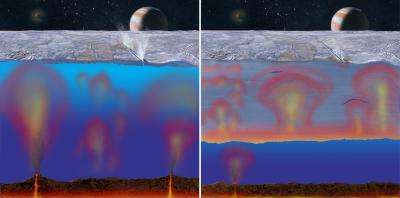
Scientists are all but certain that Europa has an ocean underneath its surface ice, but do not know how thick this ice might be. This artists' conception illustrates two possible cut-away views through Europa's ice shell. In both heat escapes, possibly volcanically, from Europa's rocky mantle and is carried upward by buoyant oceanic currents. If the heat from below is intense and the ice shell is thin enough (left), the ice shell can directly melt, causing what are called "chaos" on Europa, regions of what appear to be broken, rotated, and tilted ice blocks. On the other hand, if the ice shell is sufficiently thick (right), the less intense interior heat will be transferred to the warmer ice at the bottom of the shell, and additional heat is generated by tidal squeezing of the warmer ice. This warmer ice will slowly rise, flowing as glaciers do on Earth, and the slow but steady motion may also disrupt the extremely cold, brittle ice at the surface. Europa is no larger than Earth’s moon, and its internal heating stems from its eccentric orbit about Jupiter, seen in the distance. As tides raised by Jupiter in Europa’s ocean rise and fall, they may cause cracking, additional heating, and even venting of water vapor into the airless sky above Europa's icy surface. Credit: Artwork by Michael Carroll, courtesy NASA/JPL

Jupiter’s moon Europa is just as far away as ever, but new research is bringing scientists closer to being able to explore its tantalizing ice-covered ocean and determine its potential for harboring life.

“We’ve learned a lot about Europa in the past few years,” says William McKinnon, professor of Earth and Planetary Sciences at Washington University in St. Louis, Mo.

“Before we were almost sure that there was an ocean, but now the scientific community has come to a consensus that there most certainly is an ocean. We’re ready to take the next step and explore that ocean and the ice shell that overlays it. We have a number of new discoveries and techniques that can help us do that.”

McKinnon is discussing some of these recent findings and new opportunities for exploring Europa in a news briefing today at the meeting of the American Geophysical Union in San Francisco. He is joined by colleagues Donald Blankenship, research scientist at the Institute for Geophysics at the University of Texas at Austin’s Jackson School of Geosciences., and Peter Doran, associate professor of Earth and Environmental Sciences, University of Illinois at Chicago.

McKinnon points to refined methods that can use combined measurements of gravity and the magnetic field made from orbit to characterize Europa's ocean. By observing how the moon flexes and deforms and by measuring magnetic variations, researchers can determine how thick or thin the ice is over the ocean and even learn how salty the ocean is. A new model shows that radiation on Europa is much less, up to two-thirds less, than previous models predicted, making the environment much more hospitable for orbiting spacecraft or landers to operate.

Sophisticated reprocessing of data from the Galileo mission has revealed new information about the chemistry of Europa’s surface. It maps the presence of carbon dioxide, an important chemical for life, most probably coming from the ocean beneath the surface. This indicates that improved measurements from orbit have the chance to detect compounds not found in the Galileo data.

Future explorations of Europa will benefit from lessons learned from the Cassini spacecraft’s recent findings of active geysers on Saturn’s moon Enceladus. “Europa is a young, geologically active body like Enceladus,” says McKinnon. Galileo didn’t see any plumes on Europa like those spouting from Enceladus, but it didn’t have the best instrumentation to detect the telltale hot spots. “Now we know what we should look for,” says McKinnon, “and we should expect the unexpected.”

New radar sounding techniques will be a key component for exploring Europa. “There have been theories about whether the ice above the ocean is thick or thin, and now we have the ability to determine this with radar,” says Blankenship. “That’s been proved by the radar on Mars Express, which imaged the north polar cap of Mars, and the higher-resolution radar on the Mars Reconnaissance Orbiter. Radar can give us a detailed cross section through the ice shell on Europa.” The ice-penetrating radar will also be able to locate liquid water both within and beneath the shell, he continues, just as it can spot water within crevasses and lakes beneath the ice of Antarctica. "Free water within the icy shell and its relationship to the underlying ocean will be a critical factor in determining the habitability of Europa."

Researchers are also preparing for the day in the future when they will be able to get to Europa's surface and ultimately into its ocean to explore it directly. "In the meantime, we're using extreme environments on Earth as our laboratory," says Doran. "Ice-covered lakes in Antarctica are good, small-scale analogs to what we might find on Europa." Doran is lead investigator of a project called Endurance, which, in collaboration with Stone Aerospace, is developing an autonomous underwater robotic vehicle, to test approaches and procedures for exploring Europa's ocean. The project is funded by NASA's Astrobiology Science and Technology for Exploring Planets program.

"We're testing the vehicle in Wisconsin in February 2008," Doran says, "and then we'll be deploying it in Antarctica later in the year." The robotic explorer will be able to create three-dimensional maps of the subsurface Antarctic lake. It will also be able to map the biochemistry of the water body, pinpointing the chemical signatures that may indicate life.

For Europa, under-ice exploration lies in the distant future. In the meantime, say the researchers, a closer look at Europa is possible from an orbiting spacecraft able to measure gravity and magnetic fields, determine surface composition, search for active or recent eruptions, and use radar to understand the relationship between the surface and the sub-surface.

Source: University of Texas at Austin


print this article email this article download pdf blog this article bookmark this article     Stumble it Digg this share on Facebook retweet share on Reddit add to delicious
Rate this story - 4.7 /5 (36 votes)

Rank Filter

Move the slider to adjust rank threshold, so that you can hide some of the comments.


Display comments: newest first

  • saucerfreak2012 - Dec 14, 2007
    • Rank: 4.7 / 5 (3)
    So which Antarctic sub-glacial lake are they talking about? there's more than 140. I'm interested in Vostok, it's supposedly been isolated for quite a while with crazy pressure and supersaturated O2 content... should be interesting.
    I remember hearing things had ground to a halt due to potential contamination from the surface.... don't see why they can't adhere to the same policies/procedures as for steralizing spacecraft.
    Maybe they have things finally ironed-out. Hooray.
  • Valentiinro - Feb 26, 2008
    • Rank: not rated yet
    The spacecraft sterilizing procedures haven't been especially stringent, at least as far as I heard, either.

December 14, 2007 all stories

Comments: 2

4.7 /5 (36 votes)
  • Stumble this up

  • Digg this

  • share this

  • hide
  • Related Stories

  • Fantastic Voyage
    created Nov 02, 2009 | popularity not rated yet | comments 0
  • Oases for Life on the Mid-Caymen Rise
    created Oct 21, 2009 | popularity not rated yet | comments 0
  • Galileo's Jupiter Journey Began Two Decades Ago
    created Oct 19, 2009 | popularity not rated yet | comments 0
  • Jupiter's Moon Europa Has Enough Oxygen For Life
    created Oct 16, 2009 | popularity not rated yet | comments 0
  • Islands of Life Across Space and Time
    created Oct 06, 2009 | popularity not rated yet | comments 0


  • hide
  • Relevant PhysicsForums posts

  • The shape of our solar system's orbits.
    created Nov 07, 2009
  • Above or Below the Line of Nodes
    created Nov 07, 2009
  • Supernova vs. Nova?
    created Nov 07, 2009
  • Supernova's Gamma Rays and Comets
    created Nov 06, 2009
  • Our Moon
    created Nov 06, 2009
  • Question about a Carl Zeiss lens
    created Nov 05, 2009
  • More from Physics Forums - General Astronomy

Other News

Deep creep means milder, more frequent earthquakes along Southern California's San Jacinto fault

Deep creep means milder, more frequent earthquakes along Southern California's San Jacinto fault

Space & Earth / Earth Sciences

created 19 hours ago | popularity 4.5 / 5 (4) | comments 0

With an average of four mini-earthquakes per day, Southern California's San Jacinto fault constantly adjusts to make it a less likely candidate for a major earthquake than its quiet neighbor to the east, the ...


Success in 'space elevator' competition (AP)

Success in 'space elevator' competition (Update 3)

Space & Earth / Space Exploration

created Nov 05, 2009 | popularity 4.3 / 5 (33) | comments 50

(AP) -- A robot powered by a ground-based laser beam climbed a long cable dangling from a helicopter on Wednesday to qualify for prize money in a $2 million competition to test the potential reality of the ...


In a Galaxy Far, Far Away...

In a Galaxy Far, Far Away...

Space & Earth / Astronomy

created Nov 06, 2009 | popularity 4.8 / 5 (5) | comments 17

(PhysOrg.com) -- Astronomers have published the discovery of the farthest known object in the cosmos: a star that exploded when the universe was only 630 million years old -- only 4.6% of its current age. ...


'Dropouts' pinpoint earliest galaxies

'Dropouts' pinpoint earliest galaxies

Space & Earth / Astronomy

created Nov 06, 2009 | popularity 4.2 / 5 (10) | comments 13

Astronomers, conducting the broadest survey to date of galaxies from about 800 million years after the Big Bang, have found 22 early galaxies and confirmed the age of one by its characteristic hydrogen signature ...


Space hotel taking bookings for 2012 opening

Space hotel taking bookings for 2012 opening

Space & Earth / Space Exploration

created Nov 05, 2009 | popularity 4.4 / 5 (21) | comments 11

(PhysOrg.com) -- The first orbiting space hotel is on track to open for its first customers in 2012, but hurry, as bookings are filling fast.