Ancient Egyptian glassmaking recreated
December 14, 2007
Ancient Furnace

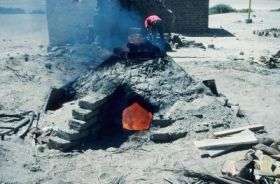
The reconstructed kiln built by Dr. Paul Nicholson of Cardiff University and Dr. Caroline Jackson of Sheffield University. Credit: Cardiff University

A team led by a Cardiff University archaeologist has reconstructed a 3,000-year-old glass furnace, showing that Ancient Egyptian glassmaking methods were much more advanced than previously thought.

Dr Paul Nicholson, of the University’s School of History and Archaeology, is leader of an Egypt Exploration Society team working on the earliest fully excavated glassmaking site in the world. The site, at Amarna, on the banks of the Nile, dates back to the reign of Akhanaten (1352 - 1336 B.C.), just a few years before the rule of Tutankhamun.

It was previously thought that the Ancient Egyptians may have imported their glass from the Near East at around this time. However, the excavation team believes the evidence from Amarna shows they were making it themselves, possibly in a single stage operation. Dr Nicholson and his colleague Dr Caroline Jackson of Sheffield University demonstrated this was possible, using local sand to produce a glass ingot from their own experimental reconstruction of a furnace near the site.

The team have also discovered that the glassworks was part of an industrial complex which involved a number of other high temperature manufacturing processes. The site also contained a potter’s workshop and facilities for making blue pigment and faience - a material used in amulets and architectural inlays. The site was near one of the main temples at Amarna and may have been used to produce materials in state buildings.

Dr Nicholson, who has been working at Amarna since 1983, said: “It has been argued that the Egyptians imported their glass and worked it into the artefacts that have been discovered from this time. I believe there is now enough evidence to show that skilled craftsmen could make their own glass and were probably involved in a range of other manufacturing industries as well.”

Source: Cardiff University

4.2 /5 (15 votes)  

Rank 4.2 /5 (15 votes)
Tags

Relevant PhysicsForums posts
  • Factors affecting beet root cell membrane
    created7 hours ago
  • Stem cell question.
    createdFeb 10, 2012
  • Protease cleavage
    createdFeb 10, 2012
  • Pertubance in a model
    createdFeb 10, 2012
  • Cancer drugs and Alzheimer's, Oh my!
    createdFeb 09, 2012
  • Squishing cells
    createdFeb 09, 2012
  • More from Physics Forums - Biology

More news stories

A frank discussion of the power law and linking correlation to causation

(PhysOrg.com) -- Michael Stumpf a mathematics professor at Imperial College in London, and Mason Porter a lecturer at Oxford have teamed together to write and publish a perspective piece in Science regarding the in ...

Other Sciences / Mathematics

created Feb 10, 2012 | popularity 5 / 5 (5) | comments 10 | with audio podcast report

Employers feel no love for unscrupulous practice of 'service sweethearting'

A new study led by two Florida State University marketing professors finds that some frontline service employees who are rewarded for hikes in customer loyalty and satisfaction also may engage in "service ...

Other Sciences / Economics & Business

created Feb 10, 2012 | popularity 3.3 / 5 (3) | comments 10

US workers are 'giving away the store,' costing firms billions

Nearly 70 percent of the nation's service employees give away free goods and services – from hamburgers to cable TV – costing companies billions of dollars a year, according to a groundbreaking study.

Other Sciences / Economics & Business

created Feb 09, 2012 | popularity 3 / 5 (5) | comments 10

New insights into how to correct false knowledge

The abundance of false information available on the Internet, in movies and on TV has created a big challenge for educators.

Other Sciences / Social Sciences

created Feb 07, 2012 | popularity 4.9 / 5 (7) | comments 9 | with audio podcast

Neanderthal demise due to many influences, including cultural changes: study

As an ice age crept upon them thousands of years ago, Neanderthals and modern human ancestors expanded their territory ranges across Asia and Europe to adapt to the changing environment.

Other Sciences / Archaeology & Fossils

created Feb 07, 2012 | popularity 4.4 / 5 (5) | comments 8 | with audio podcast


Google might launch Drive for cloud storage soon

(PhysOrg.com) -- Google's next big move, according to the Wall Street Journal, is a cloud storage service called Drive. Hardly first to the plate, Google is simply catching up to introducing its cloud reposi ...

Scientists discover molecular secrets of 2,000-year-old Chinese herbal remedy

For roughly two thousand years, Chinese herbalists have treated Malaria using a root extract, commonly known as Chang Shan, from a type of hydrangea that grows in Tibet and Nepal. More recent studies suggest that halofuginone, ...

New method to examine batteries -- MRI from the inside

There is an ever-increasing need for advanced batteries for portable electronics, such as phones, cameras, and music players, but also to power electric vehicles and to facilitate the distribution and storage of energy derived ...

Lab study raises questions over nano-particle impact

Tests involving chickens have raised questions about the impact on health from engineered nano-particles, the ultra-fine grains commonly used in drugs and processed foods, scientists said on Sunday.

Injured boomers beware: Know when to see doctor

(AP) -- It happened to nurse Jane Byron years after an in-line skating fall, business owner Haralee Weintraub while doing "men's" push-ups, and avid cyclist Gene Wilberg while lifting a heavy box.

A mitosis mystery solved: How chromosomes align perfectly in a dividing cell

Although the process of mitotic cell division has been studied intensely for more than 50 years, Whitehead Institute researchers have only now solved the mystery of how cells correctly align their chromosomes during symmetric ...