NASA Sends Spacecraft on Mission to Comet Hartley 2
December 14, 2007 NASA Sends Spacecraft on Mission to Comet Hartley 2

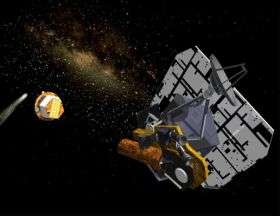
This is an artist's rendition of the Deep Impact flyby spacecraft releasing its impactor, 24 hours before the impact event in July 2005. Pictured from left to right are comet Tempel 1, the impactor, and the flyby spacecraft. The impactor is a 370-kilogram mass with an onboard guidance system. The flyby spacecraft includes a solar panel (right), a high-gain antenna (top), a debris shield (left, background), and science instruments for high and medium resolution imaging, infrared spectroscopy, and optical navigation (yellow box and cylinder, lower left). The fly spacecraft is about 3.2 meters long, 1.7 meters wide, and 2.3 meters high. The launch payload has a mass of 1020 kilograms. The flyby spacecraft is being re-christened as EPOXI. Credit: NASA/JPL

NASA has approved the retargeting of the EPOXI mission for a flyby of comet Hartley 2 on Oct. 11, 2010. Hartley 2 was chosen as EPOXI's destination after the initial target, comet Boethin, could not be found. Scientists theorize comet Boethin may have broken up into pieces too small for detection.

The EPOXI mission melds two compelling science investigations -- the Extrasolar Planet Observation and Characterization and the Deep Impact Extended Investigation. Both investigations will be performed using the Deep Impact spacecraft.

In addition to investigating comet Hartley 2, the spacecraft will point the larger of its two telescopes at nearby exosolar planetary systems in late January 2008 to observe several previously discovered planetary systems outside our solar system. It will study the physical properties of giant planets and search for rings, moons and planets as small as three Earth masses. It also will look at Earth as though it were an exosolar planet to provide data that could become the standard for characterizing these types of planets.

"The search for exosolar planetary systems is one of the most intriguing explorations of our time," said Drake Deming, EPOXI deputy principal investigator at NASA's Goddard Space Flight Center, Greenbelt, Md. "With EPOXI we have the potential to discover new worlds and even analyze the light they emit to perhaps discover what atmospheres they possess."

The mission's closest approach to the small half-mile-wide comet will be about 620 miles. The spacecraft will employ the same suite of two science instruments the Deep Impact spacecraft used during its prime mission to guide an impactor into comet Tempel 1 in July 2005.

If EPOXI's observations of Hartley 2 show it is similar to one of the other comets that have been observed, this new class of comets will be defined for the first time. If the comet displays different characteristics, it would deepen the mystery of cometary diversity.

"When comet Boethin could not be located, we went to our backup, which is every bit as interesting but about two years farther down the road," said Tom Duxbury, EPOXI project manager at NASA's Jet Propulsion Laboratory in Pasadena, Calif.

Mission controllers at JPL began directing EPOXI towards Hartley 2 on Nov. 1. They commanded the spacecraft to perform a three-minute rocket burn that changed the spacecraft's velocity. EPOXI's new trajectory sets the stage for three Earth flybys, the first on Dec. 31, 2007. This places the spacecraft into an orbital "holding pattern" until time for the optimal encounter of comet Hartley 2 in 2010.

"Hartley 2 is scientifically just as interesting as comet Boethin because both have relatively small, active nuclei," said Michael A'Hearn, principal investigator for EPOXI at the University of Maryland, College Park.

EPOXI's low mission cost of $40 million is achieved by taking advantage of the existing Deep Impact spacecraft.

JPL manages EPOXI for NASA's Science Mission Directorate, Washington. The spacecraft was built for NASA by Ball Aerospace & Technologies Corp., Boulder, Colo.

Source: NASA


print this article email this article download pdf blog this article bookmark this article     Stumble it Digg this share on Facebook retweet share on Reddit add to delicious
Rate this story - 4.7 /5 (10 votes)


December 14, 2007 all stories

Comments: 0

4.7 /5 (10 votes)
  • Stumble this up

  • Digg this

  • share this

  • hide
  • Related Stories

  • Deep Impact, Moon Mineralogy Mapper find clear evidence of water on moon
    created Sep 23, 2009 | popularity not rated yet | comments 0
  • Scientists Develop New Method to Find Alien Oceans, Earth-like Planets (w/Videos)
    created May 26, 2009 | popularity not rated yet | comments 0
  • NASA Tests First Deep-Space Internet
    created Nov 18, 2008 | popularity not rated yet | comments 0
  • Deep Impact Films Earth as an Alien World
    created Jul 18, 2008 | popularity not rated yet | comments 0
  • Deep Impact Begins Hunt for Alien Worlds
    created Feb 08, 2008 | popularity not rated yet | comments 0


  • hide
  • Relevant PhysicsForums posts

  • Some help with a X-Ray astronomy question please!
    created 3 hours ago
  • Help with Images and Optical Instrument Question..
    created 15 hours ago
  • Redshift as a distance indicator
    created 22 hours ago
  • Question about 2-body gravity
    created Nov 24, 2009
  • More from Physics Forums - General Astronomy

Other News

In Greenland, warming fuels dream of hidden wealth (AP)

In Greenland, warming fuels dream of hidden wealth

Space & Earth / Environment

created 1hour ago | popularity 5 / 5 (1) | comments 0

(AP) -- Gert Ignatiussen returns to this fjord-front Inuit town with the spoils of his hunting trip. Six seals, all killed with a single shot to the head.


China is set to launch its second moon orbiter next October, state media have reported

China to launch second lunar probe: state media

Space & Earth / Space Exploration

created 3 hours ago | popularity 5 / 5 (2) | comments 0

China will launch its second moon orbiter next October, state media reported Friday, as it powers ahead with a space programme that has sparked concerns abroad.


Space shuttle Atlantis heads for morning landing

Space & Earth / Space Exploration

created 2 hours ago | popularity not rated yet | comments 0

(AP) -- Space shuttle Atlantis and seven astronauts are on their way home.


Past regional cold and warm periods linked to natural climate drivers

Space & Earth / Earth Sciences

created 19 hours ago | popularity 3.7 / 5 (13) | comments 21

Intervals of regional warmth and cold in the past are linked to the El Niņo phenomenon and the so-called "North Atlantic Oscillation" in the Northern hemisphere's jet stream, according to a team of climate scientists. These ...


New climate targets may not change daily life much (AP)

New climate targets may not change daily life much

Space & Earth / Environment

created 2 hours ago | popularity not rated yet | comments 0

(AP) -- Americans' day-to-day lives won't change noticeably if President Barack Obama achieves his newly announced goal of slashing carbon dioxide pollution by one-sixth in the next decade, experts say.