Years of Observing Combined Into Best-Yet Look at Mars Canyon
March 13, 2006 Years of Observing Combined Into Best-Yet Look at Mars Canyon

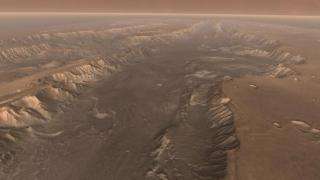
Melas Chasma, from "Flight Through Mariner Valley," a video produced for NASA by JPL.

A new view of the biggest canyon in the solar system, merging hundreds of photos from NASA's Mars Odyssey orbiter, offers scientists and the public an online resource for exploring the entire canyon in detail.

This canyon system on Mars, named Valles Marineris, stretches as far as the distance from California to New York. Steep walls nearly as high as Mount Everest give way to numerous side canyons, possibly carved by water. In places, walls have shed massive landslides spilling far out onto the canyon floor.

A simulated fly-through using the newly assembled imagery is available online at http://www.nasa.gov/mission_pages
/mars/missions/odyssey/20060313.html The fly-through plus tools for wandering across and zooming into the large image are at http://themis.asu.edu .

"We picked Valles Marineris to make this first mosaic because it's probably the most complex, interesting feature on the entire planet," said Dr. Phil Christensen of Arizona State University, Tempe. He is the principal investigator for Mars Odyssey's versatile camera, the Thermal Emission Imaging System. "To understand many of the processes on Mars -- erosion, landsliding and the effects of water -- you really need to have a big-picture view but still be able to see the details."

Small parts of the canyon have been seen at higher resolution, but at 100 meters (328 feet) per pixel, the new view has sharper resolution than any previous imaging of the entire canyon.

In addition to the completed mosaic of Valles Marineris images, the camera team has also prepared an online data set of nearly the entire planet of Mars at 232 meters (760 feet) per pixel, the most detailed global view of the red planet. The team plans to post 100-meter-resolution mosaics of other regions of Mars in coming months.

Odyssey reached Mars in 2001. The Thermal Emission Imaging System began observing the planet systematically in February 2002 both in visible wavelengths and in infrared wavelengths, which are better for seeing surface details through Mars' atmospheric dust. As the spacecraft passes over an area, the camera records images of swaths 32 kilometers wide (20 miles wide). More than three years of observations made at infrared wavelengths during Martian daytime are combined into the assembled view of Valles Marineris and the global image data set.

Mars Odyssey is managed by NASA's Jet Propulsion Laboratory, a division of the California Institute of Technology, Pasadena, for NASA's Science Mission Directorate, Washington. Lockheed Martin Space Systems, Denver, is the prime contractor for the project and built the spacecraft. The orbiter began an extended mission in August 2004 after successfully completing its primary mission.

Source: NASA


print this article email this article download pdf blog this article bookmark this article     Stumble it Digg this share on Facebook retweet share on Reddit add to delicious
Rate this story - 3.4 /5 (8 votes)


March 13, 2006 all stories

Comments: 0

3.4 /5 (8 votes)
  • Stumble this up

  • Digg this

  • share this

  • hide
  • Related Stories

  • HiRISE Camera Captures High-Resolution 3-D Images of Mars
    created Dec 09, 2008 | popularity not rated yet | comments 0
  • Noctis Labyrinthus, labyrinth of the night
    created Nov 30, 2007 | popularity not rated yet | comments 0
  • Mars with ice, shaken, not stirred
    created Oct 26, 2007 | popularity not rated yet | comments 0
  • Mars Rover and Orbiter Team Examines Victoria Crater
    created Oct 06, 2006 | popularity not rated yet | comments 0
  • Mars Mission Lasts Well Past Sell-By Date
    created Jul 22, 2006 | popularity not rated yet | comments 0


Other News

Fermi Telescope Peers Deep into Microquasar

Fermi Telescope Peers Deep into Microquasar (w/ Video)

Space & Earth / Astronomy

created 10 hours ago | popularity 4.5 / 5 (6) | comments 0

(PhysOrg.com) -- NASA's Fermi Gamma-ray Space Telescope has made the first unambiguous detection of high-energy gamma-rays from an enigmatic binary system known as Cygnus X-3. The system pairs a hot, massive ...


The Energy Sources of Ultraluminous Galaxies

The Energy Sources of Ultraluminous Galaxies

Space & Earth / Astronomy

created 10 hours ago | popularity 4.3 / 5 (9) | comments 0

(PhysOrg.com) -- Ultraluminous infrared galaxies ((ULIRGs) are galaxies whose luminosity exceeds that of a trillion suns; for comparison, the Milky Way galaxy has a typical (and much more modest) luminosity ...


Space shuttle Atlantis, 7 astronauts back on Earth (AP)

Space shuttle Atlantis, 7 astronauts back on Earth

Space & Earth / Space Exploration

created 11 hours ago | popularity not rated yet | comments 0

(AP) -- Space shuttle Atlantis and its seven astronauts returned to Earth with a smooth touchdown Friday to end an 11-day flight that resupplied the International Space Station.


China is set to launch its second moon orbiter next October, state media have reported

China to launch second lunar probe: state media

Space & Earth / Space Exploration

created 15 hours ago | popularity 5 / 5 (4) | comments 0

China will launch its second moon orbiter next October, state media reported Friday, as it powers ahead with a space programme that has sparked concerns abroad.


Herschel takes a peek at the ingredients of the galaxies

Herschel takes a peek at the ingredients of the galaxies

Space & Earth / Astronomy

created 9 hours ago | popularity 4.3 / 5 (3) | comments 0

(PhysOrg.com) -- The European Space Agency has today released spectacular new observations from the Herschel Space Observatory, including the UK-led SPIRE instrument. Spectrometers on board all three Hershel ...