Neuronal circuits able to rewire on the fly to sharpen senses
December 16, 2007
Neuronal circuits able to rewire on the fly to sharpen senses

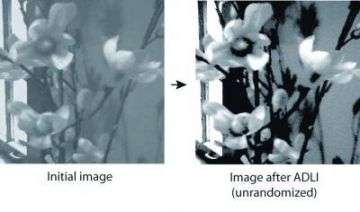
An blurry image processed with a computer model of activity-dependent lateral inhibition appears in deep contrast, illustrating dynamic connectivity. Credit: Center for the Neural Basis of Cognition, Pittsburgh, Pa.

Researchers from the Center for the Neural Basis of Cognition (CNBC), a joint project of Carnegie Mellon University and the University of Pittsburgh, have for the first time described a mechanism called “dynamic connectivity,” in which neuronal circuits are rewired “on the fly” allowing stimuli to be more keenly sensed. The process is described in a paper in the January 2008 issue of Nature Neuroscience.

This new, biologically inspired algorithm for analyzing the brain at work allows scientists to explain why when we notice a scent, the brain can quickly sort through input and determine exactly what that smell is.

“If you think of the brain like a computer, then the connections between neurons are like the software that the brain is running. Our work shows that this biological software is changed rapidly as a function of the kind of input that the system receives,” said Nathan Urban, associate professor of biological sciences at Carnegie Mellon.

When a stimulus such as an odor is encountered, many neurons start to fire. When many neurons fire at the same time, the signals can be difficult for the brain to interpret. During lateral inhibition, the stimulated neurons send “cease-fire” messages to the neighboring neurons, reducing the noise and making it easier to precisely identify a stimulus. This process also facilitates accurate recognition of stimuli in many sensory areas of the brain.

In this project, Urban and colleagues specifically examine the process of lateral inhibition in an area of the brain called the olfactory bulb, which is responsible for processing scents. Until now, scientists thought that the connections made by the neurons in the olfactory bulb were dictated by anatomy and could only change slowly.

However, in this current study, Urban and colleagues found that the connections are, in fact, not set but rather able to change dynamically in response to specific patterns of stimuli. In their experiments, they found that when excitatory neurons in the olfactory bulb fire in a correlated fashion, this determines how they are functionally connected.

The researchers showed that dynamic connectivity allows lateral inhibition to be enhanced when a large number of neurons initially respond to a stimulus, filtering out noise from other neurons. By filtering out the noise, the stimulus can be more clearly recognized and separated from other similar stimuli.

“This mechanism helps to explain why you can walk into a room and recognize a smell that seems to be floral. As you continue to smell the odor, you begin to recognize that the scent is indeed flowers and even more specifically is the scent of roses,” Urban said. “By understanding how the brain does this, we can then apply this mechanism to other problems faced by the brain.”

Researchers converted this mechanism into an algorithm and used computer modeling to further show that dynamic connectivity makes it easier to identify and discriminate between stimuli by enhancing the contrast, or sharpness, of the stimuli, independent of the spatial patterns of the active neurons. This algorithm allows researchers to show the applicability of the mechanism in other areas of the brain where similar inhibitory connections are widespread. For example, the researchers applied the algorithm to a blurry picture and the picture appeared refined and in sharper contrast (see figure).

Link: http://dx.doi.org/ … .1038/nn2030

Source: Carnegie Mellon University

4.2 /5 (29 votes)  

Filter


Move the slider to adjust rank threshold, so that you can hide some of the comments.


Display comments: newest first

Wicked
Dec 17, 2007

Rank: not rated yet
Layman's summary:
Researchers were studying the olfactory bulb of the brain and discovered a mechanism they called "dynamic connectivity." An algorithm was then empirically derived from this mechanism. In a computer model, the algorithm is applied to (jpg?) images and can sharpen blurry images.

How do we know they didn't just use photoshop?
KB6
Dec 17, 2007

Rank: not rated yet
Lateral inhibition between neurons has been known about for a long time. While it may be useful in identifying specific stimuli, concentrating attention and sharpening images, it can also introduce error. Lateral inhibition between neurons in the visual pathways is responsible for many optical illusions.
Rank 4.2 /5 (29 votes)
Tags

Relevant PhysicsForums posts
  • Is Everyday Technology Killing Us?
    createdFeb 08, 2012
  • Exercise and weight loss
    createdFeb 08, 2012
  • Why do we have head aches? Our brains can't feel anything.
    createdFeb 07, 2012
  • "The end of diseases" by David Agus, interview from Daily Show with Jon Stewart
    createdFeb 04, 2012
  • Oncolytic adenovirus
    createdFeb 04, 2012
  • Nutrition label stuffs and diets
    createdFeb 02, 2012
  • More from Physics Forums - Medical Sciences

More news stories

Complex wiring of the nervous system may rely on a just a handful of genes and proteins

Researchers at the Salk Institute have discovered a startling feature of early brain development that helps to explain how complex neuron wiring patterns are programmed using just a handful of critical genes. ...

Medicine & Health / Research

created 6 hours ago | popularity 4.9 / 5 (9) | comments 0 | with audio podcast

Both maternal and paternal age linked to autism

Older maternal and paternal age are jointly associated with having a child with autism, according to a recently published study led by researchers at The University of Texas Health Science Center at Houston (UTHealth).

Medicine & Health / Psychology & Psychiatry

created 11 hours ago | popularity 4 / 5 (2) | comments 0 | with audio podcast

New understanding of DNA repair could eventually lead to cancer therapy

A research group in the Faculty of Medicine & Dentistry at the University of Alberta is hoping its latest discovery could one day be used to develop new therapies that target certain types of cancers.

Medicine & Health / Cancer

created 10 hours ago | popularity 4.8 / 5 (4) | comments 0 | with audio podcast

Curry spice component may help slow prostate tumor growth

Curcumin, an active component of the Indian curry spice turmeric, may help slow down tumor growth in castration-resistant prostate cancer patients on androgen deprivation therapy (ADT), a study from researchers ...

Medicine & Health / Cancer

created 12 hours ago | popularity 4.4 / 5 (8) | comments 0 | with audio podcast

Human cognitive performance suffers following natural disasters, researchers find

Not surprisingly, victims of a natural disaster can experience stress and anxiety, but a new study indicates that it might also cause them to make more errors - some serious - in their daily lives. In their upcoming Human Fa ...

Medicine & Health / Psychology & Psychiatry

created 8 hours ago | popularity 4 / 5 (1) | comments 0


Google users warned of threat to smartphone wallets

Users of Google smartphone wallets were being warned on Friday that there is a way to crack pass codes intended to thwart thieves from going on illicit shopping sprees.

Anonymous knocks CIA website offline (Update)

The website of the Central Intelligence Agency was inaccessible on Friday after the hacker group Anonymous claimed to have knocked it offline.

New error-correcting codes guarantee the fastest possible rate of data transmission

Error-correcting codes are one of the triumphs of the digital age. They’re a way of encoding information so that it can be transmitted across a communication channel — such as an optical fiber o ...

The power of estrogen -- male snakes attract other males

A new study has shown that boosting the estrogen levels of male garter snakes causes them to secrete the same pheromones that females use to attract suitors, and turned the males into just about the sexiest ...

Humans may have helped the decline of African rainforests 3000 years ago

(PhysOrg.com) -- Large areas of rainforests in Central Africa mysteriously disappeared over three thousand years ago, to be replaced by savannas. The prevailing theory has been that the cause was a change ...

New power source discovered

(PhysOrg.com) -- Researchers at the Massachusetts Institute of Technology (MIT) and RMIT University have made a breakthrough in energy storage and power generation.