Greenhouse theory smashed by biggest stone
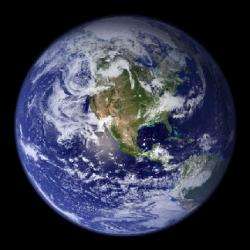
A new theory to explain global warming was revealed at a meeting at the University of Leicester (UK) and is being considered for publication in the journal "Science First Hand". The controversial theory has nothing to do with burning fossil fuels and atmospheric carbon dioxide levels.
According to Vladimir Shaidurov of the Russian Academy of Sciences, the apparent rise in average global temperature recorded by scientists over the last hundred years or so could be due to atmospheric changes that are not connected to human emissions of carbon dioxide from the burning of natural gas and oil. Shaidurov explained how changes in the amount of ice crystals at high altitude could damage the layer of thin, high altitude clouds found in the mesosphere that reduce the amount of warming solar radiation reaching the earth's surface.
Shaidurov has used a detailed analysis of the mean temperature change by year for the last 140 years and explains that there was a slight decrease in temperature until the early twentieth century. This flies in the face of current global warming theories that blame a rise in temperature on rising carbon dioxide emissions since the start of the industrial revolution. Shaidurov, however, suggests that the rise, which began between 1906 and 1909, could have had a very different cause, which he believes was the massive Tunguska Event, which rocked a remote part of Siberia, northwest of Lake Baikal on the 30th June 1908.
The Tunguska Event, sometimes known as the Tungus Meteorite is thought to have resulted from an asteroid or comet entering the earth's atmosphere and exploding. The event released as much energy as fifteen one-megaton atomic bombs. As well as blasting an enormous amount of dust into the atmosphere, felling 60 million trees over an area of more than 2000 square kilometres. Shaidurov suggests that this explosion would have caused "considerable stirring of the high layers of atmosphere and change its structure." Such meteoric disruption was the trigger for the subsequent rise in global temperatures.
Global warming is thought to be caused by the "greenhouse effect". Energy from the sun reaches the earth's surface and warms it, without the greenhouse effect most of this energy is then lost as the heat radiates back into space. However, the presence of so-called greenhouse gases at high altitude absorb much of this energy and then radiate a proportion back towards the earth's surface. Causing temperatures to rise.
Many natural gases and some of those released by conventional power stations, vehicle and aircraft exhausts act as greenhouse gases. Carbon dioxide, natural gas, or methane, and chlorofluorocarbons (CFCs) are all potent greenhouse gases. Carbon dioxide and methane are found naturally in the atmosphere, but it is the gradual rise in levels of these gases since the industrial revolution, and in particular the beginning of the twentieth century, that scientists have blamed for the gradual rise in recorded global temperature. Attempts to reverse global warming, such as the Kyoto Protocol, have centred on controlling and even reducing CO2 emissions.
However, the most potent greenhouse gas is water, explains Shaidurov and it is this compound on which his study focuses. According to Shaidurov, only small changes in the atmospheric levels of water, in the form of vapour and ice crystals can contribute to significant changes to the temperature of the earth's surface, which far outweighs the effects of carbon dioxide and other gases released by human activities. Just a rise of 1% of water vapour could raise the global average temperature of Earth's surface more then 4 degrees Celsius.
The role of water vapour in controlling our planet's temperature was hinted at almost 150 years ago by Irish scientist John Tyndall. Tyndall, who also provided an explanation as to why the sky is blue, explained the problem: "The strongest radiant heat absorber, is the most important gas controlling Earth's temperature. Without water vapour, he wrote, the Earth's surface would be 'held fast in the iron grip of frost'." Thin clouds at high altitude allow sunlight to reach the earth's surface, but reflect back radiated heat, acting as an insulating greenhouse layer.
Water vapour levels are even less within our control than CO2 levels. According to Andrew E. Dessler of the Texas A & M University writing in 'The Science and Politics of Global Climate Change', "Human activities do not control all greenhouse gases, however. The most powerful greenhouse gas in the atmosphere is water vapour, he says, "Human activities have little direct control over its atmospheric abundance, which is controlled instead by the worldwide balance between evaporation from the oceans and precipitation."
As such, Shaidurov has concluded that only an enormous natural phenomenon, such as an asteroid or comet impact or airburst, could seriously disturb atmospheric water levels, destroying persistent so-called 'silver', or noctilucent, clouds composed of ice crystals in the high altitude mesosphere (50 to 85km). The Tunguska Event was just such an event, and coincides with the period of time during which global temperatures appear to have been rising the most steadily - the twentieth century. There are many hypothetical mechanisms of how this mesosphere catastrophe might have occurred, and future research is needed to provide a definitive answer.
Source: University of Leicester


