New mechanical insights into wound healing and scar tissue formation
December 17, 2007
New mechanical insights into wound healing and scar tissue formation

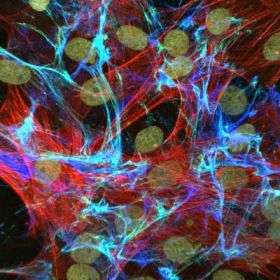
Contractile fibroblasts secrete and organize extracellular matrix fibers (blue) that are loaded with growth factor complexes (green), resulting in a turquoise overlay color. The contractile fibers inside the cells are visualized by detecting a smooth muscle protein (red). The cells' nuclei are visualized in yellow. Credit: EPFL/LCB

New research published today in the Journal of Cell Biology illuminates the mechanical factors that play a critical role in the differentiation and function of fibroblasts, connective tissue cells that play a role in wound healing and scar tissue formation.

When we are injured, the body launches a complex rescue operation. Specialized cells called fibroblasts lurking just beneath the surface of the skin jump into action, enter the provisional wound matrix (the clot) and start secreting collagen to close the wound as fast as possible.

This matrix is initially soft and loaded with growth factors. The fibroblasts "crawl" around the matrix, pulling and reorganizing the fibers. The matrix grows stiffer, and at a certain point, the fibroblasts stop migrating and, like Popeye, change into powerful contractile cells, anchoring themselves to the matrix and pulling the edges of the wound together.

The research reported today reveals for the first time that a mechanical mechanism is crucial for this switch from migrating to contractile cells. To make this change, the fibroblasts need to get at their "spinach" -- the growth factor sitting in the matrix which, once liberated, stimulates the production of smooth-muscle proteins. Previously, researchers postulated that the fibroblasts did this by digesting the matrix. But EPFL scientist Boris Hinz, doctoral student Pierre-Jean Wipff and their colleagues have discovered that the cells unlock the growth factor via a purely mechanical process.

With experiments using novel cell culture substrates of varying rigidity, they found that at a certain point, the matrix is sufficiently rigid that cell-exerted force allows the growth factor to pop out, like candy from a wrapper. Once the growth factor is available, the fibroblast expresses the contractile proteins, sticks more firmly to the matrix and starts to contract, pulling the matrix tightly together. In the process it liberates yet more growth factor that in turn stimulates other fibroblasts to become contractile. The mechanical nature of the switch ensures that the contraction only develops when the matrix is "ready."

Although this process will heal a wound quickly, if left unchecked, it can also lead to a buildup of fibrous tissue. Following trauma to vital organs such as the heart, lung, liver and kidney, overzealous fibroblasts can continue to build fibrous strands, leading to scar tissue buildup that can impair the organ's function.

This condition, called "fibrosis", can be fatal. Fibroblasts are also the culprits in problems caused by implants -- if the implant is too smooth, it never becomes properly incorporated into the connective tissue. But if it is too rough, scar tissue develops around it and it won't function properly. Occasionally, following plastic surgery, unsightly excessive scar tissue can develop in the skin as well. The process can also cause problems in mesenchymal stem cell cultures -- if the culture's substrate is stiff, considerable efforts have to be made to prevent the stem cells from turning prematurely into fibroblasts instead of the desired cell type. Controlling the rigidity of the cell culture is therefore critical.

This new understanding of the mechanical nature of fibroblast activation could be used to reduce or prevent fibrosis from occurring, says Hinz, without inhibiting the growth factor, which serves many other vital functions in the body. There are several possibilities: "You could interfere with the way the cells grab onto the growth factor complex, you could interfere with their attachment points on the matrix, and you could interfere with their contractile forces so that the matrix never gets stiff enough to liberate the growth factor," he suggests.

Citation: Pierre-Jean Wipff, Daniel B. Rifkin, Jean-Jacques Meister and Boris Hinz, "Myofibroblast contraction activates latent TGF-b from the extracellular matrix", Journal of Cell Biology, December 17, 2007.

Source: Ecole Polytechnique Fédérale de Lausanne


Rank 5 /5 (5 votes)
Tags

Relevant PhysicsForums posts
  • Is Everyday Technology Killing Us?
    createdFeb 08, 2012
  • Exercise and weight loss
    createdFeb 08, 2012
  • Why do we have head aches? Our brains can't feel anything.
    createdFeb 07, 2012
  • "The end of diseases" by David Agus, interview from Daily Show with Jon Stewart
    createdFeb 04, 2012
  • Oncolytic adenovirus
    createdFeb 04, 2012
  • Nutrition label stuffs and diets
    createdFeb 02, 2012
  • More from Physics Forums - Medical Sciences

More news stories

Starve a virus, feed a cure? Findings show how some cells protect themselves against HIV

A protein that protects some of our immune cells from the most common and virulent form of HIV works by starving the virus of the molecular building blocks that it needs to replicate, according to research published online ...

Medicine & Health / Research

created 1 hour ago | popularity 5 / 5 (1) | comments 0 | with audio podcast

Injured boomers beware: Know when to see doctor

(AP) -- It happened to nurse Jane Byron years after an in-line skating fall, business owner Haralee Weintraub while doing "men's" push-ups, and avid cyclist Gene Wilberg while lifting a heavy box.

Medicine & Health / Health

created 2 hours ago | popularity 5 / 5 (1) | comments 0

FDA-approved drug rapidly clears amyloid from the brain, reverses Alzheimer's symptoms in mice

Neuroscientists at Case Western Reserve University School of Medicine have made a dramatic breakthrough in their efforts to find a cure for Alzheimer's disease. The researchers' findings, published in the journal Science, show t ...

Medicine & Health / Neuroscience

created Feb 09, 2012 | popularity 4.9 / 5 (55) | comments 21 | with audio podcast

Green tea found to reduce disability in the elderly

(Medical Xpress) -- A lot of research has been done over the past several years looking into the health benefits of green tea. As a result, scientists have found that regular consumption of the beverage leads ...

Medicine & Health / Health

created Feb 07, 2012 | popularity 4.4 / 5 (14) | comments 11 | with audio podcast report

Teen school drop-outs three times as likely to be on benefits in later life

Teen school drop-outs are almost three times as likely to be on benefits in later life as their peers who complete their schooling, indicates research published online in the Journal of Epidemiology and Community Health.

Medicine & Health / Health

created Feb 06, 2012 | popularity not rated yet | comments 13


Lab study raises questions over nano-particle impact

Tests involving chickens have raised questions about the impact on health from engineered nano-particles, the ultra-fine grains commonly used in drugs and processed foods, scientists said on Sunday.

Iran blocks email, restricts net access: reports

Iran has further restricted access to the Internet and blocked popular email services for the past few days, in a move a top lawmaker said could "cost the regime dearly," media reports said on Sunday.

Salvage workers begin pumping fuel from Italian shipwreck

Salvage workers Sunday began pumping fuel from the shipwrecked Italian cruise liner Costa Concordia, a day ahead of schedule, officials said.

Scientists discover molecular secrets of 2,000-year-old Chinese herbal remedy

For roughly two thousand years, Chinese herbalists have treated Malaria using a root extract, commonly known as Chang Shan, from a type of hydrangea that grows in Tibet and Nepal. More recent studies suggest that halofuginone, ...

New method to examine batteries -- MRI from the inside

There is an ever-increasing need for advanced batteries for portable electronics, such as phones, cameras, and music players, but also to power electric vehicles and to facilitate the distribution and storage of energy derived ...

A mitosis mystery solved: How chromosomes align perfectly in a dividing cell

Although the process of mitotic cell division has been studied intensely for more than 50 years, Whitehead Institute researchers have only now solved the mystery of how cells correctly align their chromosomes during symmetric ...