A 'gizmo' that saves lives
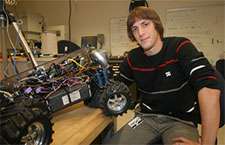
When Javier Rodriguez Molina visited the Atocha Train Station Memorial in Madrid last summer, the Barcelona native felt a great sadness for the victims of the 11 March 2004 Madrid train bombings. But he also felt some hope that his advanced emergency technology work at University of California, San Diego can some day save lives in similar disasters.
Police, firefighters and other emergency workers responding to natural or manmade disasters may someday save more lives with the help of “Gizmo,” an advanced mobile wireless communications device.
Rodríguez is Gizmo’s lead gadgeteer. He’s an electrical engineering graduate student and programmer analyst at UC San Diego's California Institute for Telecommunications and Information Technology (Calit2), one of the most advanced, interdisciplinary research institutes in the world. "Gizmo," which looks like a cross between a remote-controlled toy truck and a lunar landing vehicle, may eventually transform disaster response by collecting and transmitting in real time any information that emergency personnel need via any communications system they're using.
“In almost any emergency, the most important thing is immediate, accurate information,” Rodriguez said. “Gizmo will eventually be able to go anywhere on its own and send back in real time whatever information you might need."
From the Circuits Lab at Calit2, Rodriguez hopes to build many varieties of Gizmos -- even one that flies. The devices could go anywhere that it's too dangerous for humans, including urban emergencies such as hostage situations, terrorist attacks or a building collapse. The current Gizmo is the size of a remote-controlled toy truck. But future models may be alternately much smaller (so they could enter a hostage situation without being detected), or much bigger, such as a full sized truck, which could penetrate disaster situations even in the harshest conditions, such as a hurricane.
"Using technology to try to save lives is the most important thing for me now," Rodriguez said. "I'm taking part in work that can make people more secure by helping police, helping firefighters, helping anybody who is responding to a dangerous situation."
Working under Ramesh Rao, an internationally recognized expert in emergency technology and director of the UC San Diego division of Calit2, Rodriguez is now guiding a team of engineering undergraduates who are building Gizmos, which create their own wireless network bubble wherever they go. One Gizmo can create a wireless network 200 meters in diameter; several working in conjunction can create an exponentially larger network.
The mission of Calit2 is to apply the most advanced technology to real-world problems, and produce solutions that people can actually use. One of the biggest problems for responders in any emergency situation is losing communications with one another and not knowing what's going on inside a dangerous area. So, Rodriguez and his colleagues concentrated on building Gizmo to collect accurate information in emergency situations and transmit it back to responders immediately using whatever communications system is operating.
The data collected by Gizmos can be sent back via wireless network connection to virtually anywhere, whether it's a police command station a block away or a research laboratory on the other side of the world. Gizmos can be controlled by cell phone, laptop or a gaming joystick hooked to a computer. The platform on each Gizmo can be mounted with any kind of device - high definition cameras; super sensitive microphones; sensors that detect dangerous gases, radiation or high heat levels; or a remote controlled arm that can collect samples. Then, that information can be sent to any communications device - cell phones, lap tops, Bluetooth, or whatever type of wireless transmitter emergency personnel are using. If one communications system fails, emergency personnel can switch to another. Like any wireless Internet system, Gizmo can send information through walls or other obstructions.
Another goal for Rodriguez is to make sure that Gizmo is relatively cheap -- under $1,000 - and constructed with many easy-to-replace parts so that they can be mass produced. That way, almost any police, fire and other emergency agencies could buy them off the shelf. If one Gizmo is destroyed in the line of duty, it can be easily replaced.
For now, Gizmos are wheeled vehicles, but Rodriguez and his colleagues already are building one with tank treads so it can go up stairs or over curbs and rocks. The opportunities for Gizmo are immense. Rodriguez envisions using them at delicate archeological ruins, underground cave-ins or even for routine security patrols.
"People see Gizmo and immediately think of a new idea for what it can do," he said. "I'm sure it has important uses that we haven't even thought of yet."
Source: University of California - San Diego


