Protons - Everything Revolves Around Spin
December 17, 2007
Protons - Everything Revolves Around Spin

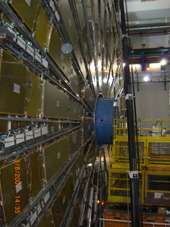
Enormous particle accelerators and their detectors (shown is the ATLAS detector in process of being constructed) help to understand the forces that keep our world together. Credit: Steven Bass

Current understanding of the spin structure of protons has been summarised in a single book for the first time. The book examines attempts to solve one of the greatest puzzles of physics. Models and experiments to date have been unable to properly explain a fundamental property of protons spin.

Published by Dr. Steven Bass as part of an Austrian Science Fund FWF project, the book summarises over 1,000 publications and the results of a global research programme on this phenomenon.

Many particles rotate around their own axis like spinning tops. However, unlike spinning tops, this spin has a fundamental influence on the properties of the particle - and therefore on our world. Quantum physical interactions mean that spin is responsible for the magnetic moment of protons, and therefore also the stability of the universe. It is a truly fundamental force. This makes it all the more surprising that experiments have so far failed to identify the origin of 30 percent of proton spin.

Dr. Steven Bass, from the Institute of Theoretical Physics at the University of Innsbruck and a researcher at CERN (European Organisation of Nuclear Research), has summarised the current understanding of this discrepancy in a new book. Besides referring to 1,000 publications on the theory of spin, he also presents the results of a worldwide research programme that was carried out in the particle accelerators of CERN, DESY (German Electron Synchrotron), BNL (Brookhaven National Laboratory), JLab (Jefferson Laboratory) and SLAC (Stanford Linear Accelerator Centre).

Dr. Bass on the missing spin of protons: "Protons are combinations of more basic entities called quarks and gluons. Each proton is made up of three quarks that are bound together by the gluons. Just like the protons, the quarks and gluons themselves also spin. The spin of the proton is therefore generated by the spin of its constituent parts. For example, current models state that 60 percent of the spin of a proton must originate from the spin of the quarks. The remaining 40 percent would therefore come from other types of movement produced by the quarks within the proton. However, experiments involving some of the most advanced particle accelerators in the world indicate that a maximum of 30 percent of proton spin originates from quark spin. So where does the rest come from?"

The aforementioned global research programme was initiated and a whole range of calculations were published in an attempt to find an answer to this question. These efforts are now beginning to bear fruit and it is these results that Dr. Bass has compiled in his book.

The results initially seemed to indicate that the apparent discrepancy was the result of inaccurate interpretation, in other words, that in reality there is no discrepancy. The theory behind this hypothesis is that the spin of the gluons - the particles responsible for binding together quarks - screens quark spin in proportion to the gluon polarisation. This would influence any attempts to measure quark spin and distort calculations. But it was not long before other experiments produced data that contradicted this theory. This data shows that gluon polarisation is not strong enough to account for the "missing" 30 percent of quark spin. However, calculations from even more accurate measurements are expected soon and will deliver new findings - or disprove existing ones.

As a result, we need to constantly re-examine our current understanding of what holds together protons - and for that matter the universe. Dr. Bass, who also heads up an FWF project on this subject, therefore believes that his book has been published at precisely the right time: "The results of new and ever more accurate measurements need to be analysed in the light of the latest understanding. I hope that this book goes some way towards helping achieve this."

Reference: The Spin Structure of the Proton. By Steven D Bass, Publisher World Scientific, ISBN 978-981-270-9479.

Source: Austrian Science Fund (FWF)

4.4 /5 (22 votes)  

Filter


Move the slider to adjust rank threshold, so that you can hide some of the comments.


Display comments: newest first

out7x
Dec 18, 2007

Rank: 1 / 5 (1)
Spin is a quantum state. Quark-gluon interactions are the strong force. How are they related?
Rank 4.4 /5 (22 votes)
Tags

Relevant PhysicsForums posts
  • what is electricity???
    created4 hours ago
  • Can Plasma Be Solid
    created5 hours ago
  • What is delta Δ ?
    created6 hours ago
  • Need some help understanding HertzĀ–Knudsen formula
    created6 hours ago
  • Anatomy of Fat man: implosion-critical bomb
    created8 hours ago
  • what makes two sounds similar???
    created9 hours ago
  • More from Physics Forums - General Physics

More news stories

Explained: Sigma

It's a question that arises with virtually every major new finding in science or medicine: What makes a result reliable enough to be taken seriously? The answer has to do with statistical significance -- but ...

Physics / General Physics

created Feb 09, 2012 | popularity 5 / 5 (20) | comments 78

Quantum physicist explains $100K offer for proof scaled-up quantum computing is impossible

(PhysOrg.com) -- MIT researcher Scott Aaronson has certainly riled the physics community with his offer this past Friday, of $100,000 to anyone who can prove that scaled-up quantum computing is impossible. ...

Physics / Quantum Physics

created Feb 08, 2012 | popularity 4.3 / 5 (15) | comments 37 | with audio podcast weblog

Diamond light, brighter than the sun

It’s the size of five football pitches and generates light 10 billion times brighter than the sun. As the Diamond Light Source celebrates its tenth anniversary this year, Penny Bailey visits one of the ...

Physics / General Physics

created Feb 07, 2012 | popularity 4.1 / 5 (10) | comments 18 | with audio podcast

Physicists 'record' magnetic breakthrough

An international team of scientists has demonstrated a revolutionary new way of magnetic recording which will allow information to be processed hundreds of times faster than by current hard drive technology.

Physics / General Physics

created Feb 07, 2012 | popularity 4.6 / 5 (43) | comments 15 | with audio podcast

Hints of the Higgs - papers are submitted

Back in December 2011, the ATLAS and CMS experiments at CERN presented some exciting results that provided tantalising hints of the Higgs boson.

Physics / General Physics

created Feb 08, 2012 | popularity 4.3 / 5 (8) | comments 10


Scientists discover molecular secrets of 2,000-year-old Chinese herbal remedy

For roughly two thousand years, Chinese herbalists have treated Malaria using a root extract, commonly known as Chang Shan, from a type of hydrangea that grows in Tibet and Nepal. More recent studies suggest that halofuginone, ...

New method to examine batteries -- MRI from the inside

There is an ever-increasing need for advanced batteries for portable electronics, such as phones, cameras, and music players, but also to power electric vehicles and to facilitate the distribution and storage of energy derived ...

Google might launch Drive for cloud storage soon

(PhysOrg.com) -- Google's next big move, according to the Wall Street Journal, is a cloud storage service called Drive. Hardly first to the plate, Google is simply catching up to introducing its cloud reposi ...

A mitosis mystery solved: How chromosomes align perfectly in a dividing cell

Although the process of mitotic cell division has been studied intensely for more than 50 years, Whitehead Institute researchers have only now solved the mystery of how cells correctly align their chromosomes during symmetric ...

Lab study raises questions over nano-particle impact

Tests involving chickens have raised questions about the impact on health from engineered nano-particles, the ultra-fine grains commonly used in drugs and processed foods, scientists said on Sunday.

Starve a virus, feed a cure? Findings show how some cells protect themselves against HIV

A protein that protects some of our immune cells from the most common and virulent form of HIV works by starving the virus of the molecular building blocks that it needs to replicate, according to research published online ...