'Death Star' Galaxy Black Hole Fires at Neighboring Galaxy
December 17th, 2007 'Death Star' Galaxy Black Hole Fires at Neighboring Galaxy

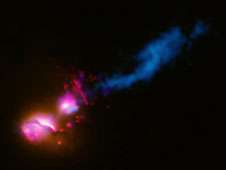
A black hole jet at the center of a galaxy strikes the edge of another galaxy. Image Credit: X-ray: NASA/CXC/ CfA/D.Evans et al.; Optical/UV: NASA/ STScI; Radio: NSF/VLA/CfA/D.Evans et al., STFC/JBO/MERLIN

A powerful jet from a super massive black hole is blasting a nearby galaxy, according to new findings from NASA observatories. This never-before witnessed galactic violence may have a profound effect on planets in the jet's path and trigger a burst of star formation in its destructive wake.

Known as 3C321, the system contains two galaxies in orbit around each other. Data from NASA's Chandra X-ray Observatory show both galaxies contain super massive black holes at their centers, but the larger galaxy has a jet emanating from the vicinity of its black hole. The smaller galaxy apparently has swung into the path of this jet.

This "death star" galaxy was discovered through the combined efforts of both space and ground-based telescopes. NASA's Chandra X-ray Observatory, Hubble Space Telescope, and Spitzer Space Telescope were part of the effort. The Very Large Array telescope, Socorro, N.M., and the Multi-Element Radio Linked Interferometer Network (MERLIN) telescopes in the United Kingdom also were needed for the finding.

"We've seen many jets produced by black holes, but this is the first time we've seen one punch into another galaxy like we're seeing here," said Dan Evans, a scientist at the Harvard-Smithsonian Center for Astrophysics and leader of the study. "This jet could be causing all sorts of problems for the smaller galaxy it is pummeling."

Jets from super massive black holes produce high amounts of radiation, especially high-energy X-rays and gamma-rays, which can be lethal in large quantities. The combined effects of this radiation and particles traveling at almost the speed of light could severely damage the atmospheres of planets lying in the path of the jet. For example, protective layers of ozone in the upper atmosphere of planets could be destroyed.

Jets produced by super massive black holes transport enormous amounts of energy far from black holes and enable them to affect matter on scales vastly larger than the size of the black hole. Learning more about jets is a key goal for astrophysical research.

"We see jets all over the universe, but we're still struggling to understand some of their basic properties," said co-investigator Martin Hardcastle of the University of Hertfordshire in the United Kingdom. "This system of 3C321 gives us a chance to learn how they're affected when they slam into something like a galaxy and what they do after that."

The effect of the jet on the companion galaxy is likely to be substantial, because the galaxies in 3C321 are extremely close at a distance of only about 20,000 light years apart. They lie approximately the same distance as Earth is from the center of the Milky Way galaxy.

A bright spot in the Very Large Array and MERLIN images shows where the jet has struck the side of the galaxy, dissipating some of the jet's energy. The collision disrupted and deflected the jet.

Another unique aspect of the discovery in 3C321 is how relatively short-lived this event is on a cosmic time scale. Features seen in the Very Large Array and Chandra images indicate that the jet began impacting the galaxy about one million years ago, a small fraction of the system's lifetime. This means such an alignment is quite rare in the nearby universe, making 3C321 an important opportunity to study such a phenomenon.

It is possible the event is not all bad news for the galaxy being struck by the jet. The massive influx of energy and radiation from the jet could induce the formation of large numbers of stars and planets after its initial wake of destruction is complete.

The results from Evans and his colleagues will appear in The Astrophysical Journal.

Source: NASA


print this article email this article download pdf blog this article bookmark this article     Digg this Stumble it share on Facebook share on Reddit add to delicious save to Yahoo! bookmarks
4.4/5 after 49 votes

Rank Filter

Move the slider to adjust rank threshold, so that you can hide some of the comments.


Display comments: newest first

  • HarryStottle - Dec 17, 2007
    • Rank: not rated yet
    Ouch
  • seanpu - Dec 18, 2007
    • Rank: 1 / 5 (3)
    "...how they're affected when they slam into something like a galaxy..."

    assumptions, assumptions. Looks like a glow discharge, nothing slamming into nothing, just energy exchange going on between structures.
  • Savgargin - Dec 18, 2007
    • Rank: not rated yet
    An image of intense collision of energies,espcially that of galaxies...sure, must have an intense effect, even if the affected is just a grain of sand.

December 17th, 2007 all stories
Space & Earth / Astronomy

Comments: 3
Rank: 4.4/5 after 49 votes

  • Stumble this up

  • Digg this

  • Share it:
  • share on Facebook
  • share on MySpace
  • share on Slashdot
  • rss-newsfeed
  • share on Google
  • share on Reddit
  • add to delicious
  • save to Yahoo! bookmarks
  • share on Windows Live
  • Add to Mixx!
Rating: 4.4/5 after 49 votes

  • Related Stories

  • VLBA locates superenergetic bursts near giant black hole
    created Jul 02, 2009 | popularity not rated yet | comments 0
  • Computer Finds Massive Black Hole in Nearby Galaxy
    created Jun 09, 2009 | popularity not rated yet | comments 0
  • An Intriguing, Glowing Galaxy
    created May 14, 2009 | popularity not rated yet | comments 0
  • Spitzer Telescope Warms Up to New Career
    created May 06, 2009 | popularity not rated yet | comments 0
  • Active galaxies flare and fade in Fermi telescope all-sky movie (w/Video)
    created Apr 24, 2009 | popularity not rated yet | comments 0

Tags


  • Transform a ball into a rock -- or make it invisible -- using transformation optics
    Transform a ball into a rock -- or make it invisible -- using transformation optics
    Physics / General Physics
    created 5 hours ago | popularity 3 / 5 (2) | comments 0
  • Could a quantum motor do work?
    Physics / General Physics
    created Jul 07, 2009 | popularity 4 / 5 (12) | comments 0
  • Physicists Demonstrate Quantum Memory with Matter Qubits
    Physicists Demonstrate Quantum Memory with Matter Qubits
    Physics / General Physics
    created Jul 03, 2009 | popularity 4.5 / 5 (20) | comments 1
  • 'Holey' Nanosheets for Wastewater Dye Removal
    Nanotechnology / Nanomaterials
    created Jul 01, 2009 | popularity 5 / 5 (5) | comments 1
  • Jellyfish Robot Swims Like its Biological Counterpart
    Jellyfish Robot Swims Like its Biological Counterpart
    Electronics / Robotics
    created Jun 26, 2009 | popularity 4.4 / 5 (9) | comments 1
  • Other News

    Tremors on southern San Andreas Fault may mean increased earthquake risk

    Space & Earth / Earth Sciences

    created 27 minutes ago | popularity not rated yet | comments 0

    (PhysOrg.com) -- Increases in mysterious underground tremors observed in several active earthquake fault zones around the world could signal a build-up of stress at locked segments of the faults and presumably an increased ...


    A Galaxy Collision in Action

    A Galaxy Collision in Action

    Space & Earth / Astronomy

    created 35 minutes ago | popularity not rated yet | comments 0

    This beautiful image gives a new look at Stephan's Quintet, a compact group of galaxies discovered about 130 years ago and located about 280 million light years from Earth. The curved, light blue ridge running ...


    Methane-eating microbes can use iron and manganese oxides to 'breathe'

    Methane-eating microbes can use iron and manganese oxides to 'breathe'

    Space & Earth / Earth Sciences

    created 1hour ago | popularity 5 / 5 (2) | comments 0

    Iron and manganese compounds, in addition to sulfate, may play an important role in converting methane to carbon dioxide and eventually carbonates in the Earth's oceans, according to a team of researchers ...


    Astrophysicists solve mystery in Milky Way galaxy

    Astrophysicists solve mystery in Milky Way galaxy

    Space & Earth / Astronomy

    created 4 hours ago | popularity 4.8 / 5 (6) | comments 0

    A team of astrophysicists has solved a mystery that led some scientists to speculate that the distribution of certain gamma rays in our Milky Way galaxy was evidence of a form of undetectable "dark matter" ...


    Galileo's notebooks may reveal secrets of new planet

    Space & Earth / Astronomy

    created 5 hours ago | popularity 4.5 / 5 (2) | comments 0

    Galileo knew he had discovered a new planet in 1613, 234 years before its official discovery date, according to a new theory by a University of Melbourne physicist.