Protecting Future Hard Drives
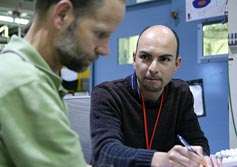
The newest iPod can store every episode of The Simpsons that ever aired and still fit into an Altoids can—and the next version will hold more data in an even tinier package. Consumers have a voracious appetite for data storage capacity, and with the help of Stanford's Synchrotron Radiation Laboratory (SSRL), Hitachi Global Storage Technologies is striving to keep up with the demands.
Ricardo Ruiz, a Research Staff Member at Hitachi in San Jose, is using Beamline 2-1 to help develop the next generation of hard disk drives. "My particular project involves the material that protects the magnetic recording surface of hard drives—from scratches, corrosion and other forms of damage," he explained.
Currently, high-quality overcoats are made from hydrogenated carbon and are about 15 nanometers thick. But as the data capacity of hard disk drives continues to increase, the density of the magnetic domains storing the information must scale up accordingly. Consequently, the distance between the disk reader and the disk surface must move closer together, demanding a thinner overcoat.
"That's a problem because the overcoat has to be very thin but still protect the magnetic medium," said Ruiz. "Carbon is reaching its limits, so we need to find a replacement." One promising alternative to carbon is silicon nitride. "It's very dense—much denser than carbon," Ruiz said. "It has real potential."
A critical issue for the overcoat's functionality is its smoothness. "The rougher it is, the easier it is for the oxygen to get through and oxidize the magnetic medium," Ruiz explained. To ascertain the structural profile with high accuracy, Ruiz is using a technique called x-ray reflectivity—made possible by SSRL's intense x-ray beams.
"We look at how the surface reflects the x-rays," said Ruiz. "If the surface is perfectly smooth, all the x-rays will be reflected like a perfect mirror. We move the detector around and see how much light you detect in different locations." These "diffuse scattering measurements" allow Ruiz to characterize the surface's microstructure, with a resolution limited only by the wavelength of the x-rays. At SSRL, Ruiz can probe a region the size of the beam (approximately 0.5 millimeters) with a resolution on the order of 1.5 angstroms—far superior to any other form of structure analysis.
Last week, Ruiz performed pilot studies with samples of silicon nitride, and will return in February to test prototype hard disk drives. "The initial tests were promising, and I'm looking forward to analyzing how well it works on the disks," said Ruiz.
Source: by Elizabeth Buchen, SLAC


