Monkeys perform arithmetic as well as college students
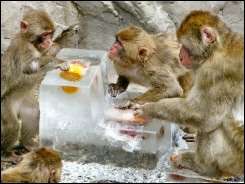
December 18, 2007 Monkeys enjoy fruits in Thailand

This file photo shows macaques trying to dig out fruits from an ice block at Tokyo's Ueno Zoo. A college education doesn't give you much of an edge over a monkey when it comes to doing some basic arithmetic, according to a study released Monday that underscores the surprising mental agility of our simian relatives.

Researchers at Duke University have demonstrated that monkeys have the ability to perform mental addition. In fact, monkeys performed about as well as college students given the same test.

The findings shed light on the shared evolutionary origins of arithmetic ability in humans and non-human animals, according to Assistant Professor Elizabeth Brannon, Ph.D. and Jessica Cantlon, Ph.D., of the Duke Center for Cognitive Neuroscience.

Current evidence has shown that both humans and animals have the ability to mentally represent and compare numbers. For instance, animals, infants and adults can discriminate between four objects and eight objects. However, until now it was unclear whether animals could perform mental arithmetic.

"We know that animals can recognize quantities, but there is less evidence for their ability to carry out explicit mathematical tasks, such as addition," said graduate student Jessica Cantlon. "Our study shows that they can."

Cantlon and Brannon set up an experiment in which macaque monkeys were placed in front of a computer touch screen displaying a variable number of dots. Those dots were then removed and a new screen appeared with a different number of dots. A third screen then appeared displaying two boxes; one containing the sum of the first two sets of dots and one containing a different number. The monkeys were rewarded for touching the box containing the correct sum of the sets.

The same test was presented to college students, who were asked to choose the correct sum without counting the individual dots. While the college students were correct 94 percent the time and the monkeys 76 percent, the average response time for both monkeys and humans was about one second.

Interestingly, both the monkeys' and the college students' performance worsened when the two choice boxes were close in number.

"If the correct sum was 11 and the box with the incorrect number held 12 dots, both monkeys and the college students took longer to answer and had more errors. We call this the ratio effect," explained Cantlon. "What's remarkable is that both species suffered from the ratio effect at virtually the same rate."

That monkeys and humans share the ability to add suggests that basic arithmetic may be part of our shared evolutionary past.

Humans have added language and writing to their repertoire, which undoubtedly changes the way we represent numbers. "Much of adult humans' mathematical capacity lies in their ability to represent numerical concepts using symbolic language. A monkey can't tell the difference between 2000 and 2001 objects, for instance. However, our work has shown that both humans and monkeys can mentally manipulate representations of number to generate approximate sums of individual objects," says Brannon.

The study was published in the December 2007 issue of the journal PLoS Biology.

Citation: Cantlon JF, Brannon EM (2007) Basic math in monkeys and college students. PLoS Biol 5(12): e328. doi:10.1371/journal.pbio.0050328

Source: Duke University


print this article email this article download pdf blog this article bookmark this article     Stumble it Digg this share on Facebook retweet share on Reddit add to delicious
Rate this story - 4.1 /5 (29 votes)

Rank Filter

Move the slider to adjust rank threshold, so that you can hide some of the comments.


Display comments: newest first

  • BigTone - Dec 18, 2007
    • Rank: not rated yet
    I guess the statement about having a bunch of monkeys working around the clock - sounds more competitive than funny
  • snwboardn - Dec 18, 2007
    • Rank: not rated yet
    That's pretty funny Big Tone. I can see the headline now, "Monkeys stealing American Jobs."
  • HeRoze - Dec 18, 2007
    • Rank: 3 / 5 (1)
    This study appears to show that monkeys can form estimations of the total number of objects. To say that the 76% success rate of monkeys means they perform "about as well as" the 94% success rate of college students is misleading. Also, to extrapolate this to "basic arithmetic may be part of our shared evolutionary past" is pure conjecture. It just as easily 'may not be'. This appears to be decent science corrupted by faulty or unsubstantiated conclusions.
  • quantum_flux - Dec 18, 2007
    • Rank: not rated yet
    Well, does this research suggest any method on how to more precisely visualize exact numbers when they're in a group? Like, for instance, how Rain Man can tell you that there are exactly 253 toothpicks that fell on the ground and be entirely correct?
  • ontheinternets - Dec 18, 2007
    • Rank: not rated yet
    Humans aren't particularly good at arithmetic. I consider it a curious weakness rather than a strength. A well-trained pigeon with a slide rule would give Einstein a run for his money.
  • fredrick - Dec 18, 2007
    • Rank: 2.5 / 5 (2)
    This study appears to show that monkeys can form estimations of the total number of objects. To say that the 76% success rate of monkeys means they perform "about as well as" the 94% success rate of college students is misleading. Also, to extrapolate this to "basic arithmetic may be part of our shared evolutionary past" is pure conjecture. It just as easily 'may not be'. This appears to be decent science corrupted by faulty or unsubstantiated conclusions.


    The news article here is slightly misleading, but not the study itself... what was interesting was not the similarity in accuracy between the monkeys and humans (the 76% and the 94%), which is a quantitative measure; but rather how they were qualitatively very much the same.

    quote from article:
    Moreover, predicted performance from the model of ratio-dependent addition captured the accuracy data from both monkeys and humans (humans: R2=0.95, p, 0.0001; monkeys: R2=0.90, p, 0.0001)


    This is what is referred to in the physorg article here:
    "If the correct sum was 11 and the box with the incorrect number held 12 dots, both monkeys and the college students took longer to answer and had more errors. We call this the ratio effect," explained Cantlon. "What's remarkable is that both species suffered from the ratio effect at virtually the same rate."


    The article is worth reading to get a better understanding (and its free). But basically, it wasn't suggesting that humans and monkeys perform arithmetic with the same accuracy (almost obviously, humans are going to do better - if only because of more training). But the qualitative similarities in how accuracy fell according to the ratio effect for both monkeys and humans suggests that we use similiar cognitive facilities for such basic maths - which in turn suggests that our common ancestor had such facilities and passed them down both lineages... there is some conjecture to it, and it could do with more testing (especially in other primates, like chimps or gorillas), but it is strongly suggestive and not "pure conjecture". Anyway, here is a link to the article if you want to keep discussing... http://biology.pl...document&doi=10.1371/journal.pbio.0050328

    sorry I can't fix that link for some reason
  • ontheinternets - Dec 19, 2007
    • Rank: not rated yet
    To get the link to the article, try using the following search string in Google:
    "Basic math in monkeys" site:plosjournals.org

    The resulting link will bring up a list of articles from Duke University, ordered with the most recent articles at the top.
  • fredrick - Dec 19, 2007
    • Rank: 1 / 5 (1)
    or, just click the link I posted, then in the url add &doi=10.1371/journal.pbio.0050328 to the end of the address, and that will take you directly to the article. Apparently this forum software thinks the '&' marks the end of the url...

    edit: hey what the... it worked 5 hours ago, now it isn't... weird. Do the admins at this site know about how posted urls screw up all the time?

December 18, 2007 all stories

Comments: 8

4.1 /5 (29 votes)
  • Stumble this up

  • Digg this

  • share this

  • hide
  • Related Stories

  • Color blindness cured in monkeys
    created Sep 16, 2009 | popularity not rated yet | comments 0
  • Pre-verbal number sense common to monkeys, babies, college kids
    created Feb 13, 2009 | popularity not rated yet | comments 0
  • AIDS: Are the wilderness years over for vaccine research?
    created Oct 21, 2009 | popularity not rated yet | comments 0
  • Cracking the brain's numerical code
    created Sep 24, 2009 | popularity not rated yet | comments 0
  • Scientists identify 'DNA barcodes' to help track illegal trading of wildlife products
    created Sep 15, 2009 | popularity not rated yet | comments 0


Other News

Computational microscope peers into the working ribosome

Computational microscope peers into the working ribosome (w/ Video)

Biology / Cell & Microbiology

created 16 hours ago | popularity 4.9 / 5 (7) | comments 0

Two new studies reveal in unprecedented detail how the ribosome interacts with other molecules to assemble new proteins and guide them toward their destination in biological cells. The studies used molecular ...


Spider secrets decoded in world-first database

Biology / Plants & Animals

created 11 hours ago | popularity not rated yet | comments 0

(PhysOrg.com) -- Queensland scientists have developed a world-first database that catalogues the venom components from hundreds of spiders.


New chameleon species discovered in East Africa

New chameleon species discovered in East Africa (w/ Podcast)

Biology / Plants & Animals

created 19 hours ago | popularity 5 / 5 (1) | comments 0

A new species of chameleon has been discovered in Tanzania by a team of scientists.


Indian engineer invents device to stop rampaging elephants

Biology / Plants & Animals

created 22 hours ago | popularity 4.3 / 5 (3) | comments 0

An Indian inventor has created a device to stop rampaging elephants in their tracks, amid concern about human injuries and deaths when they run amok, his company said Monday.


A year after discovery, Congo's 'mother lode' of gorillas remains vulnerable

A year after discovery, Congo's 'mother lode' of gorillas remains vulnerable

Biology / Plants & Animals

created 14 hours ago | popularity 5 / 5 (1) | comments 0

A new study by the Wildlife Conservation Society says that western lowland gorillas living in a large swamp in the Republic of Congo—part of the "mother lode" of more than 125,000 gorillas discovered last ...