Color sudoku puzzle demonstrates new vision for computing
December 18, 2007
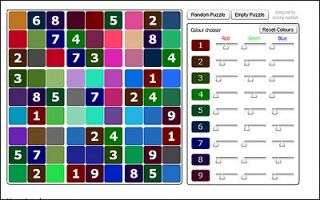
Researchers at the University of Warwick’s Department of Computer Science have developed a colour based Sudoku Puzzle that will help Sudoku players solve traditional Sudoku puzzles but also helps demonstrate the potential benefits of a radical new vision for computing.
The colour Sudoku adds another dimension to solving the puzzle by assigning a colour to each digit. Squares containing a digit are coloured according to the digit's colour. Empty squares are coloured according to which digits are possible for that square taking account of all current entries in the square's row, column and region. The empty square's colour is the combination of the colours assigned to each possible digit. This gives players major clues as darker coloured empty squares imply fewer number possibilities.
More usefully an empty square that has the same colour as a completed square must contain the same digit. If a black square is encountered then a mistake has been made. Players also can gain additional clues by changing the colour assigned to the each digit and watching the unfolding changes in the pattern of colours.
Sudoku players can test this for themselves at: www.warwick.ac.uk/ … uk/go/sudoku. (NB page requires Flash 9)
However the colour Sudoku is more than just a game to the University of Warwick Computer Scientists. For doctoral researcher Antony Harfield it is a way of exploring how logic and perception interact using a radical approach to computing called Empirical Modelling. The method can be applied to other creative problems and he is exploring how this experimental modelling technique can be used in educational technology and learning.
The interplay between logic and perception, as it relates to interactions between computers and humans is viewed as key to the building of better software. It is of particular relevance for artificial intelligence, computer graphics, and educational technology. The interaction between the shifting colour squares and the logical deductions of the Sudoku puzzle solver is a good illustration of the unusual quality of this "Empirical Modelling" approach.
Previously the researchers have been able to use their principles to analyse a railway accident in the Clayton Tunnel near Brighton when the telegraph was introduced in 1861. Reports at the time sought to blame various railway personnel but by applying Empirical Modelling the researchers have created an environment in which experimenters can replay the roles of the drivers, signalmen and other personnel involved. This has shown that there were systemic problems arising from the introduction of the new technology.
Dr Steve Russ of the Empirical Modelling group at the University of Warwick said:
"Traditional computer programs are best-suited for tasks that are so well-understood they can, without much loss, be expressed in a closed, mechanical form in which all interactions or changes are ‘pre-planned’. Even in something so simple as a Sudoku puzzle humans use a mixture of perception, expectation, experience and logic that is just incompatible with the way a computer program would typically solve the puzzle. For safety-critical systems (such as railway management) it is literally a matter of life and death that we learn to use computers in ways that integrate smoothly with human perception, communication and action. This is our goal with Empirical Modelling."
Source: University of Warwick
-
Titanic Jigsaw Challenge: Piecing together a global colour map of Saturn’s largest moon
Oct 04, 2011 |
5 / 5 (5) |
1
-
Mysteries of colour vision revealed as scientists map out eye's neural network
Nov 05, 2010 |
4.8 / 5 (13) |
0
-
All-over tan is a myth, study finds
Aug 03, 2010 |
4 / 5 (1) |
0
-
Japan astronaut solves bubble puzzle
Apr 15, 2010 |
4.4 / 5 (9) |
1
-
Planck sees tapestry of cold dust (w/ Video)
Mar 17, 2010 |
4.4 / 5 (7) |
6
-
Fast photon control brings quantum photonic technologies closer
10 hours ago |
5 / 5 (4) |
0
-
Engineers build first sub-10-nm carbon nanotube transistor
Feb 01, 2012 |
4.9 / 5 (33) |
30
-
Something old, something new: Evolution and the structural divergence of duplicate genes
Jan 31, 2012 |
4.6 / 5 (7) |
1
-
The hidden nanoworld of ice crystals: Revealing the dynamic behavior of quasi-liquid layers
Jan 30, 2012 |
5 / 5 (5) |
1
-
Stock market network reveals investor clustering
Jan 27, 2012 |
3.9 / 5 (23) |
8
-
Digital scratch pad?
1 hour ago
-
Quantum computer faster than regular computer?
12 hours ago
-
Flushing RAM in Mathematica
17 hours ago
-
Synergistic relations between computer science and technology.
Feb 06, 2012
-
how do iphone gloves work?
Feb 05, 2012
-
iPhone battery over time
Jan 30, 2012
- More from Physics Forums - Computing & Technology
More news stories
Music service gives Myspace second wind
Faded online social network Myspace said Monday it was getting a second wind due to the popularity of a freshly launched online music player.
2 hours ago |
5 / 5 (1) |
0
US, EU clear Google's $12.5B Motorola Mobility bid (Update)
Google's $12.5 billion acquisition of cellphone maker Motorola Mobility have won approvals from U.S. and European antitrust regulators, moving Google a major step closer to completing the biggest deal in its ...
3 hours ago |
5 / 5 (1) |
0
Apple shares close over $500
Apple shares surged past $500 for the first time on Wall Street on Monday, powered by reports a new iPad may be unveiled next month.
1 hour ago |
not rated yet |
0
Computer programs that think like humans
Intelligence what does it really mean? In the 1800s, it meant that you were good at memorising things, and today intelligence is measured through IQ tests where the average score for humans is 100. ...
Technology / Computer Sciences
2 hours ago |
not rated yet |
1
EU executive defends contested online piracy pact
The European Commission on Monday defended a global online-piracy pact opposed by some EU states and still to be ratified by the European Parliament.
3 hours ago |
not rated yet |
0
First-of-its-kind stem cell study re-grows healthy heart muscle in heart attack patients
Results from a Cedars-Sinai Heart Institute clinical trial show that treating heart attack patients with an infusion of their own heart-derived cells helps damaged hearts re-grow healthy muscle.
Scientists discover reason for Mt. Hood's non-explosive nature
(PhysOrg.com) -- For a half-million years, Mount Hood has towered over the landscape, but unlike some of its cousins in Oregons Cascade Mountains and many other volcanoes around the Pacific Rim ...
Discovery paves way for salmonella vaccine
(Medical Xpress) -- An international research team led by a University of California, Davis, immunologist has taken an important step toward an effective vaccine against salmonella, a group of increasingly antibiotic-resistant ...
Time of year important in projections of climate change effects on ecosystems
(PhysOrg.com) -- Does it matter whether long periods of hot weather, such as last year's heat wave that gripped the U.S. Midwest, happen in June or July, August or September?
Smoking bans lead to less, not more, smoking at home: study
Smoking bans in public/workplaces don't drive smokers to light up more at home, suggests a study of four European countries with smoke free legislation, published online in Tobacco Control.
Ovarian cancer arises in fallopian tube of knockout mice
(Medical Xpress) -- The most deadly form of "ovarian" cancer arises in the fallopian tubes not the ovaries of knockout mice that lack two genes associated with the disease, said researchers led by Baylor College ...