Measuring the density of ultra-pure water
December 18, 2007 Magnetic Floatation Equipment

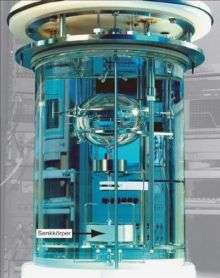
The sinker lies on a holder whose weight is compensated by the buoyancy of a hollow sphere and of an adjusting weight. Credit: PTB

For oceanography – and there in particular for the description of ocean currents – accurate measurements of the density of sea water are of great importance. For this purpose, measuring instruments are needed which reach an uncertainty of approx. 0.001 kg/m3 (relative 1 · 10–6).

To be able to calibrate these measuring instruments, ultra-pure water is required as a reference fluid – the density of which can now be measured with the required accuracy over a large temperature range by means of the Magnetic Flotation Method which has been further developed at PTB (The Physikalisch-Technische Bundesanstalt, Germany).

Normally, the hydrostatic weighing method is used for measuring the density of liquids. Thereby, the density of the liquid is determined by means of Archimedes' principle from the buoyancy which is experienced by a sinker that plunges into the fluid. This method has several disadvantages which become apparent especially when water is to be measured. For this method, an open fluid tank is required into which the sinker – hanging on a wire – plunges.

At the point where the wire passes through the surface of the liquid into the water, a meniscus forms which, in the case of water, is extremely difficult to be reproduced and therefore contributes significantly to the measurement uncertainty. Along the wire, a temperature gradient occurs which, too, increases the measurement uncertainty. Due to the open system, the gas content of the water is difficult to control, but it alters the density.

In order to eliminate these sources of uncertainty, an apparatus has been developed in which the wire has been replaced by a magnetic coupling. In this magnetic flotation system, a small magnet is mounted at the holder of the sinker. By means of this magnet, and with the aid of a controllable magnetic field produced by an electromagnet, the sinker is kept in a fixed position. The current needed for this purpose is a measure for the buoyancy that is experienced by the sinker. The fluid tank can almost be shut as the liquid is linked with the outside world only via a thin pipe by means of which the pressure can be regulated. In this way, it is possible to measure also with fully degassed water.

Thanks to the fact that the above-mentioned sources of uncertainty are avoided, measurements can be carried out with a repeatability standard deviation of approx. 2 · 10–7. The total measurement uncertainty of the water density measurement therefore reaches a value below 1 · 10–6.

The measurements carried out with this new apparatus could confirm to a large extent the values delivered by foreign colleagues. However, there are still discrepancies in the temperature range around 4 °C, which is of great importance especially in oceanography. Therefore, there is still a great need for further research in this field.

Source: Physikalisch-Technische Bundesanstalt (PTB)


print this article email this article download pdf blog this article bookmark this article     Stumble it Digg this share on Facebook retweet share on Reddit add to delicious
Rate this story - 4.3 /5 (6 votes)


December 18, 2007 all stories

Comments: 0

4.3 /5 (6 votes)
  • Stumble this up

  • Digg this

  • share this

  • hide
  • Related Stories

  • Sea Level Rise Due to Global Warming Poses Threat to New York City
    created Mar 13, 2009 | popularity not rated yet | comments 0
  • Tipping elements in the Earth's climate system
    created Feb 04, 2008 | popularity not rated yet | comments 0
  • MIT tool determines landslide risk in tropics
    created Jun 26, 2007 | popularity not rated yet | comments 0
  • Quantum Effects Make the Difference
    created Mar 01, 2007 | popularity not rated yet | comments 0
  • Herschel takes a peek at the ingredients of the galaxies
    created 7 hours ago | popularity not rated yet | comments 0


  • hide
  • Relevant PhysicsForums posts

  • Climate Science Update
    created 12 hours ago
  • The IPCC and the term "most"
    created Nov 23, 2009
  • Is global warming a fact?
    created Nov 23, 2009
  • Random variability of wind patterns
    created Nov 23, 2009
  • More from Physics Forums - Earth

Other News

Fermi Telescope Peers Deep into Microquasar

Fermi Telescope Peers Deep into Microquasar (w/ Video)

Space & Earth / Astronomy

created 8 hours ago | popularity 4.5 / 5 (4) | comments 0

(PhysOrg.com) -- NASA's Fermi Gamma-ray Space Telescope has made the first unambiguous detection of high-energy gamma-rays from an enigmatic binary system known as Cygnus X-3. The system pairs a hot, massive ...


The Energy Sources of Ultraluminous Galaxies

The Energy Sources of Ultraluminous Galaxies

Space & Earth / Astronomy

created 9 hours ago | popularity 4.4 / 5 (8) | comments 0

(PhysOrg.com) -- Ultraluminous infrared galaxies ((ULIRGs) are galaxies whose luminosity exceeds that of a trillion suns; for comparison, the Milky Way galaxy has a typical (and much more modest) luminosity ...


Space shuttle Atlantis, 7 astronauts back on Earth (AP)

Space shuttle Atlantis, 7 astronauts back on Earth

Space & Earth / Space Exploration

created 10 hours ago | popularity not rated yet | comments 0

(AP) -- Space shuttle Atlantis and its seven astronauts returned to Earth with a smooth touchdown Friday to end an 11-day flight that resupplied the International Space Station.


Herschel takes a peek at the ingredients of the galaxies

Herschel takes a peek at the ingredients of the galaxies

Space & Earth / Astronomy

created 7 hours ago | popularity 4.5 / 5 (2) | comments 0

(PhysOrg.com) -- The European Space Agency has today released spectacular new observations from the Herschel Space Observatory, including the UK-led SPIRE instrument. Spectrometers on board all three Hershel ...


China is set to launch its second moon orbiter next October, state media have reported

China to launch second lunar probe: state media

Space & Earth / Space Exploration

created 14 hours ago | popularity 5 / 5 (4) | comments 0

China will launch its second moon orbiter next October, state media reported Friday, as it powers ahead with a space programme that has sparked concerns abroad.