CMS tracking detector successfully installed
December 18, 2007
CMS tracking detector successfully installed

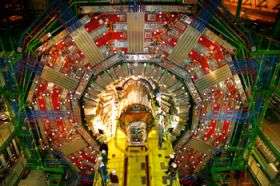
Installation of the world's largest silicon tracking detector in the CMS experiment at CERN.

Installation of the world’s largest silicon tracking detector was today successfully completed at CERN. In the early hours of Thursday 13 December the CMS Silicon Strip Tracking Detector began its journey from the main CERN site to the CMS experimental facility. Later that day it was lowered 90 metres into the CMS cavern. Installation began on Saturday 15 December and was concluded this morning.

“This achievement completes the installation of sub-detectors inside the CMS magnet, which was lowered into the cavern on 28 February,” said CMS technical coordinator Austin Ball. “It’s a big milestone for us.”

With a total surface area of 205 square metres, about the same as a singles tennis court, the CMS Silicon Strip Tracking Detector is by far the largest semiconductor silicon detector ever constructed. Its silicon sensors are patterned to provide a total of 10 million individual sensing strips, each of which is read out by one of 80,000 custom designed microelectronics chips. Data are then transported via 40,000 optical fibres into the CMS data acquisition system.

“The complete system operating at the LHC will produce data at a higher rate than the entire global telephone system,” said project manager Peter Sharp.

The silicon sensors are precision mounted onto 15,200 modules that are in turn mounted onto a very low mass carbon fibre structure that maintains the position of the sensors to less than the diameter of a human hair (100 microns).

“Each of the charged particles produced in LHC particle collisions at the heart of the CMS detector will be tracked with a precision of better than 20 microns,” said Sharp.

Final assembly of the silicon tracking detector began in December 2006 and was completed in March 2007. All of the systems were then fully commissioned, with 20% of the full detector operated over several months during which five million cosmic ray tracks were recorded. The results from these data were then rapidly analyzed using the CMS Grid-based distributed computing system. This commissioning demonstrated that the detector fully meets the experiment’s requirements.

“Constructing a scientific instrument of this size and complexity, designed to operate at the LHC without intervention for more than ten years, is a major engineering and scientific achievement,” said CMS spokesman Tejinder Virdee. “More than five hundred scientists and engineers from fifty-one research institutions world-wide have contributed to the success of the project.”

Institutions involved in the CMS tracker project are located in Austria, Belgium, CERN, Finland, France, Germany, Italy, Switzerland, the United Kingdom and the United States.

CMS is a worldwide collaboration comprising over 2500 scientists and engineers from 180 institutes in 38 countries and regions. These are Armenia, Austria, Belarus, Belgium, Brazil, Bulgaria, China, Colombia, Croatia, Cyprus, Estonia, Finland, France, Georgia, Germany, Greece, Hungary, India, Iran, Ireland, Italy, Korea, Lithuania, Mexico, New Zealand, Pakistan, Poland, Portugal, Russian Federation, Serbia, Spain, Switzerland, Taiwan, Turkey, Ukraine, United Kingdom, United States of America and Uzbekistan.

Source: CERN

4.7 /5 (14 votes)  

Rank 4.7 /5 (14 votes)
Tags

Relevant PhysicsForums posts

More news stories

Fast photon control brings quantum photonic technologies closer

(PhysOrg.com) -- Using photons instead of electrons to transmit information could lead to faster and more secure ways to communicate, among other advantages. Now a team of physicists has taken another step toward realizing ...

Physics / Optics & Photonics

created 8 hours ago | popularity 5 / 5 (4) | comments 0 | with audio podcast feature

Tandem polymer solar cells that set record for energy-conversion

(PhysOrg.com) -- In the effort to convert sunlight into electricity, photovoltaic solar cells that use conductive organic polymers for light absorption and conversion have shown great potential. Organic polymers ...

Physics / Optics & Photonics

created 4 hours ago | popularity 5 / 5 (4) | comments 2 | with audio podcast

Leading the quest to crack cosmological mysteries

Sometimes a scientist can only laugh in the face of a seemingly insurmountable challenge.

Physics / General Physics

created 2 hours ago | popularity 3.8 / 5 (4) | comments 0 | with audio podcast

Researchers make better heat sensor based on butterfly wings

(PhysOrg.com) -- Scientists have long known that butterfly wings produce their iridescent colors by bouncing light around and between tiny ridges in structures made of chitin. More recently they’ve discovered ...

Physics / Optics & Photonics

created 10 hours ago | popularity 5 / 5 (2) | comments 0 | with audio podcast report

Rapunzel, Leonardo and the physics of the ponytail

(PhysOrg.com) -- New research provides the first mathematical understanding of the shape of a ponytail and could have implications for the textile industry, computer animation and personal care products.

Physics / General Physics

created 13 hours ago | popularity 4.4 / 5 (9) | comments 1 | with audio podcast


Plants use circadian rhythms to prepare for battle with insects

In a study of the molecular underpinnings of plants' pest resistance, Rice University biologists have shown that plants both anticipate daytime raids by hungry insects and make sophisticated preparations to ...

Sensing self and non-self: New research into immune tolerance

At the most basic level, the immune system must distinguish self from non-self, that is, it must discriminate between the molecular signatures of invading pathogens (non-self antigens) and cellular constituents that usually ...

Missing dark matter located: Intergalactic space is filled with dark matter

Researchers at the University of Tokyo’s Institute for the Physics and Mathematics of the Universe (IPMU) and Nagoya University used large-scale computer simulations and recent observational data of gravitational ...

Fetal exposure to radiation increases risk of testicular cancer

Male fetuses of mothers that are exposed to radiation during early pregnancy may have an increased chance of developing testicular cancer, according to a study in mice at The University of Texas MD Anderson Cancer Center. ...

Challenges of identifying cognitive abilities in severely brain-injured patients

Only by employing complex machine-learning techniques to decipher repeated advanced brain scans were researchers at NewYork-Presbyterian/Weill Cornell able to provide evidence that a patient with a severe brain injury could, ...

Radiation treatment transforms breast cancer cells into cancer stem cells

Breast cancer stem cells are thought to be the sole source of tumor recurrence and are known to be resistant to radiation therapy and don't respond well to chemotherapy.