Supercomputers offer new explanation of Tunguska disaster
December 18, 2007 Sandia supercomputers offer new explanation of Tunguska disaster

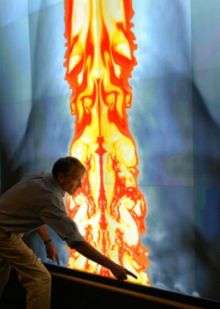
In this supercomputer image, Mark Boslough demonstrates hotpoints of the asteroid fire ball. Credit: Randy Montoya

The stunning amount of forest devastation at Tunguska, a century ago in Siberia, may have been caused by an asteroid only a fraction as large as previously published estimates, Sandia supercomputer simulations suggest.

“The asteroid that caused the extensive damage was much smaller than we had thought,” says Sandia principal investigator Mark Boslough of the impact that occurred June 30, 1908. “That such a small object can do this kind of destruction suggests that smaller asteroids are something to consider. Their smaller size indicates such collisions are not as improbable as we had believed.”

Because smaller asteroids approach Earth statistically more frequently than larger ones, he says, “We should be making more efforts at detecting the smaller ones than we have till now.”

The new simulation — which more closely matches the widely known facts of destruction than earlier models — shows that the center of mass of an asteroid exploding above the ground is transported downward at speeds faster than sound. It takes the form of a high-temperature jet of expanding gas called a fireball.

This causes stronger blast waves and thermal radiation pulses at the surface than would be predicted by an explosion from a point-source at the height where the burst was initiated.

“Our understanding was oversimplified,” says Boslough, “We no longer have to make the same relatively primitive assumptions, because more modern supercomputers allow us to do things with high resolution in 3-D. Everything gets clearer as you look at things with more refined tools.”

The new interpretation also accounts for the fact that winds were amplified above ridgelines where trees tended to be blown down, and that the forest at the time of the explosion, according to foresters, was not healthy. Thus previous scientific estimates had overstated the devastation caused by the asteroid, since topographic and ecologic factors contributing to the result had not been taken into account.

“There’s actually less devastation than previously thought,” says Boslough, “but it was caused by a far smaller asteroid. Unfortunately, it’s not a complete wash in terms of the potential hazard, because there are more smaller asteroids than larger ones.”

Boslough and colleagues achieved fame more than a decade ago by accurately predicting that that the fireball caused by the intersection of the comet Shoemaker-Levy 9 with Jupiter would be observable from Earth.

Simulations show that the material of an incoming asteroid is compressed by the increasing resistance of Earth’s atmosphere. As it penetrates deeper, the more and more resistant atmospheric wall causes it to explode as an airburst that precipitates the downward flow of heated gas.

Because of the additional energy transported toward the surface by the fireball, what scientists had thought to be an explosion between 10 and 20 megatons was more likely only three to five megatons. The physical size of the asteroid, says Boslough, depends upon its speed and whether it is porous or nonporous, icy or waterless, and other material characteristics.

“Any strategy for defense or deflection should take into consideration this revised understanding of the mechanism of explosion,” says Boslough.

One of most prominent papers in estimating frequency of impact was published five years ago in Nature by Sandia researcher Dick Spalding and his colleagues, from satellite data on explosions in atmosphere. “They can count those events and estimate frequencies of arrival through probabilistic arguments,” says Boslough.

The work was presented at the American Geophysical Union meeting in San Francisco on Dec. 11. A paper on the phenomenon, co-authored by Sandia researcher Dave Crawford and entitled “Low–altitude airbursts and the impact threat” has been accepted for publication in the International Journal of Impact Engineering.

Source: Sandia National Laboratories


print this article email this article download pdf blog this article bookmark this article     Stumble it Digg this share on Facebook retweet share on Reddit add to delicious
Rate this story - 4.4 /5 (39 votes)

Rank Filter

Move the slider to adjust rank threshold, so that you can hide some of the comments.


Display comments: newest first

  • barakn - Dec 18, 2007
    • Rank: 4.3 / 5 (6)
    This makes NASA's decision to ignore Congress's mandate to come up with a plan for cataloging even smaller asteroids http://space.news...say.html seem even more short-sighted and ill-advised. Arecibo in particular deserves to retain full funding.
  • ShadowRam - Dec 18, 2007
    • Rank: 1.8 / 5 (5)
    Without a realistic plan to control or destroy said asteroids, what would be the point of tracking them? Early warning system? How accurate do think any current tracking system would be? evacuate entire provinces? Not likely.. Can't stop it, can't predict where it will land to evacuate = Why track it?
  • barakn - Dec 18, 2007
    • Rank: 5 / 5 (5)
    Without a realistic plan to control or destroy said asteroids, what would be the point of tracking them? Early warning system? How accurate do think any current tracking system would be? evacuate entire provinces? Not likely.. Can't stop it, can't predict where it will land to evacuate = Why track it?
    The implication that since there is no plan now there will never be a plan is amusing. However, the discovery of a possible impact would force the creation of a plan. And quite frankly, a smaller asteroid is going to be much easier "to control or destroy" than a large one. We should be tracking the smaller ones because there's a lot more of them, they're more destructive than we thought, and there's a better chance we might be able to do something about them.
  • SDMike - Dec 18, 2007
    • Rank: 4 / 5 (4)
    Oh no! An asteroid might be coming!
    I don't know how to stop it.
    So I'll just ignore it.
    I thought only children thought like that.
    Even if we can't stop it,
    even if we can't predict exactly where it will strike,
    we can prepare for the results.
    Besides, if we know about it we can track it and the closer it gets the more accurate our strike prediction becomes.
  • out7x - Dec 19, 2007
    • Rank: 2.8 / 5 (4)
    Evacuation would be the best defense. Flight path should be able to be accurately tracked. We could even fry it with a laser.
  • mikiwud - Dec 19, 2007
    • Rank: 1 / 5 (3)
    If the Bali Carbon Cap Clowns have their way and destroy the economies of the developed countries we could not afford to do anything anyway.
  • Doug_Huffman - Dec 19, 2007
    • Rank: 5 / 5 (2)
    Conspiracy of ignorance? Right above. Utterly pathetic lack of basic physics - hell, no grip on reality.

    The conspiracy of ignorance masquerades as common sense.
  • flubber - Dec 19, 2007
    • Rank: 1 / 5 (2)
    Hummmm? evacuate the Pacific Rim.
  • gopher65 - Dec 19, 2007
    • Rank: 2 / 5 (1)
    It isn't NASA's fault barakn. Congress has ordered them to do one thing, and the president has ordered them to do something else. They have limited funds and must choose one or the other (because neither Congress nor the President are willing to increase their small chunk of funding).

    Personally I'd rather they just have canned that "return to the moon" crap and done REAL science.
  • nilbud - Dec 30, 2007
    • Rank: not rated yet
    "Personally I'd rather they just have canned that "return to the moon" crap and done REAL science."

    tsk, what an attitude, must be a biologist not a scientist.
  • Kairos - Jul 03, 2008
    • Rank: not rated yet
    it's BS like this that eventually justifies the same weaponry, that can cause such "events," to be used for the "defense" against them. And other various occulted experiments.

    http://www.kairol...spot.com

    It was the Wardenclyffe Tower, folks. The Department of Defense... which now owns the modern version of it (multiplied by 180 towers), called HAARP, was completed by BAE Systems in 2005 and it was rocking and rolling on Katrina and Rita (just examine the public-available HAARP magnetometer readouts for those dates)... would not want people knowing of, let alone understanding the implications of, such powerful devices. Sort of the same reason that wireless was already in motion at the turn of LAST century, but only now do we have cell phones. It takes military declassification to "allow" us those "privelages" due to "national security."

    My argumentation is solid on that above weblog. Dig it.

    Light and Truth,
    Brendan Bombaci

December 18, 2007 all stories

Comments: 11

4.4 /5 (39 votes)
  • Stumble this up

  • Digg this

  • share this

  • hide
  • Related Stories

  • Craters on Vesta and Ceres Could Hold Key to Jupiter's Age
    created Sep 15, 2009 | popularity not rated yet | comments 0
  • Spacecraft Could Save Earth from Asteroids
    created Sep 04, 2009 | popularity not rated yet | comments 0
  • What Hit Jupiter?
    created Aug 03, 2009 | popularity not rated yet | comments 0
  • Crashing comets not likely the cause of Earth's mass extinctions: new research
    created Jul 30, 2009 | popularity not rated yet | comments 0
  • Hubble captures rare Jupiter collision
    created Jul 25, 2009 | popularity not rated yet | comments 0


  • hide
  • Relevant PhysicsForums posts

  • The Origin of the term 'fossil' fuels
    created 12 hours ago
  • co2
    created Nov 03, 2009
  • Early Earths Sulfidic Ocean Conditions
    created Oct 30, 2009
  • vegetation
    created Oct 29, 2009
  • More from Physics Forums - Earth

Other News

Rapid supernova could be new class of exploding star

Rapid supernova could be new class of exploding star

Space & Earth / Astronomy

created 11 hours ago | popularity 4.5 / 5 (11) | comments 2

(PhysOrg.com) -- An unusual supernova rediscovered in seven-year-old data may be the first example of a new type of exploding star, possibly from a binary star system where helium flows from one white dwarf ...


Success in 'space elevator' competition (AP)

Success in 'space elevator' competition (Update 3)

Space & Earth / Space Exploration

created 21 hours ago | popularity 4.3 / 5 (28) | comments 46

(AP) -- A robot powered by a ground-based laser beam climbed a long cable dangling from a helicopter on Wednesday to qualify for prize money in a $2 million competition to test the potential reality of the ...


Space hotel taking bookings for 2012 opening

Space hotel taking bookings for 2012 opening

Space & Earth / Space Exploration

created 15 hours ago | popularity 4.7 / 5 (14) | comments 10

(PhysOrg.com) -- The first orbiting space hotel is on track to open for its first customers in 2012, but hurry, as bookings are filling fast.


Climate Change, Nitrogen Loss Threaten Plant Life in Arid Desert Soils

Climate Change, Nitrogen Loss Threaten Plant Life in Arid Desert Soils

Space & Earth / Environment

created 8 hours ago | popularity 2.3 / 5 (3) | comments 1

(PhysOrg.com) -- In the Mojave Desert winds howl across this hottest place in North America, blowing sands across Death Valley and through empty ghost towns, swirling across treeless land for hundreds of miles. ...


Airborne nitrogen shifts aquatic nutrient limitation in pristine lakes

Airborne nitrogen shifts aquatic nutrient limitation in pristine lakes

Space & Earth / Earth Sciences

created 10 hours ago | popularity 4 / 5 (3) | comments 2

The impact of airborne nitrogen released from the burning of fossil fuels and wide-spread use of fertilizers in agriculture is much greater that previously recognized and even extends to remote alpine lakes, ...