Intergalactic 'shot in the dark' shocks astronomers
December 18, 2007 Intergalactic 'shot in the dark' shocks astronomers

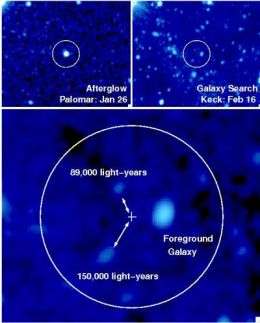
The robotic Palomar 60-inch telescope imaged the afterglow of GRB 070125 on Jan. 26, 2007. RIGHT: An image taken of the same field on February 16 with the 10-meter Keck I telescope reveals no trace of an afterglow, or a host galaxy. The white cross in this zoom-in view marks the GRB's location. The two nearest galaxies, and their distances, are marked with arrows. Credit: B. Cenko, et al.

A team of astronomers has discovered a cosmic explosion that seems to have come from the middle of nowhere — thousands of light-years from the nearest galaxy-sized collection of stars, gas, and dust. This "shot in the dark" is surprising because the type of explosion, a long-duration gamma-ray burst (GRB), is thought to be powered by the death of a massive star.

"Here we have this very bright burst, yet it's surrounded by darkness on all sides," says Brad Cenko of the California Institute of Technology, Pasadena, Calif., lead author of the team’s paper, which has been accepted for publication in The Astrophysical Journal. "The nearest galaxy is more than 88,000 light-years away, and there's almost no gas lying between the burst and Earth."

The blast was detected on January 25, 2007, by several spacecraft of the Inter-Planetary Network. Observations by NASA's Swift satellite pinpointed the explosion, named GRB 070125 for its detection date, to a region of sky in the constellation Gemini. It was one of the brightest bursts of the year, and the Caltech/Penn State team moved quickly to observe the burst’s location with ground-based telescopes.

Using the team's robotic 60-inch telescope at Palomar Observatory in Calif., the astronomers discovered that the burst had a bright and fast-fading afterglow in visible light. This prompted them to observe the afterglow in detail with two of the world's largest telescopes, the 8-meter Gemini North telescope and 10-meter Keck I telescope, both near the summit of Hawaii's Mauna Kea.

What came next was a total surprise. Contrary to experience with more than a hundred previous GRBs, Gemini spectra revealed no signs of dense gas and dust absorbing the light of the afterglow. A trace of magnesium revealed that the burst took place more than 9.4 billion years ago, as deduced by the shift in wavelength of the afterglow’s light, and that the surrounding gas and dust was more tenuous than the environment around any previous burst.

To further pin down the environment that could produce such an unusual explosion, the group obtained Keck images of the location of GRB 070125 long after its afterglow light had faded away. Surprisingly, the resulting images showed no galaxy at this location. "A Keck image could have revealed a very small, faint galaxy at that distance," says coauthor Derek Fox of Penn State.

Astronomers have amassed a great deal of evidence that GRBs are triggered by the explosive deaths of massive stars, which live very short lives. Because of their short lifespans, massive stars don’t have time to wander far from their birthplaces, usually dense clouds of gas and dust inside respectable-size galaxies. So GRB 070125 raises the perplexing question of how a massive star could be found so far away from any galaxy.

"Big stars live fast and die young, without much time to move around," says Fox. "So if this massive star died far away from any galaxy, the key question is, how did it manage to be born there?" The formation of massive stars requires similarly massive aggregations of gas and dust, which are usually found in bright galaxies.

One possibility is that the star formed in the outskirts of an interacting galaxy, as seen in the famous Hubble Space Telescope picture of the "Tadpole" galaxy, UGC 10214. "In the local universe, about one percent of star formation happens in tidal tails, on the outskirts of two interacting galaxies," says Cenko. "So it might even make sense to find one in 100 gamma-ray bursts in such an environment."

If this idea is correct, it should be possible to detect the tidal tail hosting GRB 070125 by taking a long exposure with the Hubble Space Telescope. "That's definitely our next stop," says Cenko.

"Many Swift discoveries have left astronomers scratching their heads in befuddlement," adds Swift lead scientist Neil Gehrels of NASA Goddard Space Flight Center in Greenbelt, Md. "But this discovery of a long GRB with no host galaxy is one of the most perplexing of all."

Source: Goddard Space Flight Center


print this article email this article download pdf blog this article bookmark this article     Stumble it Digg this share on Facebook retweet share on Reddit add to delicious
Rate this story - 4.6 /5 (43 votes)

Rank Filter

Move the slider to adjust rank threshold, so that you can hide some of the comments.


Display comments: newest first

  • MrGrynch - Dec 18, 2007
    • Rank: 2.5 / 5 (6)
    According to plasma cosmology, the universe is pervaded by an intertwined web of Birkeland currents. These currents are normally invisible, and are detectable only by their magnetic tell-tales.

    Occasionally, the plasma double layers which separate different charge potentials explode, releasing large amounts of energy. There is no requirement to actually have a star at the location of the explosion in this scenario. The only thing needed is an instability insulating walls of the Birkeland currents. The location of this explosion is likely the nexus of several current strands.
  • LearmSceince - Dec 18, 2007
    • Rank: 4 / 5 (6)
    According to plasma cosmology,...

    Yea.

    Or, it could be a hyperspace ship re-entering regular space after suffering an engine-blowout at speed.

    Or it could be the "ultimate doomsday weapon" that destroyed the entire galaxy, so naturally we don't see one when looking =after= the event.

  • mattytheory - Dec 18, 2007
    • Rank: 2.4 / 5 (5)
    I think that it was a binary system that was somehow sling-shotted from its parent galaxy and the GRB we are seeing is the final death-throes of the stars in this binary system merging to form a black-hole.

    Any thoughts?
  • brant - Dec 18, 2007
    • Rank: 2.6 / 5 (5)
    "Astronomers have amassed a great deal of evidence that GRBs are triggered by the explosive deaths of massive stars, which live very short lives."

    That is the interpretation. And it does not seem to be true.

    We see that their "evidence" does not mean what they thought.
    "Polarization in Gamma-Ray Bursts Produced by Pinch Discharge"
    http://adsabs.har....5...57W&db_key=AST&data_type=HTML&format=&high=42ca922c9c03905
  • seanpu - Dec 09, 2008
    • Rank: not rated yet

    Yea.

    Or, it could be a hyperspace ship re-entering regular space after suffering an engine-blowout at speed.

    Or it could be the "ultimate doomsday weapon" that destroyed the entire galaxy, so naturally we don't see one when looking =after= the event.


    Or maybe a blackhole banished from its host galaxy for insulting the elders found an unsuspecting cloud of gas on which to take its revenge and gobbled it up for dinner one evening whilst pondering how to create its own galaxy to rival his new nemesis.

    Get a grip LS, the New Scientific Revolution is coming, no more epicycles, infinite densities, magnetic field ghosts without their charges and star sized billiard-ball physics.


December 18, 2007 all stories

Comments: 5

4.6 /5 (43 votes)
  • Stumble this up

  • Digg this

  • share this

  • hide
  • Related Stories

  • Hubble Image Showcases Star Birth in M83, the Southern Pinwheel
    created Nov 05, 2009 | popularity not rated yet | comments 0
  • Stars Fueled by Dark Matter Could Hold Secrets to the Universe
    created Nov 03, 2009 | popularity not rated yet | comments 0
  • Fermi Telescope Detects Gamma-Ray From 'Star Factories' in Other Galaxies
    created Nov 02, 2009 | popularity not rated yet | comments 0
  • Starburst galaxy sheds light on longstanding cosmic mystery
    created Nov 02, 2009 | popularity not rated yet | comments 0
  • Dark Matter in a Galaxy
    created Oct 30, 2009 | popularity not rated yet | comments 0


  • hide
  • Relevant PhysicsForums posts

  • The shape of our solar system's orbits.
    created 21 hours ago
  • Above or Below the Line of Nodes
    created Nov 07, 2009
  • Supernova vs. Nova?
    created Nov 07, 2009
  • Supernova's Gamma Rays and Comets
    created Nov 06, 2009
  • More from Physics Forums - General Astronomy

Other News

Deep creep means milder, more frequent earthquakes along Southern California's San Jacinto fault

Deep creep means milder, more frequent earthquakes along Southern California's San Jacinto fault

Space & Earth / Earth Sciences

created 7 hours ago | popularity 4.7 / 5 (3) | comments 0

With an average of four mini-earthquakes per day, Southern California's San Jacinto fault constantly adjusts to make it a less likely candidate for a major earthquake than its quiet neighbor to the east, the ...


Success in 'space elevator' competition (AP)

Success in 'space elevator' competition (Update 3)

Space & Earth / Space Exploration

created Nov 05, 2009 | popularity 4.3 / 5 (33) | comments 50

(AP) -- A robot powered by a ground-based laser beam climbed a long cable dangling from a helicopter on Wednesday to qualify for prize money in a $2 million competition to test the potential reality of the ...


In a Galaxy Far, Far Away...

In a Galaxy Far, Far Away...

Space & Earth / Astronomy

created Nov 06, 2009 | popularity 4.8 / 5 (5) | comments 15

(PhysOrg.com) -- Astronomers have published the discovery of the farthest known object in the cosmos: a star that exploded when the universe was only 630 million years old -- only 4.6% of its current age. ...


'Dropouts' pinpoint earliest galaxies

'Dropouts' pinpoint earliest galaxies

Space & Earth / Astronomy

created Nov 06, 2009 | popularity 4.2 / 5 (10) | comments 13

Astronomers, conducting the broadest survey to date of galaxies from about 800 million years after the Big Bang, have found 22 early galaxies and confirmed the age of one by its characteristic hydrogen signature ...


Space hotel taking bookings for 2012 opening

Space hotel taking bookings for 2012 opening

Space & Earth / Space Exploration

created Nov 05, 2009 | popularity 4.4 / 5 (20) | comments 11

(PhysOrg.com) -- The first orbiting space hotel is on track to open for its first customers in 2012, but hurry, as bookings are filling fast.