Explosives on a chip
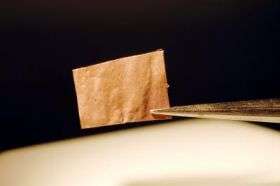
Tiny copper structures with pores at both the nanometer and micron size scales could play a key role in the next generation of detonators used to improve the reliability, reduce the size and lower the cost of certain military munitions.
Developed by a team of scientists from the Georgia Tech Research Institute (GTRI) and the Indian Head Division of the Naval Surface Warfare Center, the highly-uniform copper structures will be incorporated into integrated circuits – then chemically converted to millimeter-diameter explosives. Because they can be integrated into standard microelectronics fabrication processes, the copper materials will enable micro-electromechanical (MEMS) fuzes for military munitions to be mass-produced like computer chips.
“An ability to tailor the porosity and structural integrity of the explosive precursor material is a combination we’ve never had before,” said Jason Nadler, a GTRI research engineer. “We can start with the Navy’s requirements for the material and design structures that are able to meet those requirements. We can have an integrated design tool able to develop a whole range of explosive precursors on different size scales.”
Nadler uses a variety of templates, including microspheres and woven fabrics, to create regular patterns in copper oxide paste whose viscosity is controlled by the addition of polymers. He then thermochemically removes the template and converts the resulting copper oxide structures to pure metal, retaining the patterns imparted by the template. The size of the pores can be controlled by using different templates and by varying the processing conditions.
So far, he’s made copper structures with channel sizes as small as a few microns – with structural components that have nanoscale pores.
Based on feedback from the Navy scientists, Nadler can tweak the structures to help optimize the overall device – known as a fuze – which controls when and where a munition will explode.
“We are now able to link structural characteristics to performance,” Nadler noted. “We can produce a technically advanced material that can be tailored to the thermodynamics and kinetics that are needed using modeling techniques.”
Beyond the fabrication techniques, Nadler developed characterization and modeling techniques to help understand and control the fabrication process for the unique copper structures, which may also have commercial applications.
The copper precursor developed in GTRI is a significant improvement over the copper foam material that Indian Head had previously been evaluating. Produced with a sintered powder process, the foam was fragile and non-uniform, meaning Navy scientists couldn’t precisely predict reliability or how much explosive would be created in each micro-detonator.
“GTRI has been able to provide us with material that has well-controlled and well-known characteristics,” said Michael Beggans, a scientist in the Energetics Technology Department of the Indian Head Division of the Naval Surface Warfare Center. “Having this material allows us to determine the amount of explosive that can be formed in the MEMS fuze. The size of that charge also determines the size and operation of the other components.”
The research will lead to a detonator with enhanced capabilities. “The long-term goal of the MEMS Fuze program is to produce a low-cost, highly-reliable detonator with built-in safe and arm capabilities in an extremely small package that would allow the smallest weapons in the Navy to be as safe and reliable as the largest,” Beggans explained.
Reducing the size of the fuze is part of a long-term strategy toward smarter weapons intended to reduce the risk of collateral damage. That will be possible, in part, because hundreds of fuzes, each about a centimeter square, can be fabricated simultaneously using techniques developed by the microelectronics industry.
“Today, everything is becoming smaller, consuming less power and offering more functionality,” Beggans added. “When you hear that a weapon is ‘smart,’ it’s really all about the fuze. The fuze is ‘smart’ in that it knows the exact environment that the weapon needs to be in, and detonates it at the right time. The MEMS fuze would provide ‘smart’ functionality in medium-caliber and sub-munitions, improving results and reducing collateral damage.”
Development and implementation of the new fuze will also have environmental and safety benefits.
“Practical implementation of this technology will enable the military to reduce the quantity of sensitive primary explosives in each weapon by at least two orders of magnitude,” said Gerald R. Laib, senior explosives applications scientist at Indian Head and inventor of the MEMS Fuze concept. “This development will also vastly reduce the use of toxic heavy metals and waste products, and increase the safety of weapon production by removing the need for handling bulk quantities of sensitive primary explosives.”
The next step will be for Indian Head to integrate all the components of the fuze into the smallest possible package – and then begin producing the device in large quantities.
A specialist in metallic and ceramic cellular materials, Nadler said the challenge of the project was creating structures porous enough to be chemically converted in a consistent way – while retaining sufficient mechanical strength to withstand processing and remain stable in finished devices.
“The ability to design things on multiple size scales at the same time is very important,” he added. “Designing materials on the nano-scale, micron-scale and even the millimeter-scale simultaneously as a system is very powerful and challenging. When these different length scales are available, a whole new world of capabilities opens up.”
Source: Georgia Institute of Technology


