Researchers develop foundation for electronics based on graphite
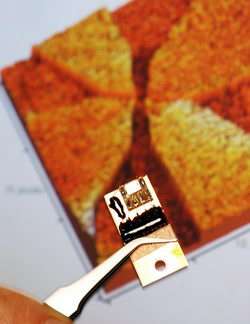
Graphite, the material that gives pencils their marking ability, could be the basis for a new class of nanometer-scale electronic devices that have the attractive properties of carbon nanotubes – but could be produced using established microelectronics manufacturing techniques.
Using thin layers of graphite known as graphene, researchers at the Georgia Institute of Technology in the United States, in collaboration with the Centre National de la Recherche Scientifique (CNRS) in France, have produced proof-of-principle transistors, loop devices and circuitry. Ultimately, the researchers hope to use graphene layers less than 10 atoms thick as the basis for revolutionary electronic systems that would manipulate electrons as waves rather than particles, much like photonic systems control light waves.
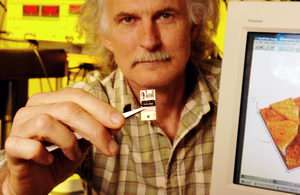
"We expect to make devices of a kind that don't really have an analog in silicon-based electronics, so this is an entirely different way of looking at electronics," said Walt de Heer, a professor in Georgia Tech's School of Physics. "Our ultimate goal is integrated electronic structures that work on diffraction of electrons rather than diffusion of electrons. This will allow the production of very small devices with very high efficiencies and low power consumption."
Supported by the U.S. National Science Foundation and the Intel Corporation, the work was described March 13th at the March Meeting of the American Physical Society. Details of fabrication techniques have been reported in the Journal of Physical Chemistry.
Because carbon nanotubes conduct electricity with virtually no resistance, they have attracted strong interest for use in transistors and other devices. However, serious obstacles must be overcome before nanotube-based devices could be scaled up into high-volume industrial products, including:
-- An inability to produce nanotubes of consistent sizes and consistent electronic properties,
-- Difficulty integrating nanotubes into electronic devices using processes suitable for volume production, and
-- High electrical resistance that produces heating and energy loss at junctions between nanotubes and the metal wires connecting them.
De Heer, who helped discover many properties of carbon nanotubes over the past decade, believes their primary value has been in calling attention to the useful properties of graphene. Continuous graphene circuitry can be produced using standard microelectronic processing techniques, potentially allowing creation of a "road map" for high-volume graphene electronics manufacturing, he said.
"Nanotubes are simply graphene that has been rolled into a cylindrical shape," de Heer explained. "Using narrow ribbons of graphene, we can get all the properties of nanotubes because those properties are due to the graphene and the confinement of the electrons, not the nanotube structures."
De Heer envisions using the graphene electronics for specialized applications, potentially within conventional silicon-based systems. Graphene systems could also be used as the foundation for molecular electronics, helping resolve resistance issues that now affect such systems.
"There is a huge advantage to making a system out of one continuous material, compared to having different materials with different interfaces – and large contract resistances to cause heating at the contacts," he said.
De Heer and collaborators Claire Berger, Nate Brown, Edward Conrad, Zhenting Dai, Rui Feng, Phillip First, Joanna Hass, Tianbo Li, Xuebin Li, Alexei Marchenkov, James Meindl, Asmerom Ogbazghi, Thomas Orlando, Zhimin Song, Xiaosong Wu of Georgia Tech and Didier Mayou and Cecile Naud of CNRS start with a wafer of silicon carbide, a material made up of silicon and carbon atoms. By heating the wafer in a high vacuum, they drive silicon atoms from the surface, leaving a thin continuous layer of graphene.
Next, they spin-coat onto the surface a photo-resist material of the kind used in established microelectronics techniques. Using optical lithography or electron-beam lithography, they produce patterns on the surface, then use conventional etching processes to remove unwanted graphene.
"We are doing lithography, which is completely familiar to those who work in microelectronics," said de Heer. "It's exactly what is done in microelectronics, but with a different material. That is the appeal of this process."
Using electron beam lithography, they've created feature sizes as small as 80 nanometers – on the way toward a goal of 10 nanometers with the help of a new nanolithographer in Georgia Tech's Microelectronics Research Center.
The graphene circuitry demonstrates high electron mobility – up to 25,000 square centimeters per volt-second, showing that electrons move with little scattering. The researchers have also shown electronic coherence at near room temperature, and evidence of quantum interference effects. They expect to see ballistic transport when they make structures small enough.
So far, they have built an all graphene planar field-effect transistor. The side-gated device produces a change in resistance through its channel when voltage is applied to the gate. However, this first device has a substantial current leak, which the team expects to eliminate with minor processing adjustments.
The researchers have also built a working quantum interference device, a ring-shaped structure that would be useful in manipulating electronic waves.
The key to properties of the new circuitry is the width of the ribbons, which confine the electrons in a quantum effect similar to that seen in carbon nanotubes. The width of the ribbon controls the material's band-gap. Other structures, such as sensing molecules, could be attached to the edges of the ribbons, which are normally passivated by hydrogen atoms.
De Heer and collaborators began working on graphene in 2001 and received support from Intel in 2003. They later received a Nanoscale Interdisciplinary Research Team (NIRT) award from the U.S. National Science Foundation. They have filed one patent for their methods of fabricating graphene circuitry.
De Heer and his colleagues expect to continue improving their materials and fabrication processes, while producing and testing new structures. "We have taken the first step of a very long road," de Heer said. "Building a new class of electronics based on graphene is going to be very difficult and require the efforts of many people."
Source: Georgia Institute of Technology


