Holiday giving season complicated by shifting norms on gratuities, psychologist suggests
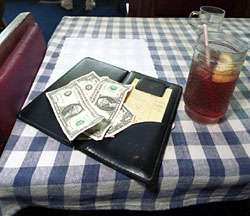
With the holiday season upon us, Americans are grappling more than ever with what's appropriate when it comes to rewarding service providers with tips, gifts and other token gratuities, suggests Leonard Green, a psychology professor in Arts & Sciences who studies tipping behavior at Washington University in St. Louis.
"Tipping is, to a large extent, a cultural phenomenon, but cultural norms can change rapidly," Green says. "We're seeing tip jars springing up in all sorts of new places. At the same time, some high-end restaurants are banning tips altogether in favor of a mandatory service charge. If these new approaches to tipping work well, we'll start to see them more and more. They'll quickly become the new norm."
In recent research, Green and colleagues compiled data from nearly 1,000 tips left in restaurants, hair salons and with cab drivers. Their analysis determined that the larger the bill, the smaller the tip percentage that food servers, hair stylists and cab drivers receive. Their findings indicate that the percent of the tip actually decreases with the amount of the bill across all three tipping situations.
The researchers also found that with bills more than $100, the percent of the tip levels off — if the bill is $200, the server is likely to receive about the same percentage of tip as if the bill was $100.
Green, a specialist in behavioral economics, studies tipping because it provides a good model for understanding economic and psychological decision-making.
While his research sheds light on how much we're likely to tip in certain situations, much less is known about why we tip in the first place.
"Some theories suggest that we tip because it's a norm of our society and that we feel as though we have to do it. Others suggest that we tip to reward good service and to increase the odds of better service in the future. And, some just see it as an issue of fairness. We don't want to be seen as a free-rider."
Cultural expectations clearly have an impact on tipping behaviors, says Green, noting that tipping is not expected in many European countries, and that even in America, we don't tip for services in most department stores or fast food restaurants. Changes in technology and service delivery systems, he adds, may be spurring subtle shifts in traditional tipping norms.
"It was easier to justify tipping the paper boy when some neighborhood kid brought the paper to your door and accepted your payment," Green suggests.
"We're probably less inclined to tip for newspaper delivery if we're sending a check to some company and someone you've never met drives by and throws the paper on your doorstep. That's why we sometimes see the newspaper delivery service tucking a nice note and a little self-addressed envelope in the paper just before the holidays. They're looking for some way to encourage the tradition of tipping for newspaper delivery."
He sees a general increase in the pressure to tip, especially during the holidays, and a growing sense, that some people now consider tipping to be more of an entitlement, more of an obligation regardless of the quality of service rendered. "It has been said that Woody Allen once suggested that much of success in life is due to just showing up, and I believe a lot of service providers now have a similar attitude about tipping -- that they deserve a tip just for being there."
Green, who comes from New York, says he has lots of friends back home who spent hours anguishing over how to distribute their holiday tipping budget -- how much to give and to whom?
"I think the decision often comes down to how much control the person really has over your life," Green says. "When it comes down to it, getting your newspaper every day is not that important. But, if there's no heat in your apartment, who do you contact for help. If someone, like a building superintendent, provides essential services, then a person might think that a nice tip helps ensure that the service will be there the next time you need it. Some people tip because they don't want to take the risk that not tipping may cause someone to hold back on an essential service. A holiday tip might not get you better service, but it may reduce the chances of getting worse service."
Green's research does offer a somewhat counterintuitive "tip" for food servers: Encourage separate checks at large tables to get a bigger tip.
For example, let's say you had a bill of $10 and left a tip of $2, or 20 percent. The next week you're at a trendy restaurant and dinner for two is $80. You leave a tip of $12, or 15 percent. The relative value of what is considered an appropriate tip has been influenced by the absolute amounts involved.
"The magnitude effect as seen in our study would suggest that, for a table of six, and a bill of $25 a person, a single bill of $150 would give the server a smaller percentage tip than six individual bills of $25 each," Green said. "For the server, it pays to give individual bills."
Source: Washington University in St. Louis


