Nanorods show benefits cancer treatment
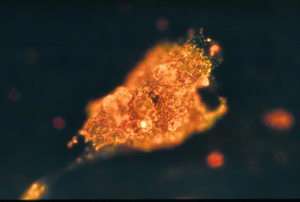
Researchers at the Georgia Institute of Technology and the University of California, San Francisco, have found an even more effective and safer way to detect and kill cancer cells. By changing the shapes of gold nanospheres into cylindrical gold nanorods, they can detect malignant tumors hidden deeper under the skin, like breast cancer, and selectively destroy them with lasers only half as powerful as before – without harming the healthy cells. The method, which allows for a safer, deeper penetrating noninvasive cancer treatment, has just appeared in the Journal of the American Chemical Society.
Last year, the father and son research team of Mostafa El-Sayed and Ivan El-Sayed, showed that gold nanoparticles coated with a cancer antibody were very effective at binding to tumor cells. When bound to the gold, the cancer cells scattered light, making it very easy to identify the noncancerous cells from the malignant ones. The nanoparticles also absorbed the laser light more easily, so that the coated malignant cells only required half the laser energy to be killed compared to the benign cells. This makes it relatively easy to ensure that only the malignant cells are being destroyed.
Now, they've discovered that by changing the spheres into rods, they can lower the frequency to which the nanoparticles respond from the visible light spectrum used by the nanospheres to the near-infrared spectrum. Since these lasers can penetrate deeper under the skin than lasers in the visible spectrum, they can reach tumors that are inaccessible to visible lasers.
"With the nanospheres we're using visible lasers, but most of the solid cancer is under the tissues and visible light doesn't go but a few millimeters deep. But by using the nanorods we can tune them to react to the infrared lasers, which can penetrate the tumor without being absorbed by the tissues," said Mostafa El-Sayed, director of the Laser Dyanamics Laboratory and Regents' professor of chemistry at Georgia Tech.
Many cancer cells have a protein, known as Epidermal Growth Factor Receptor (EFGR), all over their surface, while healthy cells typically do not express the protein as strongly. By conjugating, or binding, the gold nanorods to an antibody for EFGR, suitably named anti-EFGR, researchers were able to get the nanoparticles to attach themselves to the cancer cells.
In this latest study, researchers incubated two malignant oral epithelial cell lines and one benign epithelial cell lines with nanorods conjugated to anti-EFGR. Not only were the malignant lines clearly identifiable as such under a simple optical microscope, but after being exposed to a continuous sapphire laser in the near infrared spectrum, the malignant lines only required half the laser energy to kill them as the healthy cells.
"This makes it more practical than the sphere in terms of treating cancer," said Mostafa El-Sayed. "For laser phototherapy treatment of skin cancer or, for diagnostic biopsies, the spheres are fine, but for phototherapy of cancer deep under the skin, like breast cancer, then one really needs to use the nanorods treatment."
Source: Georgia Institute of Technology


