Traffic jam mystery solved by mathematicians
December 19, 2007
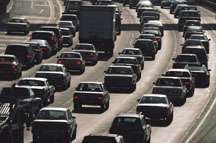
Mathematicians from the University of Exeter have solved the mystery of traffic jams by developing a model to show how major delays occur on our roads, with no apparent cause. Many traffic jams leave drivers baffled as they finally reach the end of a tail-back to find no visible cause for their delay.
Now, a team of mathematicians from the Universities of Exeter, Bristol and Budapest, have found the answer and published their findings in leading academic journal Proceedings of the Royal Society.
The team developed a mathematical model to show the impact of unexpected events such as a lorry pulling out of its lane on a dual carriageway. Their model revealed that slowing down below a critical speed when reacting to such an event, a driver would force the car behind to slow down further and the next car back to reduce its speed further still.
The result of this is that several miles back, cars would finally grind to a halt, with drivers oblivious to the reason for their delay. The model predicts that this is a very typical scenario on a busy highway (above 15 vehicles per km). The jam moves backwards through the traffic creating a so-called ‘backward travelling wave’, which drivers may encounter many miles upstream, several minutes after it was triggered.
Dr Gábor Orosz of the University of Exeter said: “As many of us prepare to travel long distances to see family and friends over Christmas, we’re likely to experience the frustration of getting stuck in a traffic jam that seems to have no cause. Our model shows that overreaction of a single driver can have enormous impact on the rest of the traffic, leading to massive delays.”
Drivers and policy-makers have not previously known why jams like this occur, though many have put it down to the sheer volume of traffic. While this clearly plays a part in this new theory, the main issue is around the smoothness of traffic flow. According to the model, heavy traffic will not automatically lead to congestion but can be smooth-flowing. This model takes into account the time-delay in drivers’ reactions, which lead to drivers braking more heavily than would have been necessary had they identified and reacted to a problem ahead a second earlier.
Dr Orosz continued: “When you tap your brake, the traffic may come to a full stand-still several miles behind you. It really matters how hard you brake - a slight braking from a driver who has identified a problem early will allow the traffic flow to remain smooth. Heavier braking, usually caused by a driver reacting late to a problem, can affect traffic flow for many miles.”
The research team now plans to develop a model for cars equipped with new electronic devices, which could cut down on over-braking as a result of slow reactions.
Source: University of Exeter


http://www.math.u...pet.html
Looks like the Univ of Exeter experienced their own delays of sort...
As mentioned, sensors that prevent drivers from approaching within a certain distance of another vehicle would make a big difference. And with adequate sensor / artificial driver technology, stop lights/signs could be made obsolete by the fact you could have traffic weave between each other at intersections.
Don't even get me started on people who can't figure out how to merge.
This was always obviously a buffer between cars problem.. this is new to people??? What kind of world are we living in? FFS...
The content is inaccurate. The title misleading.
A poor showing for a Web site that purports to maintain high scientific standards.
I remember stop and go driving for miles on a freeway in a 70mph zone, and the discovery that it was all caused by an old pickup traveling 35mph in the left (passing) lane. But I've never seen police enforcement of driving violations that contribute to traffic congestion!
What I'd like to see analyzed next is how rude lane behavior that leads to unnecessary speed changes contributes to lower fuel economy as well as congestion.
Taking that in to account, such jams caused by these stopping "waves" could occur at any time given any number of vehicles on the road. Of course, it's less likely to occur with fewer vehicles and I would assume there is some average reaction time given a certain number of cars on the road.
Additionally, awareness alone will not solve this problem. People are simply too stupid. What interests me is applying this model to on board electronics such as distance sensors and automatic cruise control and GPS.
Now that would be a breakthrough. Of course, nobody will be driving for themselves anymore.
Perhaps we should all take trains :)
To say people just don't leave enough space is not enough off an answer. Or to say that some people simply react slowly. It's definately a complex combination and electronic traffic control devices will not solve the problem. Never mind the fact that many will be hacked or disabled (and it only takes a single driver to cause such an event), they would not account for many traffic situations such as lateral incidents - a tire blow out causing a vehicle to swerve into another lane. Yes this is an accident and not normal traffic, but consider during an accident how these distance control devices would actually make the situation WORSE potentially bringing traffic to a complete stop.
The likely problem is the design on highway systems especially for large cities where ALL ROADS LEAD IN. Can we say "GRIDLOCK".
Truckers drive over 120,000 miles per year compared to the 10,000-15,000 miles per year that autos do. That's a heck of a lot more experience which is where the traffic knowledge comes from.
But hey, if you need a formula to figure it out...
If this stuff was taught in school, traffic would be dramatically improved!:
Common Sense Driving Code:
http://www.blogwe...comments&member=trafficguru&newsid=2526
use this one:
Common Sense Driving Code:
http://www.blogwe...fficguru
Way back in 1985, in my second year of CS, a couple of other students and I, created such a model as part of a Simula67 programming course. The conclusions where exactly the same as these Exeter folks.
So what's the big deal? This is really basic stuff. Getting moronic politicians and civil servants to understand this, and act accordingly, is a totally different ballgame though!
The first part stems froms idiots--especially here in the US--that don't understand the concept of a "passing lane" and use any ol' available lane for travel.
Or, worse still are those that obliviously stagger their cars adjacent vehicles in adjacent lanes so that no passing is possible.
Worse yet are those that drive in the "passing lane." There is absolutely, positively no excuse for driving a continued distance in the passing lane. Ever.
Hop into the passing lane. Pass slower vehicles and get the heck back out.
The worst of all is when you get both someone driving in the passing lane AND another knucklehead in the adjacent lane staggered too closely to the vehicle in the passing lane so that no one can pass.
Finally, when no one can move by the two blocking cars, cars _end up_ having to brake as drivers weave in and out and jockey to try to get around the now massively bunched up cluster of cars, many of which are in incorrect lanes, exacerbating things further.
THIS, my friends, is what *causes* traffic jams!
If only people would realize the effect of their incorrect lane selection, traffic jams would all but evaporate.
Alas, I am not too hopeful of changing the driving habits of millions of people.
It's amazing that so many are criticising the study, but don't understand traffic themselves. Many are saying that the solution is to increase the distance to the car ahead. However, this will likely bring the traffic to a crawl on congested motorways. How do people not understand this?
people at the fed--and they need to farm this
math to mathematician/economist teams who
can build this into their models.
The short of the long, is "Give them Three, Save a Life" Save a lifetime of stop and go traffic and don't worry about the person dicing in front of you, worry about all the ones behind you as that little bit of space means more to them than it does to you.
If only Transportation Policy included Public Relations and Driver Training and Awareness.
http://en.wikiped...i/Phonon
Also, it may take up more space on a freeway, but since the speed of the cars actually ON the freeway would be greatly increased it would probably more than offset the density of cars achieved in stop and go traffic.
but its also illigal, yet verry effective!!