Parents show bias in sibling rivalry, says study
Most parents would hotly deny favouring one child over another but new research suggests they may have little choice in the matter.
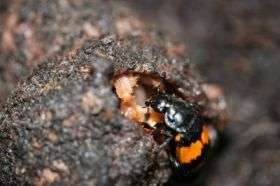
Biologists studying a unique species of beetle that raises and cares for its young have found that parents instinctively favour the oldest offspring.
The University of Manchester research – published in Ecology this month – supports the findings of studies carried out on human families but is significant in that it suggests a wholly natural tendency towards older siblings.
“The burying beetle Nicrophorus vespilloides has a similar family structure to that of a human family unit in that there are two parents, a number of offspring and interactions between parents and their young,” said Dr Per Smiseth, who led the research in the University’s Faculty of Life Sciences.
“Of course human families are more complex and parent-child relationships are much more sophisticated. However, studying this beetle can help us understand the basic biological principles of how family relationships work.
“Our study looked at how the parent beetles mediate competition between different aged offspring compared to what happens when the young were left to fend for themselves and indicates that parental decisions are important in determining the outcome of competition between offspring.”
The beetles, which are native to Britain, give birth to a batch of about 20 young in the carcass of a dead animal over a period of 30 hours. The parents feed the young grubs on regurgitated flesh from the carcass.
The young beetles are able to feed themselves but they grow more quickly and become larger when fed by their parents. By generating experimental broods comprising two sets of offspring, one set of older grubs and one younger set, the scientists were able to study their development, first with the parents present and then when left to fend for themselves.
“When both sets of grubs were left to fend for themselves they grew at the same rate and matured to an equal size,” said Dr Smiseth, whose research is funded by the Natural Environment Research Council and the Medical Research Council.
“However, when we allow the parents to remain with the offspring, there is clear favouritism towards the older siblings, which grow at a faster rate as they take the lion’s share of their parents’ offerings.”
The team believes there are two explanations for the behaviour: the first is that the parents attach more value to the older offspring as their maturity gives them a better chance of survival than their younger siblings.
The second explanation is that the older grubs, being stronger, are able to dominate their younger rivals and, in doing so, better attract the attention of the parents when begging for food.
“Even if this second theory is true, the parents are still complicit in the bias towards the older siblings,” said Dr Smiseth. “However, the true answer is probably some combination of the two explanations.
“The research tells us something about the relationships within families. We have this view that families are harmonious and that the overriding concern is to help one another. This is true to an extent but it’s not to say that families are not without conflict, especially if the resources cannot be divided equitably.”
Source: University of Manchester


