Squirrels use snake scent
December 19, 2007
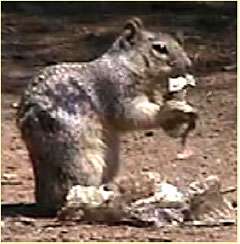
Squirrels use shed snake skins to mask their scent from predators, a UC Davis researcher has found. (Barbara Clucas/UC Davis photo)
California ground squirrels and rock squirrels chew up rattlesnake skin and smear it on their fur to mask their scent from predators, according to a new study by researchers at UC Davis.
Barbara Clucas, a graduate student in animal behavior at UC Davis, observed ground squirrels (Spermophilus beecheyi) and rock squirrels (Spermophilus variegates) applying snake scent to themselves by picking up pieces of shed snakeskin, chewing it and then licking their fur.
Adult female squirrels and juveniles apply snake scent more often than adult males, which are less vulnerable to predation by snakes, Clucas said. The scent probably helps to mask the squirrel's own scent, especially when the animals are asleep in their burrows at night, or to persuade a snake that another snake is in the burrow.
The squirrels are not limited to the use of shed snake skins, said Donald Owings, a professor of psychology at UC Davis who is Clucas' adviser and an author on the paper. They also pick up snake odor from soil and other surfaces on which snakes have been resting, and use that to apply scent. Other rodents have been observed using similar behavior.
Snake-scent application is one of a remarkable package of defenses that squirrels use against rattlesnakes, Owings said. In earlier work, Owings' lab has found that squirrels can: heat up their tails to send a warning signal to rattlesnakes, which can "see" in the infrared; assess how dangerous a particular snake is, based on the sound of its rattle; and display assertive behavior against snakes to deter attacks. In addition, work by Owings' colleague, psychology professor Richard Coss, has demonstrated that these squirrels have evolved resistance to snake venom.
"It's a nice example of the opportunism of animals," Owings said. "They're turning the tables on the snake."
The other authors on the paper, which was published Nov. 28 in the journal Animal Behavior, are Matthew Rowe, Sam Houston State University, Texas, and Patricia Arrowood at New Mexico State University.
Source: University of California - Davis
-
Engineers build first sub-10-nm carbon nanotube transistor
Feb 01, 2012 |
4.9 / 5 (33) |
30
-
Something old, something new: Evolution and the structural divergence of duplicate genes
Jan 31, 2012 |
4.6 / 5 (7) |
1
-
The hidden nanoworld of ice crystals: Revealing the dynamic behavior of quasi-liquid layers
Jan 30, 2012 |
5 / 5 (4) |
1
-
Stock market network reveals investor clustering
Jan 27, 2012 |
3.9 / 5 (23) |
8
-
Of microchemistry and molecules: Electronic microfluidic device synthesizes biocompatible probes
Jan 26, 2012 |
5 / 5 (2) |
0
More news stories
A mitosis mystery solved: How chromosomes align perfectly in a dividing cell
Although the process of mitotic cell division has been studied intensely for more than 50 years, Whitehead Institute researchers have only now solved the mystery of how cells correctly align their chromosomes during symmetric ...
11 hours ago |
4.3 / 5 (17) |
0
|
Researchers find extensive RNA editing in human transcriptome
In a new study published online in Nature Biotechnology, researchers from BGI, the world's largest genomics organization, reported the evidence of extensive RNA editing in a human cell line by analysis of RNA-seq data, demons ...
10 hours ago |
5 / 5 (4) |
0
|
The proteins ensuring genome protection
Researchers from the University of Geneva (UNIGE), Switzerland, have discovered the crucial role of two proteins in developing a cell 'anti-enzyme shield'. This protection system, which operates at the level of molecular ...
11 hours ago |
5 / 5 (3) |
0
|
Entire genome of extinct human decoded from fossil
(PhysOrg.com) -- In 2010, Svante Pääbo and his colleagues presented a draft version of the genome from a small fragment of a human finger bone discovered in Denisova Cave in southern Siberia. The ...
Feb 07, 2012 |
4.7 / 5 (60) |
51
|
Why are there so few fish in the Earth's oceans?
(PhysOrg.com) -- A Stony Brook University researcher has found that, contrary to popular belief, there are not plenty of fish in the sea.
Feb 08, 2012 |
4.3 / 5 (19) |
27
|
Scientists discover molecular secrets of 2,000-year-old Chinese herbal remedy
For roughly two thousand years, Chinese herbalists have treated Malaria using a root extract, commonly known as Chang Shan, from a type of hydrangea that grows in Tibet and Nepal. More recent studies suggest that halofuginone, ...
New method to examine batteries -- MRI from the inside
There is an ever-increasing need for advanced batteries for portable electronics, such as phones, cameras, and music players, but also to power electric vehicles and to facilitate the distribution and storage of energy derived ...
Google might launch Drive for cloud storage soon
(PhysOrg.com) -- Google's next big move, according to the Wall Street Journal, is a cloud storage service called Drive. Hardly first to the plate, Google is simply catching up to introducing its cloud reposi ...
Lab study raises questions over nano-particle impact
Tests involving chickens have raised questions about the impact on health from engineered nano-particles, the ultra-fine grains commonly used in drugs and processed foods, scientists said on Sunday.
Starve a virus, feed a cure? Findings show how some cells protect themselves against HIV
A protein that protects some of our immune cells from the most common and virulent form of HIV works by starving the virus of the molecular building blocks that it needs to replicate, according to research published online ...
Overeating may double risk of memory loss
New research suggests that consuming between 2,100 and 6,000 calories per day may double the risk of memory loss, or mild cognitive impairment (MCI), among people age 70 and older. The study was released today and will be ...