NASA to Begin Testing Engine That Will Power Ares Rockets
December 19, 2007 NASA to Begin Testing Engine That Will Power Ares Rockets

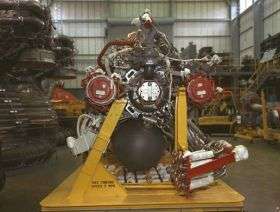
An original J-2 engine undergoes processing at NASA's Marshall Space Flight Center in Huntsville, Ala., in 1965. The Apollo-era engine, used to power the second stage of the Saturn V rockets to the moon, is being studied anew by NASA rocket scientists building the engines that will power the next generation of launch vehicles, the Ares I and Ares V, and carry human explorers to the moon. The Saturn V, like key hardware and components of the Ares launch vehicles, was designed, developed and tested by Marshall Center engineers. (NASA/MSFC)

In December, NASA will begin testing core components of a rocket engine from the Apollo era. Data from the tests will help NASA build the next generation engine that will power the nation's new Ares launch vehicles on voyages that will send humans to the moon.

NASA will test the engine's powerpack, a gas generator and turbopumps that perform the rocket engine's major pumping and combustion work. These components originally delivered propellants to the Apollo-era J-2 engine that fueled the second stage of the Saturn V rockets.

NASA is using these heritage parts to develop a new engine, known as the J2-X, to power the upper stages of both the Ares I crew launch vehicle and the Ares V cargo launch vehicle. Results from the tests will help engineers modify the machinery to meet the higher performance requirements of these two next-generation rockets.

"The J-2X engine will incorporate significant upgrades to meet higher thrust and efficiency requirements for Ares," said Mike Kynard, manager of the upper stage engine in the Ares Projects Office at NASA's Marshall Space Flight Center in Huntsville, Ala. "That's why we're taking a new look at these components -- to gather performance data, test their limits, and reduce risks down the road when we're building and testing the engine."

The powerpack tests will be conducted at NASA's Stennis Space Center near Bay St. Louis, Miss., where the components were installed in late September 2007.

"The final checkouts of the test article and facility are in work," said Gary Benton, test project manager of the Ares upper stage engine at Stennis. "The test team at Stennis has put a lot of effort into this project and looks forward to getting these first tests completed."

During the initial trials, engineers will run propellants through the powerpack, monitoring its ducts, valves and lines while simulating conditions as if it were attached to a rocket upper stage and main combustion chamber. Engineers will be able to preview conditions that might be present during an engine test fire.

The first test in the series will be a chill test, during which engineers will verify the tightness of seals in the fuel lines and pumps at propellant temperatures as low as minus 425 degrees Fahrenheit. Engineers also will verify accuracy of the chill procedure and determine the amount of time required to chill the pumps.

Later tests in the series will progress to include test fires at a variety of power levels and durations ranging from 12 seconds to 550 seconds. Testing is set to continue through February 2008.

The Ares rockets support NASA's goal of providing safe, reliable, affordable transportation to support sustainable, long-term exploration. The Ares I is an in-line, two-stage rocket that will transport the Orion crew vehicle to low Earth orbit. Orion will accommodate as many as six astronauts on missions to the International Space Station or as many as four crew members on lunar missions. The Ares V, a heavy-lift launch vehicle, will enable NASA to launch a variety of science and exploration payloads and key components needed to go to the moon.

The J-2X is an evolved version of two historic predecessors: the J-2 engine that propelled the Saturn IB and Saturn V rockets, and the J-2S, a simplified version of the J-2 that was developed and tested in the early 1970s.

Marshall manages the J-2X upper stage engine for NASA's Constellation Program, based at NASA's Johnson Space Center in Houston. Under a contract awarded in July 2007, Pratt and Whitney Rocketdyne Inc., of Canoga Park, Calif., will design, develop, test and evaluate the engine.

Source: NASA


print this article email this article download pdf blog this article bookmark this article     Stumble it Digg this share on Facebook retweet share on Reddit add to delicious
Rate this story - 4.3 /5 (3 votes)

Rank Filter

Move the slider to adjust rank threshold, so that you can hide some of the comments.


Display comments: newest first

  • AngryLabRat - Dec 22, 2007
    • Rank: not rated yet
    Re-igniting old technology. Not bad. I still doubt the credibility of the mission. Even if we should make it to the moon, then on to Mars, and even if we should accomplish the mission before China or Russia, what will it accomplish? Is this just going to be another Apollo -- heroic, but short-lived and poorly-justified, with little scientific value beyond what could be accomplished with robots, and a diversion from the real political and social issues? Or will this be a sort of conquest, like the first colonization efforts to the new world? Either way, I ponder the values. The slim possiblity of an internationally-united effort is there, building world-unity, I guess. But let's be real.

    For more comments, please see my blog post on this at:
    http://angrylabra...lse.html
  • nilbud - Dec 28, 2007
    • Rank: not rated yet
    The Russians built the most efficient rockets by a huge margin, why waste time with these second rate obsolete models. Moonbase makes perfect sense, Mars is just setting records for the sake of it.

December 19, 2007 all stories

Comments: 2

4.3 /5 (3 votes)
  • Stumble this up

  • Digg this

  • share this

  • hide
  • Related Stories

  • To the moon, NASA? Not on this budget, experts say
    created Aug 26, 2009 | popularity not rated yet | comments 0
  • Era Ends for Space Shuttle Main Engine Test Program
    created Jul 31, 2009 | popularity not rated yet | comments 0
  • NASA's New High-Performance Engine for Ares Rocket Passes Review
    created Nov 14, 2008 | popularity not rated yet | comments 0
  • Building a New Rocket for the Nation
    created Sep 17, 2008 | popularity not rated yet | comments 0
  • NASA Conducts First Test On New Motor For The Ares I Rocket
    created Sep 12, 2008 | popularity not rated yet | comments 0


  • hide
  • Relevant PhysicsForums posts

  • Some help with a X-Ray astronomy question please!
    created 14 hours ago
  • Help with Images and Optical Instrument Question..
    created Nov 26, 2009
  • Redshift as a distance indicator
    created Nov 26, 2009
  • Question about 2-body gravity
    created Nov 24, 2009
  • More from Physics Forums - General Astronomy

Other News

Fermi Telescope Peers Deep into Microquasar

Fermi Telescope Peers Deep into Microquasar (w/ Video)

Space & Earth / Astronomy

created 8 hours ago | popularity 4.5 / 5 (4) | comments 0

(PhysOrg.com) -- NASA's Fermi Gamma-ray Space Telescope has made the first unambiguous detection of high-energy gamma-rays from an enigmatic binary system known as Cygnus X-3. The system pairs a hot, massive ...


The Energy Sources of Ultraluminous Galaxies

The Energy Sources of Ultraluminous Galaxies

Space & Earth / Astronomy

created 8 hours ago | popularity 4.4 / 5 (8) | comments 0

(PhysOrg.com) -- Ultraluminous infrared galaxies ((ULIRGs) are galaxies whose luminosity exceeds that of a trillion suns; for comparison, the Milky Way galaxy has a typical (and much more modest) luminosity ...


Space shuttle Atlantis, 7 astronauts back on Earth (AP)

Space shuttle Atlantis, 7 astronauts back on Earth

Space & Earth / Space Exploration

created 9 hours ago | popularity not rated yet | comments 0

(AP) -- Space shuttle Atlantis and its seven astronauts returned to Earth with a smooth touchdown Friday to end an 11-day flight that resupplied the International Space Station.


Herschel takes a peek at the ingredients of the galaxies

Herschel takes a peek at the ingredients of the galaxies

Space & Earth / Astronomy

created 6 hours ago | popularity 5 / 5 (1) | comments 0

(PhysOrg.com) -- The European Space Agency has today released spectacular new observations from the Herschel Space Observatory, including the UK-led SPIRE instrument. Spectrometers on board all three Hershel ...


China is set to launch its second moon orbiter next October, state media have reported

China to launch second lunar probe: state media

Space & Earth / Space Exploration

created 13 hours ago | popularity 5 / 5 (3) | comments 0

China will launch its second moon orbiter next October, state media reported Friday, as it powers ahead with a space programme that has sparked concerns abroad.