Rice University researchers create 'nanorice'
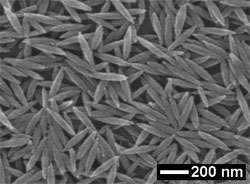
Who better to invent "nanorice" than researchers at Rice University? But marketing and whimsy weren't what motivated the team of engineers, physicists and chemists from Rice's Laboratory for Nanophotonics (LANP) to make rice-shaped particles of gold and iron oxide.
"On the nanoscale, the shape of a particle plays a critical role in how it interacts with light," said LANP Director Naomi Halas. "We were looking for a new shape that would combine the best properties of the two most optically useful shapes – spheres and rods. It's just a coincidence that that shape turned out to look exactly like a grain of rice."
Nanoparticles like nanorice can be used to focus light on small regions of space. Rice's scientists plan to capitalize on this by attaching grains of nanorice to scanning probe microscopes. By moving the grains next to proteins and unmapped features on the surfaces of cells, they hope to get a far clearer picture than what's available with current technology.
The nanorice research will appear in the April 12 issue of Nano Letters. Halas will discuss the findings today at a press conference at the American Physical Society's 2006 March Meeting.
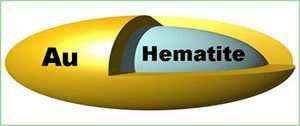
In form, nanorice is similar to nanoshells, a spherical nanoparticle Halas invented in 1998 that is currently being examined for possible applications in molecular imaging, cancer treatment, medical diagnostics and chemical sensing. Both nanorice and nanoshells are made of a non-conducting core that is covered by a metallic shell.
Halas' investigations find that nanorice possesses far greater structural tunability than nanoshells and another commonly studied optical nanoparticle, the nanorod. In fact, tests indicate that nanorice is the most sensitive surface plasmon resonance (SPR) nanosensor yet devised.
Research over the past decade has shown that nanoscale objects can amplify and focus light in ways scientists never imagined. The "how" of this involves plasmons, ripples of waves in the ocean of electrons that flow constantly across the surfaces of metals. When light of a specific frequency strikes a plasmon that oscillates at a compatible frequency, the energy from the light is converted into electrical energy that propagates, as plasmons, through the nanostructure.
Changing the shape of a metal at the nanoscale allows engineers and scientists to modify the properties of these plasmon waves, controlling the way that the metal nanostructure responds to light. Because of this, metal nanostructures can have beautiful, vivid colors that depend on their shape. Some nanoscale structures -- like nanorice and nanoshells -- act as superlenses that can amplify light waves and focus them to spot sizes far smaller than a wavelength of light.
In January 2005, for example, Halas and colleagues showed that nanoshells were about 10,000 times more effective at Surface-enhanced Raman Scattering (SERS) than traditional methods. Raman scattering is a type of spectrographic technique used by medical researchers, drug designers, chemists and others to determine the precise chemical makeup of materials.
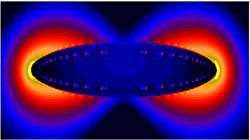
"Plasmon resonance 'hot spots' formed at the junction between a pair of nanoparticles- called dimers- provide higher SERS intensity than single nanoshells," said co-author Peter Nordlander, professor of physics and astronomy and of electrical and computer engineering. "Our computer models and experimental results show that the plasmon resonances of single grains of nanorice are on the same order of magnitude intensities as those obtained in junctions of nanoparticle dimers."
"The distinct advantage of the nanorice particle over nanoparticle dimers is that the electric field enhancements occur on open-ended surfaces of the particle that are much more accessible," said Halas, The Stanley C. Moore Professor of Electrical and Computer Engineering and professor of chemistry. "For SERS and SPR applications, we believe nanorice may have the field intensities needed to characterize biomolecules -- like proteins and DNA --that adsorb on the particle."
The nanorice core is made of non-conducting iron oxide and the outer covering of gold. The nanorice particles described in the Nano Letters paper were about 360 nanometers long and about 80 nanometers in diameter.
Source: Rice University


