The Quest for a New Class of Superconductors
December 20th, 2007 The Quest for a New Class of Superconductors

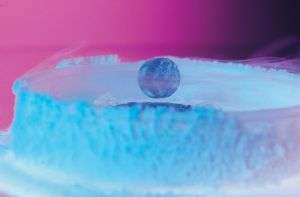
This photo shows a magnet levitating above a high-temperature superconductor, cooled with liquid nitrogen. A persistent electric current flows on the surface of the superconductor, effectively forming an electromagnet that repels the magnet. The expulsion of an electric field from a superconductor is known as the "Meissner Effect." Credit: Los Alamos National Laboratory

Fifty years after the Nobel-prize winning explanation of how superconductors work, a research team from Los Alamos National Laboratory, the University of Edinburgh and Cambridge University are suggesting another mechanism for the still-mysterious phenomenon.

In a review published today in Nature, researchers David Pines, Philippe Monthoux and Gilbert Lonzarich posit that superconductivity in certain materials can be achieved absent the interaction of electrons with vibrational motion of a material’s structure.

The review, “Superconductivity without phonons,” explores how materials, under certain conditions, can become superconductors in a non-traditional way. Superconductivity is a phenomenon by which materials conduct electricity without resistance, usually at extremely cold temperatures around minus 424 degrees Fahrenheit (minus 253 degrees Celsius)—the fantastically frigid point at which hydrogen becomes a liquid. Superconductivity was first discovered in 1911.

A newer class of materials that become superconductors at temperatures closer to the temperature of liquid nitrogen—minus 321 degrees Fahrenheit (minus 196 degrees Celsius)—are known as “high-temperature superconductors.”

A theory for conventional low-temperature superconductors that was based on an effective attractive interaction between electrons was developed in 1957 by John Bardeen, Leon Cooper and John Schrieffer. The explanation, often called the BCS Theory, earned the trio the Nobel Prize in Physics in 1972.

The net attraction between electrons, which formed the basis for the BCS theory, comes from their coupling to phonons, the quantized vibrations of the crystal lattice of a superconducting material; this coupling leads to the formation of a macroscopically occupied quantum state containing pairs of electrons—a state that can flow without encountering any resistance, that is, a superconducting state.

“Much like the vibrations in a water bed that eventually compel the occupants to move together in the center, phonons can compel electrons of opposite spin to attract one another, says Pines, who with Bardeen in 1954, showed that this attraction could win out over the apparently much stronger repulsion between electrons, paving the way for the BCS theory developed a few years later.

However, according to Pines, Monthoux and Lonzarich, electron attraction leading to superconductivity can occur without phonons in materials that are on the verge of exhibiting magnetic order—in which electrons align themselves in a regular pattern of alternating spins.

In their Review, Pines, Monthoux and Lonzarich examine the material characteristics that make possible a large effective attraction that originates in the coupling of a given electron to the internal magnetic fields produced by the other electrons in the material. The resulting magnetic electron pairing can give rise to superconductivity, sometimes at substantially higher temperatures than are found in the materials for which phonons provide the pairing glue.

Among the classes of materials that appear capable of superconductivity without phonons are the so-called heavy electron superconductors that have been studied extensively at Los Alamos since the early 1980’s, certain organic materials, and the copper oxide materials that superconduct at up to twice the temperature at which nitrogen liquefies.

“If we ever find a material that superconducts at room temperature—the ‘Holy Grail’ of superconductivity—it will be within this class of materials,” says Pines. “This research shows you the lamp post under which to look for new classes of superconducting materials.”

Link: http://www.nature.com/nature/journal/v450/n7173/abs/nature06480.html

Source: Los Alamos National Laboratory


print this article email this article download pdf blog this article bookmark this article     Digg this Stumble it share on Facebook share on Reddit add to delicious save to Yahoo! bookmarks
4.6/5 after 61 votes

Rank Filter

Move the slider to adjust rank threshold, so that you can hide some of the comments.


Display comments: newest first

  • out7x - Dec 21, 2007
    • Rank: 1 / 5 (1)
    An excellent status of current knowledge. Arrangement of internal magnetic fields should be possible thru MRI.
  • MrGrynch - Dec 27, 2007
    • Rank: 5 / 5 (1)
    If you look at the vacuum as being composed of discrete units, presenting an elastic propagation medium, the nature of electrical resistance and the merit of this research becomes obvious.

    Normally, much of an electron's charge force is distributed through a vacuum who's discrete units are randomly (or non-complimentary) polarized. Thus for a given vector of electron propagation, you must sum all of the random vectors of the vacuum as well. This is the source of electrical resistance.

    Phonons represent a localized (and transient) ordering of the surrounding vacuum. If the vector and polarization of these phonons is complimentary to electron propagation paths, no resistance is observed.

    Phonons are a transient ordering event and they must be supplied constantly to maintain superconductivity. If you lattice-lock the electrons of a material such that it contains a 'loose' electron while the others are held under electrostatic stress, you will have a superconductor at room temperature, without need of phonons. The electrons held under stress polarize the surrounding vacuum through the movement of their charge forces, while the loose electron is free to be moved through this polarized vacuum spin field.

    My monologue may imply that this is something that is easy to do, but it is not. Its hard to lattice lock atoms with their electrons under electrostatic stress, since electrostatic forces normally drive the ordering of atoms in the resulting material, alleviating the stresses. It may be possible with crystals, or through a casting or deposition process that takes place inside intense magnetic fields.
  • Ashibayai - Dec 31, 2007
    • Rank: not rated yet
    ^ Nice comment.

    I wonder what the implications of micro gravity synthesis of such a crystal would have on the purity of it's lattice. It would probably be minimal, but if you could test the creation of the lattices at temperatures approaching absolute zero, minimal gravitational disturbance, and strong magnetic fields maybe it would be possible to create a material of high purity that could be a superconductor at higher temperatures.

    Although I may be entirely overlooking the self defeating nature of this creation since the atoms would probably overcome the potential energy barriers of their organization when the environment is returned to normal. =/
  • MrGrynch - Jan 04, 2008
    • Rank: not rated yet
    Your idea of working at absolute zero has merit, and provides another possibility to realize room-temperature superconductors.

    Using a Bose-Einstein Condensate (BEC), you may be able to deposit the atoms while they are behaving as a supersolid such that their return to an energized state will result in the desired configuration.

    Electrostatic stress is needed to reduce the probabilistic orbits of the lattice-locked electrons to a desired range (one whose resulting vacuum polarization is complimentary to the conduction path).
  • Alexa - Nov 26, 2008
    • Rank: not rated yet
    vacuum as being composed of discrete units, presenting an elastic propagation medium
    Why not "Aether" in brief?..

    ..I see, because of politics. The science is formed by people and some people never admit older mistakes. Especially when they're facing a risk of profit lost.

December 20th, 2007 all stories
Physics / General Physics

Comments: 5
Rank: 4.6/5 after 61 votes

  • Stumble this up

  • Digg this

  • Share it:
  • share on Facebook
  • share on MySpace
  • share on Slashdot
  • rss-newsfeed
  • share on Google
  • share on Reddit
  • add to delicious
  • save to Yahoo! bookmarks
  • share on Windows Live
  • Add to Mixx!
Rating: 4.6/5 after 61 votes

  • Related Stories

  • New insights, and a new angle, on high-temperature superconductivity
    created Jun 29, 2009 | popularity not rated yet | comments 0
  • Thinnest superconducting metal created
    created Jun 08, 2009 | popularity not rated yet | comments 0
  • Evidence of macroscopic quantum tunneling detected in nanowires
    created May 27, 2009 | popularity not rated yet | comments 0
  • Super-efficient Transistor Material Predicted
    created May 15, 2009 | popularity not rated yet | comments 0
  • Europium discovery: New element found to be a superconductor
    created May 13, 2009 | popularity not rated yet | comments 0

Tags


  • Physicists Demonstrate Quantum Memory with Matter Qubits
    Physicists Demonstrate Quantum Memory with Matter Qubits
    Physics / General Physics
    created Jul 03, 2009 | popularity 4.4 / 5 (17) | comments 1
  • 'Holey' Nanosheets for Wastewater Dye Removal
    Nanotechnology / Nanomaterials
    created Jul 01, 2009 | popularity 5 / 5 (5) | comments 1
  • Jellyfish Robot Swims Like its Biological Counterpart
    Jellyfish Robot Swims Like its Biological Counterpart
    Electronics / Robotics
    created Jun 26, 2009 | popularity 4.4 / 5 (8) | comments 1
  • Could Maxwell's Demon Exist in Nanoscale Systems?
    Could Maxwell's Demon Exist in Nanoscale Systems?
    Physics / General Physics
    created Jun 24, 2009 | popularity 4.4 / 5 (18) | comments 29
  • Living Safely with Robots, Beyond Asimov's Laws
    Living Safely with Robots, Beyond Asimov's Laws
    Electronics / Robotics
    created Jun 22, 2009 | popularity 4.6 / 5 (53) | comments 40
  • Other News

    UQ researchers break the law -- of physics

    Physics / General Physics

    created 4 hours ago | popularity 4.6 / 5 (8) | comments 0

    (PhysOrg.com) -- Two UQ Science researchers have proved two famous physical laws that have been widely used for the past 25 years do not always work.


    Scientists create first electronic quantum processor

    Scientists create first electronic quantum processor

    Physics / General Physics

    created Jun 28, 2009 | popularity 4.8 / 5 (54) | comments 41

    A team led by Yale University researchers has created the first rudimentary solid-state quantum processor, taking another step toward the ultimate dream of building a quantum computer.


    Science journals

    How to Spot an Influential Paper Based on its Citations

    Physics / General Physics

    created Jul 04, 2009 | popularity 3.9 / 5 (10) | comments 6

    (PhysOrg.com) -- At first it may seem that the number of citations received by a published scientific paper is directly related to that paper's quality of content. The higher the quality, the more people read ...


    Fermilab's CDF observes Omega-sub-b baryon

    Fermilab's CDF observes Omega-sub-b baryon

    Physics / General Physics

    created Jun 29, 2009 | popularity 4.7 / 5 (18) | comments 7

    (PhysOrg.com) -- At a recent physics seminar at the Department of Energy’s Fermi National Accelerator Laboratory, Fermilab physicist Pat Lukens of the CDF experiment announced the observation of a new particle, ...


    New insights, and a new angle, on high-temperature superconductivity

    New insights, and a new angle, on high-temperature superconductivity

    Physics / Superconductivity

    created Jun 29, 2009 | popularity 4.9 / 5 (14) | comments 7

    (PhysOrg.com) -- A Princeton-led research team has revealed surprising information about how electron behavior influences the conduction of electricity in a class of high-temperature superconductors. An increased ...