Biologists find unusual plant gene: abstinence by mutual consent
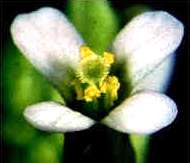
Biologists at the University of California, San Diego have discovered a gene in plants that disrupts fertilization only when mutations in the gene are present in both the female and male reproductive cells.
Their discovery, detailed in a paper that appears online today in the journal Current Biology, has been named the “abstinence by mutual consent” mutation because of its unusual properties.
“Mutations that do not allow fertilization are known in plants, but usually these mutations are caused either by a mutation in the female reproductive cells or by a mutation in the male reproductive cells,” said Julian Schroeder, a professor of biological sciences at UCSD who headed the study. “In this gene, when only the female carries the mutation, completely normal fertilization occurs, and when only the male carries the mutation, fertilization also occurs. But fertilization is completely disrupted when both male and female reproductive cells carry the mutation simultaneously.”
The scientists say the discovery of new genes that control the ability of plants to undergo fertilization could have important applications to plant breeders and conservationists.
“Mutations that cause infertility in crops can provide a powerful tool for breeders who would like to avoid crossing of their plants to related species,” said Aurelien Boisson-Dernier, a postdoctoral scholar in Schroeder’s UCSD laboratory and the first author of the study. “Conversely breeders would at times like to breed crops by crossing them into distantly related species that however do not allow crossing due to infertility. For example, adding beneficial stress resistance genes from another species may not be possible if the male and female reproductive cells can’t communicate properly. Understanding the mechanisms that mediate male-female communication during fertilization could help in circumventing the barrier of such interspecies crosses for breeding new varieties.”
In animals and plants, fertilization relies on complex and specialized mechanisms that allow the precise delivery of the male reproductive sperm cell to the female egg cell. Fertilization requires fusion of the sperm and egg cells. In flowering plants, the male pollen tube carries sperm cells through the maternal tissues to deliver the sperm to the female reproductive cells. Once the pollen tube gets close to the egg cells, fertilization requires the bursting of the pollen tube. This pollen tube bursting expels sperm cells from inside the pollen tube, so sperm can then fertilize the female reproductive cell.
In investigating why the mutation they discovered caused disruption of fertilization in the mustard plant Arabidopsis, the scientists found that the pollen tubes did not burst when they came close to the female egg cells. So in the mutant plants, the sperm cells were not expelled from the pollen tubes toward the female cells. Instead the pollen tubes, in which the sperm reside, kept growing past the eggs cells.
“The abstinence by mutual consent gene is the first gene identified so far with a critical function at the same time in both plant male and female reproductive cells that is essential for the delivery of sperm cells to the egg cell,” said Boisson-Dernier.
“The abstinence by mutual consent mutant pollen just acts as if there were no egg cell around and keeps on growing,” Schroeder added. “It’s interesting because this lack of pollen bursting only happens if the mutation is carried by both the male and female, suggesting the abstinence by mutual consent gene somehow allows the male pollen and the female reproductive cells to talk to one another.”
Boisson-Dernier found that the gene is responsible for producing a protein called peroxin that targets small organelles inside the cell called peroxisomes. Within the cell, peroxisomes are small organelles whose main functions are metabolizing fatty acids, protecting the cell from toxic free radicals and also generating a large range of signaling molecules.
Boisson-Dernier’s discovery demonstrated that peroxisomes play an unexpected key role in the dialogue between the male sperm carrier and the female egg cells. It also implies, the UCSD researchers say, that a diffusible signal generated in the peroxisomes of either the female or male reproductive cells is enough to allow the male-female communication to proceed. This signal coming from the peroxisomes of the male or female is sufficient to set off the eruption of the pollen tube allowing the sperm cells to be released.
“The interesting next question is, what is the signal coming from peroxisomes that causes pollen tube bursting"” said Schroeder.
Boisson-Dernier added, “Why does this signal only cause bursting of the pollen tubes once the pollen tube gets close to the female reproductive cells" These findings actually suggest there may be a second signal or a second key that is needed so the pollen only bursts when male and female are in close vicinity of one another.”
Source: University of California - San Diego


