International group plans strategy for Mars sample return mission
December 20, 2007
International group plans strategy for Mars sample return mission

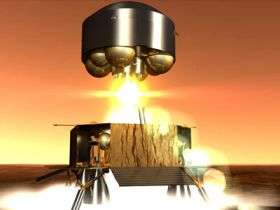
Artist's view of the Mars Sample Return (MSR) ascent module lifting off from Mars' surface with the Martian soil samples. Credits: ESA

ESA, NASA and an international team are developing plans and seeking recommendations to launch the first Mars mission to bring soil samples back to Earth. The ability to study soil from Mars here on Earth will contribute significantly to answering questions about the possibility of life on the Red Planet.

Returned samples also will increase understanding of the useful or harmful properties of Martian soil, which will support planning for the eventual human exploration of Mars.

A task force named the International Mars Architecture for Return of Samples, or IMARS, recently met in Washington to lay the foundation for an international collaboration to return samples from Mars. NASA hosted the meeting. IMARS meeting participants included representatives from more than half a dozen countries and ESA, NASA, the Canadian Space Agency (CSA) and the Japan Aerospace Exploration Agency (JAXA).

IMARS is a committee of the International Mars Exploration Working Group, or IMEWG. The group was formed in 1993 to provide a forum for the international coordination of Mars exploration missions.

"The potential paradigm-changing science from Mars samples makes this mission a high priority of the National Academy of Sciences," said Doug McCuistion, NASA's Mars Exploration program director, Science Mission Directorate, Washington.

"The exciting progress being made by the IMARS team is contributing directly to making this mission a reality in the next decade. All spacefaring nations have a standing invitation from IMEWG to participate in IMARS."

Scientists reviewed past engineering work on a Mars sample return mission, international science priorities, and sample receiving facility requirements. The IMARS team made significant progress in many of the key issues associated with the integration of science and engineering challenges. The team established a common strategy for launching a Mars sample return mission and achieving scientific objectives that can be met only by returning Martian soil to Earth.

"For Europe this is a major step to shape the future of the ESA Aurora Exploration Programme in 2008," said Bruno Gardini, ESA's Exploration Programme Manager. The Aurora Exploration Programme is part of Europe's strategy for space, initiated by ESA in 2001 to create and implement a long-term European plan for robotic and human exploration of the Solar System.

The next steps in preparing for a Mars sample return mission includes more detailed international trade studies on engineering and mission specifics, greater detail on science and sample requirements, and definition and requirements for Earth-based facilities. IMARS will address the technical issues in upcoming meetings, along with preliminary discussions of the possible roles of interested nations and agencies.

Source: ESA


Rank 3 /5 (2 votes)
Tags

Related Stories
Relevant PhysicsForums posts
  • Scale of the Universe
    created12 hours ago
  • Titan's lack of impact craters
    createdFeb 09, 2012
  • Real pictures of black hole eating a star?
    createdFeb 08, 2012
  • Hypothetical way to travel faster than light, but not technically exceed lightspeed
    createdFeb 06, 2012
  • How do scientists monitor the Sun's activity?
    createdFeb 05, 2012
  • Search patterns in observational studies
    createdFeb 05, 2012
  • More from Physics Forums - General Astronomy

More news stories

Humans may have helped the decline of African rainforests 3000 years ago

(PhysOrg.com) -- Large areas of rainforests in Central Africa mysteriously disappeared over three thousand years ago, to be replaced by savannas. The prevailing theory has been that the cause was a change ...

Space & Earth / Environment

created 23 hours ago | popularity 4.3 / 5 (13) | comments 13 | with audio podcast report

Could Venus be shifting gear?

(PhysOrg.com) -- ESA’s Venus Express spacecraft has discovered that our cloud-covered neighbour spins a little slower than previously measured. Peering through the dense atmosphere in the infrared, the ...

Space & Earth / Space Exploration

created 19 hours ago | popularity 5 / 5 (7) | comments 8 | with audio podcast

NASA budget will axe Mars deal with Europe: scientists

US President Barack Obama's budget proposal to be submitted next week for 2013 will cut NASA's budget by 20 percent and eliminate a major partnership with Europe on Mars exploration, scientists said Thursday.

Space & Earth / Space Exploration

created 22 hours ago | popularity 5 / 5 (2) | comments 19

Mars Science Laboratory computer issue resolved

(PhysOrg.com) -- Engineers have found the root cause of a computer reset that occurred two months ago on NASA's Mars Science Laboratory and have determined how to correct it.

Space & Earth / Space Exploration

created 20 hours ago | popularity 4.7 / 5 (6) | comments 4 | with audio podcast

Two new moons for Jupiter

Advances in technology have lead to the discovery of new planets outside of our Solar System, and now even new moons in our own backyard.

Space & Earth / Space Exploration

created 19 hours ago | popularity 4 / 5 (1) | comments 7


Anonymous knocks CIA website offline (Update)

The website of the Central Intelligence Agency was inaccessible on Friday after the hacker group Anonymous claimed to have knocked it offline.

New error-correcting codes guarantee the fastest possible rate of data transmission

Error-correcting codes are one of the triumphs of the digital age. They’re a way of encoding information so that it can be transmitted across a communication channel — such as an optical fiber o ...

New power source discovered

(PhysOrg.com) -- Researchers at the Massachusetts Institute of Technology (MIT) and RMIT University have made a breakthrough in energy storage and power generation.

Small modular reactor design could be a 'SUPERSTAR'

(PhysOrg.com) -- Though most of today's nuclear reactors are cooled by water, we've long known that there are alternatives; in fact, the world's first nuclear-powered electricity in 1951 came from a reactor ...

The power of estrogen -- male snakes attract other males

A new study has shown that boosting the estrogen levels of male garter snakes causes them to secrete the same pheromones that females use to attract suitors, and turned the males into just about the sexiest ...

Google users warned of threat to smartphone wallets

Users of Google smartphone wallets were being warned on Friday that there is a way to crack pass codes intended to thwart thieves from going on illicit shopping sprees.