Christmas Eve Sky Show
December 20, 2007 Christmas Eve Sky Show

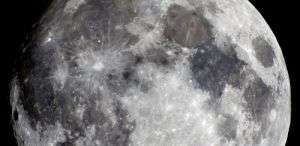
The Moon photographed by P-M Heden of Vallentuna, Sweden.

It's Christmas Eve, and you're snuggled cozily in your den. A glowing fire gently crackles and pops in the fireplace, and your head starts to droop as you nod off. Just then, something cold and wet nudges your cheek. You open your eyes to stare directly into a large black nose. It's time to take the dog for his walk.

Grumbling in vain, you put on your coat, snap the leash onto the wiggling dog's collar, open the door to a rush of cold air. You step outside and enter a magical landscape.

The night isn't dark, it's glowing with a silvery-white light. Up above, the 98% full moon looks huge and clear in the azure sky. It just might be the brightest moon you've ever seen. That's because it's the highest-riding full moon until the year 2023.
Christmas Eve Sky Show
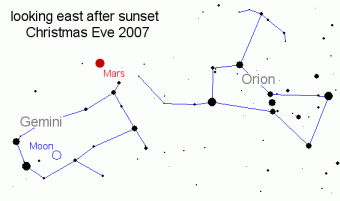
And not far from the beautiful moon glows fireplace-red Mars. This Christmas Eve, Mars is at its closest to Earth for the next nine years. Mars is also "at opposition." That's astronomy-lingo for "directly opposite the sun." It means Mars is up whenever the sun is down: on Christmas Eve, the Red Planet will be visible all night long.

As Christmas scenes go, it doesn't get much better. Gliding in formation across the sky, the moon and Mars seem so close you could almost reach up, grab the pair and bounce them down the street for Fido to retrieve.

Or maybe you could lasso them, as George says in the movie It's a Wonderful Life. "Just say the word and I'll throw a lasso around it and pull it down. Hey! That's a pretty good idea! I'll give you the moon, Mary...."

In the years ahead, NASA is going to lasso the moon. NASA's giant Ares rocket, still on the drawing board, will take form and then take mankind back to that brilliant silver orb where scientists will learn how to harness the moon's powers.

Plans are to establish a lunar base for exploration and use the moon's surface as a springboard to even further destinations. At the moon's poles there is evidence of hydrogen and perhaps actual water frozen in the soil. Furthermore, ordinary moonrocks are made of minerals that contain more than 40% oxygen. These are resources that can be used to produce rocket fuel, breathable air and a welcome drink on a dry, dusty world.

Maybe on some future Christmas Eve, one of us will step outside of our cozy lunar cabin and walk our space-suited dog with long, floating steps down some dusty lunar road. We'll look up and say, "There's a pretty full Earth tonight!"

But on this frosty Christmas Eve, your feet crunch Earth's cold ground with a crisp clear sound as you walk back toward the house looking up through the silvery stillness at the lovely moon and its bright partner, Mars. The only other sounds you hear are dog tags jingling like sleigh bells. Suddenly a shadow flits across the moon. A cloud? A plane? A sleigh! Maybe those were sleigh bells you heard!

Smiling to yourself, you open the door to go back inside, taking one last glance at the night sky and one of the loveliest heavenly sights you’ll see for years.

Don't forget to thank Fido.

Source: by Dauna Coulter, Science@NASA


print this article email this article download pdf blog this article bookmark this article     Stumble it Digg this share on Facebook retweet share on Reddit add to delicious
Rate this story - 3.9 /5 (9 votes)

Rank Filter

Move the slider to adjust rank threshold, so that you can hide some of the comments.


Display comments: newest first

  • AngryLabRat - Dec 22, 2007
    • Rank: not rated yet
    Riding high and looming large. By the time it's at the same position again, will there be men looking back down at us again? Or are the various national lunar missions just lunacy?

    See my blog at:
    http://angrylabra...lse.html

December 20, 2007 all stories

Comments: 1

3.9 /5 (9 votes)
  • Stumble this up

  • Digg this

  • share this

  • hide
  • Related Stories

  • Moon, Mars bright lights in the big sky
    created Dec 24, 2007 | popularity not rated yet | comments 0
  • Technological revolutions in sensors, robotics, and telecommunications allow new views of ocean
    created Feb 19, 2005 | popularity not rated yet | comments 0
  • Huygens to begin its final journey to Titan
    created Dec 07, 2004 | popularity not rated yet | comments 0
  • Superior Super Earths
    created Nov 30, 2009 | popularity not rated yet | comments 0
  • Distal Rampart of Crater in Chryse Planitia
    created Nov 13, 2009 | popularity not rated yet | comments 0


  • hide
  • Relevant PhysicsForums posts

  • Gravity on the surface of Gliese 581 d
    created 14 hours ago
  • astronomy
    created Nov 30, 2009
  • mass of molecular clouds versus stars
    created Nov 30, 2009
  • Astronomy Problems PLEASE HELP! PLEASE PLEASE
    created Nov 30, 2009
  • More from Physics Forums - General Astronomy

Other News

Map - France - UK

'Super-river' formed the English Channel

Space & Earth / Earth Sciences

created 2 hours ago | popularity 4.2 / 5 (5) | comments 0

(PhysOrg.com) -- A team of Anglo-French scientists studying sedimentary deposits in the Bay of Biscay have concluded that Britain and France were separated by a "super-river" during three periods of glaciations, ...


A view of San Francisco

San Francisco vs Amsterdam in green city rivalry

Space & Earth / Environment

created 7 hours ago | popularity 5 / 5 (2) | comments 0

San Francisco and Amsterdam set an online stage for an environmental rivalry regarding which city is more nature-friendly.


Maryland Farmer grows plants for green roofs around nation

Space & Earth / Environment

created 2 hours ago | popularity 5 / 5 (1) | comments 0

It is a crisp fall day on Emory Knoll Farms as John Shepley stops at a raspberry bush, picks a few berries and pops them into his mouth on his walk to the greenhouses.


UK climate scientist to temporarily step down (AP)

UK climate scientist to temporarily step down

Space & Earth / Environment

created 16 hours ago | popularity 3.2 / 5 (5) | comments 11

(AP) -- The chief of a prestigious British research center caught in a storm of controversy over claims that he and others suppressed data about climate change has stepped down pending an investigation, the ...


Acid test: Study reveals both losers and winners of CO2-induced ocean acidification

Acid test: Study reveals both losers and winners of CO2-induced ocean acidification

Space & Earth / Earth Sciences

created 20 hours ago | popularity 4.3 / 5 (7) | comments 5

(PhysOrg.com) -- As the world’s seawater becomes more acidic due to rising atmospheric carbon dioxide, some shelled marine creatures may actually become bigger and stronger, according to a new study.