Nanovideo captures motion of RNA molecules in 3-D
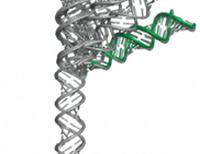
You may not find it on YouTube, but Hashim Al-Hashimi's video could create quite a stir in scientific circles.
Using an innovative variation on conventional solution state NMR spectroscopy, the University of Michigan researcher and his coworkers have produced a "nanovideo" that reveals in three dimensions how RNA molecules change shape—information that may prove useful in developing drugs against viruses such as HIV.
Similar animations have been produced from theoretical calculations, but Al-Hashimi's is based on actual experimental data and covers a much longer timescale than the simulations. The research is reported in the Dec. 20 issue of the journal Nature.
RNA is one of nature's busiest molecules. Once believed to merely store and relay genetic information, it now is known to perform a variety of other functions, from regulating gene expression and other vital cellular processes to serving as a sensor that detects cellular signals and carries out appropriate reactions in response. The versatile molecule also is essential to viruses such as HIV, which have no DNA and instead rely on RNA to both carry and execute genetic instructions for everything the virus needs to invade and overpower its host.
Typically, RNA works by binding to something else and then radically changing shape. The shape changes, in turn, trigger other processes or cascades of events. Scientists know about the shifting shapes because they've seen before-and-after snapshots of RNA, first in its unbound state, then when it's bound to something. The static images clearly show that the molecule assumes different conformations, but they don't reveal how it changes from one shape to another.
Al-Hashimi's new nanovideo offers a 3-D glimpse at how parts of the molecule—which has ladder-like arms connected by a flexible hub or linker—twist, bend and rotate relative to one another.
Obtaining such information through conventional NMR is impossible, Al-Hashimi said, because the technique measures motion relative to the magnetic field in which the sample is placed. That frame of reference can capture motion only from one point of view, resulting in a one-dimensional measurement. To get a three-dimensional view that reveals how parts of the molecule move relative to one another, Al-Hashimi's group came up with a strategy that would allow them to park the magnetic field first on the molecule's upper arm and then on its lower arm.
"Moving the frame of reference onto the molecule and measuring the same motion from different points of view is like taking pictures from different angles," said Al-Hashimi, an assistant professor of chemistry and an assistant research scientist in the U-M Biophysics Research Division. "We sit on one arm and watch the other moving; then we sit on the other arm and watch the first arm moving. By combining the measurements, we come up with a 3-D view."
The data revealed that the two arms simultaneously twist and bend and that their motion is not random but highly coordinated, exposing a new level of organization in how molecules change shapes. The nanovideo Al-Hashimi's group produced from the data also provides a longer look at molecular motions than do animations based on theoretical calculations. While those animations show motion that occurs over only one nanosecond, the Al-Hashimi movie spans about one millisecond.
Understanding the details of RNA motion can be helpful in designing drugs that interact with viral RNA. If researchers know which parts are likely to change to accommodate a drug and which parts are likely to remain rigid, they can more precisely target drugs to interact with the molecule. In the research reported in Nature, Al-Hashimi's team studied a particular RNA molecule from HIV known as TAR, which is critical for viral replication and thus is a key target for anti-HIV drugs.
The technique used in this work also should be applicable other types of biologically and medically important molecules, such as proteins, Al-Hashimi said.
Al-Hashimi's coauthors on the Nature paper are graduate students Qi Zhang and Andrew Stelzer and undergraduate student Charles Fisher. The researchers received funding from the National Institutes of Health.
Videos are available at www.umich.edu/news/index.html?Vid/nanovid/index
Source: University of Michigan


