10,000 Earths' Worth of Fresh Dust Found Near Star Explosion
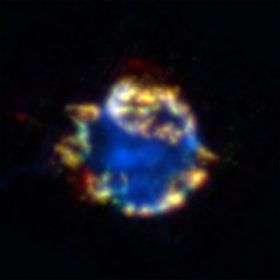
Astronomers have at last found definitive evidence that the universe's first dust – the celestial stuff that seeded future generations of stars and planets – was forged in the explosions of massive stars.
The findings, made with NASA's Spitzer Space Telescope, are the most significant clue yet in the longstanding mystery of where the dust in our very young universe came from. Scientists had suspected that exploding stars, or supernovae, were the primary source, but nobody had been able to demonstrate that they can create copious amounts of dust – until now. Spitzer's sensitive infrared detectors have found 10,000 Earth masses worth of dust in the blown-out remains of the well-known supernova remnant Cassiopeia A.
"Now we can say unambiguously that dust – and lots of it – was formed in the ejecta of the Cassiopeia A explosion. This finding was possible because Cassiopeia A is in our own galaxy, where it is close enough to study in detail," said Jeonghee Rho of NASA's Spitzer Science Center at the California Institute of Technology in Pasadena. Rho is the lead author of a new report about the discovery appearing in the Jan. 20 issue of the Astrophysical Journal.
Space dust is everywhere in the cosmos, in our own neck of the universe and all the way back billions of light-years away in our infant universe. Developing stars need dust to cool down enough to collapse and ignite, while planets and living creatures consist of the powdery substance. In our nearby universe, dust is pumped out by dying stars like our sun. But back when the universe was young, sun-like stars hadn't been around long enough to die and leave dust.
That's where supernovae come in. These violent explosions occur when the most massive stars in the universe die. Because massive stars don't live very long, theorists reasoned that the very first exploding massive stars could be the suppliers of the unaccounted-for dust. These first stars, called Population III, are the only stars that formed without any dust.
Other objects in addition to supernovae might also contribute to the universe's first dust. Spitzer recently found evidence that highly energetic black holes, called quasars, could, together with supernovae, manufacture some dust in their winds.
Rho and her colleagues analyzed the Cassopeia A supernova remnant, located about 11,000 light-years away. Though this remnant is not from the early universe, its proximity to us makes it easier to address the question of whether supernovae have the ability to synthesize significant amounts of dust. The astronomers analyzed the infrared light coming from Cassiopeia A using Spitzer's infrared spectrograph, which spreads light apart to reveal the signatures of different elements and molecules. "Because Spitzer is extremely sensitive to dust, we were able to make high-resolution maps of dust in the entire structure," said Rho.
The map reveals the quantity, location and composition of the supernova remnant's dust, which includes proto-silicates, silicon dioxide, iron oxide, pyroxene, carbon, aluminium oxide and other compounds. One of the first things the astronomers noticed was that the dust matches up perfectly with the gas, or ejecta, known to have been expelled in the explosion. This is the smoking gun indicating the dust was freshly made in the ejecta from the stellar blast. "Dust forms a few to several hundred days after these energetic explosions, when the temperature of gas in the ejecta cools down," said Takashi Kozasa, a co-author at the Hokkaido University in Japan.
The team was surprised to find freshly-made dust deeper inside the remnant as well. This cooler dust, mixed in with gas referred to as the unshocked ejecta, had never been seen before.
All the dust around the remnant, both warm and cold, adds up to about three percent of the mass of the sun, or 10,000 Earths. This is just enough to explain where a large fraction, but not all, of the universe's early dust came from. "Perhaps at least some of the unexplained portion is much colder dust, which could be observed with upcoming telescopes, such as Herschel," said Haley Gomez, a co-author at University of Wales, Cardiff. The Herschel Space Observatory, scheduled to launch in 2008, is a European Space Agency mission with significant NASA participation.
Rho also said that more studies of other supernovae from near to far are needed to put this issue to rest. She notes that the rate at which dust is destroyed – a factor in determining how much dust is needed to explain the dusty early universe – is still poorly understood.
The principal investigator of the research program, and a co-author of the paper, is Lawrence Rudnick of the University of Minnesota, Twin Cities. Other co-authors include W.T. Reach of the Spitzer Science Center; J. D. Smith of the Steward Observatory, Tucson, Ariz.; T. Delaney of the Massachusetts Institute of Technology, Cambridge; J.A. Ennis of the University of Minnesota; and A. Tappe of the Spitzer Science Center and the Harvard Smithsonian Center for Astrophysics, Cambridge, Mass.
Source: NASA Jet Propulsion Laboratory


