Study Links 'Smog' to Arctic Warming
March 14, 2006 Study Links 'Smog' to Arctic Warming

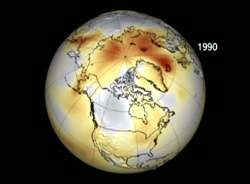
Tropospheric ozone was responsible for one-third to half of the observed warming trend in the Arctic during winter and spring, according to the research at GISS. Ozone is transported from the industrialized countries in the Northern Hemisphere to the Arctic quite efficiently during these seasons. Credit: NASA/Lori Perkins

NASA scientists have found that a major form of global air pollution involved in summertime "smog" has also played a significant role in warming the Arctic.

In a global assessment of the impact of ozone on climate warming, scientists at the NASA Goddard Institute for Space Studies (GISS), New York, evaluated how ozone in the lowest part of the atmosphere changed temperatures over the past 100 years. Using the best available estimates of global emissions of gases that produce ozone, the GISS computer model study reveals how much this single air pollutant, and greenhouse gas, has contributed to warming in specific regions of the world.

According to this new research, ozone was responsible for one-third to half of the observed warming trend in the Arctic during winter and spring. Ozone is transported from the industrialized countries in the Northern Hemisphere to the Arctic quite efficiently during these seasons. The findings have been accepted for publication in the American Geophysical Union's Journal of Geophysical Research-Atmospheres.

Ozone plays several different roles in the Earth’s atmosphere. In the high-altitude region of the stratosphere, ozone acts to shield the planet from harmful ultraviolet radiation. In the lower portion of the atmosphere (the troposphere), ozone can damage human health, crops and ecosystems. Ozone is also a greenhouse gas and contributes to global warming.

Ozone is formed from several other chemicals found in the atmosphere near the Earth's surface that come from both natural sources and human activities such as fossil fuel burning, cement manufacturing, fertilizer application and biomass burning. Ozone is one of several air pollutants regulated in the United States by the U. S. Environmental Protection Agency.

The impact of ozone air pollution on climate warming is difficult to pinpoint because, unlike other greenhouse gases such as carbon dioxide, ozone does not last long enough in the lower atmosphere to spread uniformly around the globe. Its warming impact is much more closely tied to the region it originated from. To capture this complex picture, GISS scientists used a suite of three-dimensional computer models that starts with data on ozone sources and then tracks how ozone chemically evolved and moved around the world over the past century.

The warming impact of low-altitude ozone on the Arctic is very small in the summer months because ozone from other parts of the globe does not have time to reach the region before it is destroyed by chemical reactions fueled by ample sunshine. As a result, when it is summertime in the Northern Hemisphere, ozone-induced warming is largest near the sources of ozone emissions. The computer model showed large summer warming from ozone over western North America and eastern Europe/central Asia, areas with high levels of ozone pollution during that time of year.

The new results identify an unexpected benefit of air pollution control efforts worldwide, according to lead author Drew Shindell. "We now see that reducing ozone pollution can not only improve air quality but also have the added benefit of easing climate warming, especially in the Arctic."

Source: Goddard Space Flight Center, by Stephen Cole


print this article email this article download pdf blog this article bookmark this article     Stumble it Digg this share on Facebook retweet share on Reddit add to delicious
Rate this story - 4.4 /5 (7 votes)


March 14, 2006 all stories

Comments: 0

4.4 /5 (7 votes)
  • Stumble this up

  • Digg this

  • share this

  • hide
  • Related Stories

  • Interactions with Aerosols Boost Warming Potential of Some Gases
    created Oct 29, 2009 | popularity not rated yet | comments 0
  • Navy Researchers Apply Science to Fire Fighting
    created Oct 23, 2009 | popularity not rated yet | comments 0
  • NASA Researchers Explore Lightning's NOx-ious Impact on Pollution, Climate
    created Oct 23, 2009 | popularity not rated yet | comments 0
  • North America backs plan to cut greenhouse gases
    created Sep 16, 2009 | popularity not rated yet | comments 0
  • U.S., Canada near agreement to control pollutants from ships
    created Sep 07, 2009 | popularity not rated yet | comments 0


Other News

Deep creep means milder, more frequent earthquakes along Southern California's San Jacinto fault

Deep creep means milder, more frequent earthquakes along Southern California's San Jacinto fault

Space & Earth / Earth Sciences

created 44 minutes ago | popularity 4 / 5 (1) | comments 0

With an average of four mini-earthquakes per day, Southern California's San Jacinto fault constantly adjusts to make it a less likely candidate for a major earthquake than its quiet neighbor to the east, the ...


Success in 'space elevator' competition (AP)

Success in 'space elevator' competition (Update 3)

Space & Earth / Space Exploration

created Nov 05, 2009 | popularity 4.3 / 5 (33) | comments 50

(AP) -- A robot powered by a ground-based laser beam climbed a long cable dangling from a helicopter on Wednesday to qualify for prize money in a $2 million competition to test the potential reality of the ...


'Dropouts' pinpoint earliest galaxies

'Dropouts' pinpoint earliest galaxies

Space & Earth / Astronomy

created Nov 06, 2009 | popularity 4.1 / 5 (9) | comments 12

Astronomers, conducting the broadest survey to date of galaxies from about 800 million years after the Big Bang, have found 22 early galaxies and confirmed the age of one by its characteristic hydrogen signature ...


Space hotel taking bookings for 2012 opening

Space hotel taking bookings for 2012 opening

Space & Earth / Space Exploration

created Nov 05, 2009 | popularity 4.4 / 5 (20) | comments 11

(PhysOrg.com) -- The first orbiting space hotel is on track to open for its first customers in 2012, but hurry, as bookings are filling fast.


In a Galaxy Far, Far Away...

In a Galaxy Far, Far Away...

Space & Earth / Astronomy

created Nov 06, 2009 | popularity 4.8 / 5 (4) | comments 11

(PhysOrg.com) -- Astronomers have published the discovery of the farthest known object in the cosmos: a star that exploded when the universe was only 630 million years old -- only 4.6% of its current age. ...