Stardust Findings May Alter View of Comet Formation
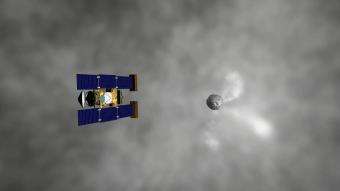
Samples from comet Wild 2 have surprised scientists, indicating the formation of at least some comets may have included materials ejected by the early sun to the far reaches of the solar system.
Scientists have found minerals formed near the sun or other stars in the samples returned to Earth by NASA's Stardust spacecraft in January. The findings suggest materials from the center of the solar system could have traveled to the outer reaches where comets formed. This may alter the way scientists view the formation and composition of comets.
"The interesting thing is we are finding these high-temperature minerals in materials from the coldest place in the solar system," said Donald Brownlee, Stardust principal investigator from the University of Washington, Seattle.
Scientists have long thought of comets as cold, billowing clouds of ice, dust and gases formed on the edges of the solar system. But comets may not be so simple or similar. They may prove to be diverse bodies with complex histories. Comet Wild 2 seems to have had a more complex history than thought.
"We have found very high-temperature minerals, which supports a particular model where strong bipolar jets coming out of the early sun propelled material formed near to the sun outward to the outer reaches of the solar system," said Michael Zolensky, Stardust curator and co-investigator at NASA's Johnson Space Center, Houston. "It seems that comets are not composed entirely of volatile rich materials but rather are a mixture of materials formed at all temperature ranges, at places very near the early sun and at places very remote from it."
One mineral found in the material brought back by Stardust is olivine, a primary component of the green sand found on some Hawaiian beaches. It is among the most common minerals in the universe, but scientists were surprised to find it in cometary dust.
Olivine is a compound of iron, magnesium and other elements. The Stardust sample is primarily magnesium. Along with olivine, the dust from Wild 2 contains high-temperature minerals rich in calcium, aluminum and titanium.
Stardust passed within 149 miles of comet Wild 2 in January 2004, trapping particles from the comet in an exposed gel. Its return capsule parachuted to the Utah desert on Jan. 15. The science canister with the Wild 2 sample arrived at Johnson on Jan. 17. Samples have been distributed to approximately 150 scientists for study.
"The collection of cometary particles is greater than we ever expected," said Stardust Deputy Principal Investigator Peter Tsou of NASA's Jet Propulsion Laboratory, Pasadena, Calif. "The collection includes about two dozen large tracks visible to the unaided eye."
The grains are tiny, most smaller than a hair's width. Thousands of them appear to be embedded in the glass-like aerogel. A single grain of 10 microns, only one-hundredth of a millimeter (.0004 inches), can be sliced into hundreds of samples for scientists.
In addition to cometary particles, Stardust gathered interstellar dust samples during its seven-year journey. The team at Johnson's curatorial facility hopes to begin detailed scanning of the interstellar tray within a month. They will initiate the Stardust at Home project. It will enable volunteers from the public to help scientists locate particles.
After registering, Stardust at Home participants may download a virtual microscope. The microscope will connect to a server and download "focus movies." The movies are images of the Stardust Interstellar Dust Collector from an automated microscope at the Cosmic Dust Lab at Johnson. Participants will search each field for interstellar dust impacts.
NASA's Jet Propulsion Laboratory, Pasadena, Calif., manages the Stardust mission for NASA's Science Mission Directorate, Washington. Lockheed Martin Space Systems, Denver, developed and operated the spacecraft.
Stardust science team members presented their first findings this week at the annual Lunar and Planetary Science Conference in League City, Texas.
Source: NASA


