Researchers simulate complete structure of virus–on computer
March 14th, 2006 Researchers simulate complete structure of virus–on computer

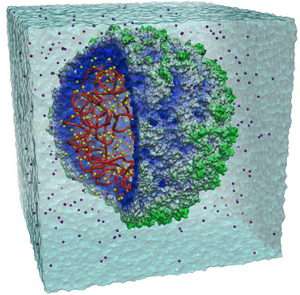
An overall computer-simulated view of the satellite tobacco mosaic virus. Credit: University of Illinois/NCSA

When Boeing and Airbus developed their latest aircraft, the companies’ engineers designed and tested them on a computer long before the planes were built. Biologists are catching on. They’ve just completed the first computer simulation of an entire life form – a virus.

In their quest to study life, biologists apply engineering knowledge somewhat differently: They “reverse engineer” life forms, test fly them in the computer, and see if they work in silico the way they do in vivo. This technique previously had been employed for small pieces of living cells, such as proteins, but not for an entire life form until now.

The accomplishment, performed by computational biologists at the University of Illinois at Urbana-Champaign and crystallographers at the University of California at Irvine, is detailed in the March issue of the journal Structure.

Deeper understanding of the mechanistic properties of viruses, the researchers say, could not only contribute to improvements in public health, but also in the creation of artificial nanomachines made of capsids – a small protein shell that contains a viral building plan, a genome, in the form of DNA or RNA.

Viruses are incredibly tiny and extremely primitive life forms that cause myriad diseases. Biologists often refer to them as particles rather than organisms. Viruses hijack a biological cell and make it produce many new viruses from a single original. They’ve evolved elaborate mechanisms of cell infection, proliferation and departure from the host when it bursts from viral overcrowding.

For their first attempt to reverse engineer a life form in a computer program, computational biologists selected the satellite tobacco mosaic virus because of its simplicity and small size.

The satellite virus they chose is a spherical RNA sub-viral agent that is so small and simple that it can only proliferate in a cell already hijacked by a helper virus – in this case the tobacco mosaic virus that is a serious threat to tomato plants.

A computer program was used to reverse engineer the dynamics of all atoms making up the virus and a small drop of salt water surrounding it. The virus and water contain more than a million atoms altogether.

The necessary calculation was done at Illinois on one of the world’s largest and fastest computers operated by the National Center for Supercomputing Applications. The computer simulations provided an unprecedented view into the dynamics of the virus.

“The simulations followed the life of the satellite tobacco mosaic virus, but only for a very brief time,” said co-author Peter Freddolino, a doctoral student in biophysics and computational biology at Illinois. “Nevertheless, they elucidated the key physical properties of the viral particle as well as providing crucial information on its assembly.”

It may take still a long time to simulate a dog wagging its tail in the computer, said co-author Klaus Schulten, Swanlund Professor of Physics at Illinois. “But a big first step has been taken to ‘test fly’ living organisms,” he said. “Naturally, this step will assist modern medicine as we continue to learn more about how viruses live.”

The computer simulations were carried out in Schulten’s Theoretical and Biophysics Group’s lab at the Beckman Institute for Avanced Science and Technology.

Other co-authors were Anton Arkhipov, a doctoral student in physics at Illinois, and Alexander McPherson, a professor of molecular biology and biochemistry, and research specialist Steven Larson, both at UC-Irvine.

Source: University of Illinois at Urbana-Champaign


print this article email this article download pdf blog this article bookmark this article     Digg this Stumble it share on Facebook share on Reddit add to delicious save to Yahoo! bookmarks
4.9/5 after 15 votes


March 14th, 2006 all stories
Other Sciences /

Comments: 0
Rank: 4.9/5 after 15 votes

  • Stumble this up

  • Digg this

  • Share it:
  • share on Facebook
  • share on MySpace
  • share on Slashdot
  • rss-newsfeed
  • share on Google
  • share on Reddit
  • add to delicious
  • save to Yahoo! bookmarks
  • share on Windows Live
  • Add to Mixx!
Rating: 4.9/5 after 15 votes

  • Related Stories

  • Computer Idle? Now You Can Donate Its Time to Find a Cure for Major Diseases
    created Jun 17, 2009 | popularity not rated yet | comments 0
  • International team tracks clues to HIV
    created May 19, 2009 | popularity not rated yet | comments 0
  • Computer simulation captures immune response to flu
    created May 18, 2009 | popularity not rated yet | comments 0
  • Conficker worm plays no tricks on April Fools' Day
    created Apr 02, 2009 | popularity not rated yet | comments 0
  • More older users heading for their keyboards
    created Feb 27, 2009 | popularity not rated yet | comments 0

Tags


  • Physicists Demonstrate Quantum Memory with Matter Qubits
    Physicists Demonstrate Quantum Memory with Matter Qubits
    Physics / General Physics
    created Jul 03, 2009 | popularity 4.4 / 5 (17) | comments 1
  • 'Holey' Nanosheets for Wastewater Dye Removal
    Nanotechnology / Nanomaterials
    created Jul 01, 2009 | popularity 5 / 5 (5) | comments 1
  • Jellyfish Robot Swims Like its Biological Counterpart
    Jellyfish Robot Swims Like its Biological Counterpart
    Electronics / Robotics
    created Jun 26, 2009 | popularity 4.4 / 5 (8) | comments 1
  • Could Maxwell's Demon Exist in Nanoscale Systems?
    Could Maxwell's Demon Exist in Nanoscale Systems?
    Physics / General Physics
    created Jun 24, 2009 | popularity 4.4 / 5 (18) | comments 29
  • Living Safely with Robots, Beyond Asimov's Laws
    Living Safely with Robots, Beyond Asimov's Laws
    Electronics / Robotics
    created Jun 22, 2009 | popularity 4.6 / 5 (54) | comments 40
  • Other News

    Creation Museum president Ken A. Ham

    Paleontologists brought to tears, laughter by Creation Museum

    Other Sciences / Other

    created Jun 30, 2009 | popularity 4.1 / 5 (47) | comments 130

    For a group of paleontologists, a tour of the Creation Museum seemed like a great tongue-in-cheek way to cap off a serious conference.


    Mummified dinosaur skin yields up new secrets

    Mummified dinosaur skin yields up new secrets

    Other Sciences / Archaeology & Fossils

    created Jul 01, 2009 | popularity 4.7 / 5 (17) | comments 10

    (PhysOrg.com) -- Scientists from The University of Manchester have identified preserved organic molecules in the skin of a dinosaur that died around 66-million years ago.


    Liberal? Conservative? Stanford study says mental nudge can make voters flip-flop

    Liberal? Conservative? Stanford study says mental nudge can make voters flip-flop

    Other Sciences / Social Sciences

    created Jul 02, 2009 | popularity 3.8 / 5 (6) | comments 4

    (PhysOrg.com) -- No doubt you’ve worked hard for your success. But chances are you’ve also had some help and lucky breaks along the way.


    Probing Question: How do Ponzi Schemes work?

    Other Sciences / Economics

    created Jul 02, 2009 | popularity 5 / 5 (2) | comments 2

    Imagine the shock, the horror, and the sheer panic that would come with learning that the financial plan you’d sunk your life savings into was a sham, the financial experts you trusted were crooks, and all your money was ...


    New fossil primate suggests common Asian ancestor, challenges primates such as 'Ida'

    New fossil primate suggests common Asian ancestor, challenges primates such as 'Ida'

    Other Sciences / Archaeology & Fossils

    created Jul 01, 2009 | popularity 4.4 / 5 (11) | comments 0

    According to new research published online in the Proceedings of the Royal Society B (Biological Sciences) on July 1, 2009, a new fossil primate from Myanmar (previously known as Burma) suggests that the co ...