Mars rovers find new evidence of 'habitable niche'
December 21, 2007
Mars rovers find new evidence of 'habitable niche'

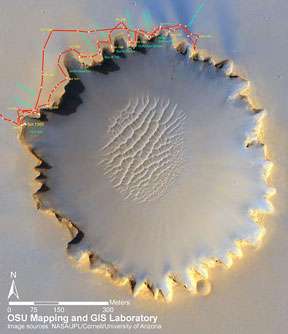
Victoria Crater, about 800 meters (one-half mile) in diameter, has been home ground for NASA's Mars Exploration Rover Opportunity for more than 14 of the rover's first 46 months on Mars. This view shows the rover's path overlaid on an image of the crater taken by the High Resolution Imaging Science Experiment on NASA's Mars Reconnaissance Orbiter. Credit: NASA/JPL-Caltech/University of Arizona/Cornell/Ohio State University

Inch by power-conserving inch, drivers on Earth have moved the Mars rover Spirit to a spot where it has its best chance at surviving a third Martian winter -- and where it will celebrate its fourth anniversary (in Earth years) since bouncing down on Mars for a projected 90-day mission in January 2004.

Meanwhile, researchers are considering the implications of what Cornell's Steve Squyres, principal investigator for NASA's Mars Exploration Rover mission, calls "one of the most significant" mission discoveries to date: silica-rich deposits uncovered in May by Spirit's lame front wheel that provide new evidence for a once-habitable environment in Gusev Crater.

Squyres and colleagues reported the silica deposits at the annual meeting of the American Geophysical Union in early December in San Francisco.

On the other side of Mars, Spirit's still-healthy twin Opportunity is creeping slowly down the inside of Victoria Crater, where layers of exposed rock are confirming findings made at the much smaller Eagle and Endurance craters -- and where deeper layers could offer new insight into the planet's history.

Spirit, which has been driving backward since its right front wheel stopped turning in March 2006, was exploring near a plateau in the Gusev Crater known as Home Plate when scientists noticed that upturned soil in the wake of its dragging wheel appeared unusually bright.

Measurements by the rover's alpha particle X-ray spectrometer and mini-thermal emission spectrometer showed the soil to be about 90 percent amorphous silica -- a substance associated with life-supporting environments on Earth.

"This is one of the most powerful pieces of evidence for formerly habitable conditions that we have found," said Squyres, Cornell's Goldwin Smith Professor of Planetary Science, in a Dec. 11 interview with the BBC.

On Earth, silica deposits are found at hot springs, where hot water dissolves silica in rock below the surface, then rises and cools, causing the silica to precipitate out near the surface; and at fumaroles, where hot acidic water or vapors seep through rock, dissolving away other elements but leaving silica behind.

"Either place on Earth is teeming with microbial life," said Squyres. "So this is, either way, a representation of what in the past was a local habitable environment -- a little habitable niche on the surface of Mars."

The discovery was reminiscent of Spirit's journey to winter safety last year, when it uncovered (and briefly got mired in) patches of bright soil that contained high levels of sulfur -- another possible indicator of past hydrothermal activity.

Unlike last year, though, Spirit enters this Martian winter handicapped by dusty solar panels -- the result of giant dust storms in June and July. So the rover's power levels, which currently range between approximately 290 and 250 watt-hours (100 watt-hours is the amount of energy needed to light a 100-watt bulb for one hour; full power for the rovers is 800-900 watt-hours) -- could drop to dangerous levels in the dwindling winter sunlight.

Spirit's perch is currently at a 15-degree tilt on the north-facing slope of the Home Plate plateau, said Jim Bell, Cornell associate professor of astronomy and leader of the mission's Pancam color camera team. As the sun moves lower in the Martian sky, drivers will nudge the rover to a steeper angle.

"The fact that we've gotten to a good tilt, and we're going to get to a better tilt, is a good sign," said Bell. Still, he added, any work the rover does over the winter -- collecting Pancam images of its surroundings, for example -- will be strictly low-exertion.

"Most of 2008 is going to be a quiet time for Spirit," he said. "It's really about survival."

Source: By Lauren Gold, Cornell University

4.6 /5 (28 votes)  

Filter


Move the slider to adjust rank threshold, so that you can hide some of the comments.


Display comments: newest first

earls
Dec 23, 2007

Rank: 1 / 5 (2)
Man, I have got to tell you, that is a gorgeous picture of an electrical discharge event. Wow, and just wow, it's very striking that the edge of the crater would bet he most energetic, and one of the best places on the planet for power.

"showed the soil to be about 90 percent amorphous silica"

Fused Quartz: The material formed by the rapid melting of quartz crystals. A meteor strike or a [bold]lightning bolt[/bold] striking sand can form fused quartz. The term quartz glass is often erroneously used to mean fused quartz, but quartz glass is a misnomer because quartz is crystalline and glass is noncrystalline.

Quartz: The most common type of crystalline silica. Some publications will use quartz and crystalline silica interchangeably, but the term crystalline silica actually encompasses several forms: quartz, cristobalite, tridymite, and several rarer forms. Also the term sand is used interchangeably.

http://www.osha.g...ary.html

"substance associated with life-supporting environments on Earth."

I promise you electrical activity is a substance necessary for a life supporting enviroment.

otherwise, I congratulate the meteor that made such a "perfect" surface strike.

btw, it's such a coincidence that another tiny meteor would hit just where it did in the bottom right hand corner.
earls
Dec 23, 2007

Rank: 1 / 5 (2)
I'm also going to be bold and say that the ridges in the center of the crater are not from wind, but are magnetic field lines.
out7x
Dec 24, 2007

Rank: 1 / 5 (1)
fumaroles do not create living cells.
saucerfreak2012
Dec 27, 2007

Rank: not rated yet
@earls...

Interesting suggestion.

What mechanism could account for such an enormous electrical discharge?
Rank 4.6 /5 (28 votes)
Tags

Related Stories
Relevant PhysicsForums posts
  • Scale of the Universe
    created12 hours ago
  • Titan's lack of impact craters
    createdFeb 09, 2012
  • Real pictures of black hole eating a star?
    createdFeb 08, 2012
  • Hypothetical way to travel faster than light, but not technically exceed lightspeed
    createdFeb 06, 2012
  • How do scientists monitor the Sun's activity?
    createdFeb 05, 2012
  • Search patterns in observational studies
    createdFeb 05, 2012
  • More from Physics Forums - General Astronomy

More news stories

Humans may have helped the decline of African rainforests 3000 years ago

(PhysOrg.com) -- Large areas of rainforests in Central Africa mysteriously disappeared over three thousand years ago, to be replaced by savannas. The prevailing theory has been that the cause was a change ...

Space & Earth / Environment

created 23 hours ago | popularity 4.3 / 5 (13) | comments 13 | with audio podcast report

Could Venus be shifting gear?

(PhysOrg.com) -- ESA’s Venus Express spacecraft has discovered that our cloud-covered neighbour spins a little slower than previously measured. Peering through the dense atmosphere in the infrared, the ...

Space & Earth / Space Exploration

created 19 hours ago | popularity 5 / 5 (7) | comments 8 | with audio podcast

NASA budget will axe Mars deal with Europe: scientists

US President Barack Obama's budget proposal to be submitted next week for 2013 will cut NASA's budget by 20 percent and eliminate a major partnership with Europe on Mars exploration, scientists said Thursday.

Space & Earth / Space Exploration

created 22 hours ago | popularity 5 / 5 (2) | comments 19

Mars Science Laboratory computer issue resolved

(PhysOrg.com) -- Engineers have found the root cause of a computer reset that occurred two months ago on NASA's Mars Science Laboratory and have determined how to correct it.

Space & Earth / Space Exploration

created 20 hours ago | popularity 4.7 / 5 (6) | comments 4 | with audio podcast

Two new moons for Jupiter

Advances in technology have lead to the discovery of new planets outside of our Solar System, and now even new moons in our own backyard.

Space & Earth / Space Exploration

created 19 hours ago | popularity 4 / 5 (1) | comments 7


Anonymous knocks CIA website offline (Update)

The website of the Central Intelligence Agency was inaccessible on Friday after the hacker group Anonymous claimed to have knocked it offline.

New error-correcting codes guarantee the fastest possible rate of data transmission

Error-correcting codes are one of the triumphs of the digital age. They’re a way of encoding information so that it can be transmitted across a communication channel — such as an optical fiber o ...

New power source discovered

(PhysOrg.com) -- Researchers at the Massachusetts Institute of Technology (MIT) and RMIT University have made a breakthrough in energy storage and power generation.

Small modular reactor design could be a 'SUPERSTAR'

(PhysOrg.com) -- Though most of today's nuclear reactors are cooled by water, we've long known that there are alternatives; in fact, the world's first nuclear-powered electricity in 1951 came from a reactor ...

The power of estrogen -- male snakes attract other males

A new study has shown that boosting the estrogen levels of male garter snakes causes them to secrete the same pheromones that females use to attract suitors, and turned the males into just about the sexiest ...

Google users warned of threat to smartphone wallets

Users of Google smartphone wallets were being warned on Friday that there is a way to crack pass codes intended to thwart thieves from going on illicit shopping sprees.