Nanotechnology brings brain recovery in sight
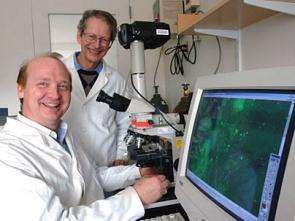
Rodents blinded by a severed tract in their brains' visual system had their sight partially restored within weeks, thanks to a tiny biodegradable scaffold invented by MIT bioengineers and neuroscientists.
This technique, which involves giving brain cells an internal matrix on which to regrow, just as ivy grows on a trellis, may one day help patients with traumatic brain injuries, spinal cord injuries and stroke.
The study, which will appear in the online early edition of the Proceedings of the National Academy of Sciences (PNAS) the week of March 13-17, is the first that uses nanotechnology to repair and heal the brain and restore function of a damaged brain region.
"If we can reconnect parts of the brain that were disconnected by a stroke, then we may be able to restore speech to an individual who is able to understand what is said but has lost the ability to speak," said co-author Rutledge G. Ellis-Behnke, research scientist in the MIT Department of Brain and Cognitive Sciences. "This is not about restoring 100 percent of damaged brain cells, but 20 percent or even less may be enough to restore function, and that is our goal."
Spinal cord injuries, serious stroke and severe traumatic brain injuries affect more than 5 million Americans at a total cost of $65 billion a year in treatment.
"If you can return a certain quality of life, if you can get some critical functions back, you have accomplished a lot for a victim of brain injury," said study co-author Gerald E. Schneider, professor of brain and cognitive sciences at MIT. Ellis-Behnke and Schneider worked with colleagues from the MIT Center for Biomedical Engineering (CBE) and medical schools in Hong Kong and China.
In the experiment on young and adult hamsters with severed neural pathways, the researchers injected the animals' brains with a clear solution containing a self-assembling material made of fragments of proteins, the building blocks of the human body. These protein fragments are called peptides.
Shuguang Zhang, associate director of the CBE and one of the study's co-authors, has been working on self-assembling peptides for a variety of applications since he discovered them by accident in 1991. Zhang found that placing certain peptides in a salt solution causes them to assemble into thin sheets of 99 percent water and 1 percent peptides. These sheets form a mesh or scaffold of tiny interwoven fibers. Neurons are able to grow through the nanofiber mesh, which is similar to that which normally exists in the extracellular space that holds tissues together.
The process does not involve growing new neurons, but creates an environment conducive for existing cells to regrow their long branchlike projections called axons, through which neurons form synaptic connections to communicate with other neurons. These projections were able to bridge the gap created when the neural pathway was cut and restore enough communication among cells to give the animals back useful vision within around six weeks. The researchers were surprised to find that adult brains responded as robustly as the younger animals' brains, which typically are more adaptable.
"Our designed self-assembling peptide nanofiber scaffold created a good environment not only for axons to regenerate through the site of an acute injury but also to knit the brain tissue together," said Zhang. The technique may be useful for helping close cuts in the brain made during surgery to remove tumors.
Doctors treating traumatic brain injury are confronted with a number of obstacles. When brain tissue is injured, the tissue closes itself like a skin wound. When this happens, scar tissue forms around the injury and large gaps appear where there was once continuous gray matter.
When the clear fluid containing the self-assembling peptides is injected into the area of the cut, it flows into gaps and starts to work as soon as it comes into contact with the fluid that bathes the brain. After serving as a matrix for new cell growth, the peptides' nanofibers break down into harmless products that are eventually excreted in urine or used for tissue repair.
The MIT researchers' synthetic biological material is better than currently available biomaterials because it forms a network of nanofibers similar in scale to the brain's own matrix for cell growth; it can be broken down into natural amino acids that may even be beneficial to surrounding tissue; it is free of chemical and biological contaminants that may show up in animal-derived products such as collagen; and it appears to be immunologically inert, avoiding the problem of rejection by surrounding tissue, the authors wrote.
The researchers are testing the self-assembling peptides on spinal cord injuries and hope to launch trials in primates and eventually humans.
Source: MIT


