Polarization technique focuses limelight
December 26, 2007 Polarization technique focuses limelight

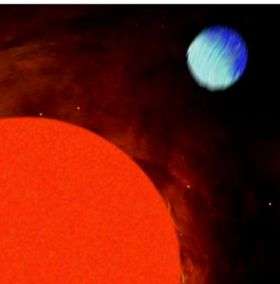
An artistic view of the HD189733 star-planet system near a half-moon phase when polarization of the light reflected by the planet reaches the maximum. Credit: ETH Zurich, S.V. Berdyugina

The ability to explore remote worlds in space has been enhanced through a polarization technique that allows the first ever detection of light reflected by extrasolar (exoplanet) planets. The study has been accepted for publication in Astrophysical Journal Letters.

An international team of astronomers, led by Professor Svetlana Berdyugina of ETH Zurich’s Institute of Astronomy, has for the first time ever been able to detect and monitor the visible light that is scattered in the atmosphere of an exoplanet.

Employing techniques similar to how Polaroid sunglasses filter away reflected sunlight to reduce glare, the team of scientists were able to extract polarized light to enhance the faint reflected starlight ‘glare’ from an exoplanet. As a result, the scientists could infer the size of its swollen atmosphere. They also directly traced the orbit of the planet, a feat of visualization not possible using indirect methods.

Hot Jupiter

The transiting exoplanet under study circles the dwarf star HD189733 in the constellation Vulpecula and lies more than 60 light years from the earth. Known as HD189733b, this exoplanet was discovered two years ago via Doppler spec-troscopy. HD189733b is so close to its parent star that its atmosphere expands from the heat. Until now, astronomers have never seen light reflected from an exoplanet, although they have deduced from other observations that HD189733b probably resembles a ‘hot Jupiter’ – a planet orbiting extremely closely to its parent star. Unlike Jupiter, however, HD189733b orbits its star in a couple of days rather than the 12 years it takes Jupiter to make one orbit of the sun.

Two half-moon phases

The international team, consisting of Svetlana Berdyugina, Dominique Fluri (ETH Zurich), Andrei Berdyugin and Vilppu Piirola (Tuorla Observatory, Finland), used the 60cm KVA telescope by remote control. The telescope, which belongs to the Royal Swedish Academy of Science, is located at La Palma, Spain and was modernised by scientists in Finland. The researchers obtained polarimetric measurements of the star and its planet. They discovered that polarization peaks near the moments when half of the planet is illuminated by the star as seen from the earth. Such events occur twice during the orbit, similar to half-moon phases.

The polarization indicates that the scattering atmosphere is considerably larger (>30%) than the opaque body of the planet seen during transits and most probably consists of particles smaller than half a micron, for example atoms, molecules, tiny dust grains or perhaps water vapour, which was recently sug-gested to be present in the atmosphere. Such particles effectively scatter blue light – in exactly the same scattering process that creates the blue sky of the earth’s atmosphere. The scientists were also able for the first time to recover the orientation of the planet’s orbit and trace its motion in the sky.

“The polarimetric detection of the reflected light from exoplanets opens new and vast opportunities for exploring physical conditions in their atmospheres”, Pro-fessor Svetlana Berdyugina said. “In addition, more can be learned about radii and true masses, and thus the densities of non-transiting planets.”

Citation: Svetlana V. Berdyugina, Andrei V. Berdyugin, Dominique M. Fluri, Vilppu Piirola: First detection of polarized scattered light from an exoplanetary atmosphere, Astrophys. J. Lett., online publication 24. December 2007.

Source: Swiss Federal Institute of Technology


print this article email this article download pdf blog this article bookmark this article     Stumble it Digg this share on Facebook retweet share on Reddit add to delicious
Rate this story - 4.7 /5 (46 votes)

Rank Filter

Move the slider to adjust rank threshold, so that you can hide some of the comments.


Display comments: newest first

  • Doug_Huffman - Dec 27, 2007
    • Rank: 1 / 5 (4)
    I can't believe that these authors haven't consulted the International Star Registry ("in book form in the US Copyright office") for a more attractive and concise name than HD189733. Might not there be some legal liability associated, ISR not insisting on whatever 'rights' its client subscribed or vice versa? The seriousness of these charges merits an investigation.
  • out7x - Feb 07, 2008
    • Rank: 1 / 5 (1)
    This says nothing about composition of the exoplanet atmosphere.

December 26, 2007 all stories

Comments: 2

4.7 /5 (46 votes)
  • Stumble this up

  • Digg this

  • share this

  • hide
  • Related Stories

  • Newly Discovered Fat Molecule: An Undersea Killer with an Upside
    created Nov 05, 2009 | popularity not rated yet | comments 0
  • Carbon Atmosphere Discovered on Neutron Star
    created Nov 04, 2009 | popularity not rated yet | comments 0
  • STAR TRAK for November: Mars is prominent again
    created Nov 02, 2009 | popularity not rated yet | comments 0
  • Fermi Telescope Detects Gamma-Ray From 'Star Factories' in Other Galaxies
    created Nov 02, 2009 | popularity not rated yet | comments 0
  • Starburst galaxy sheds light on longstanding cosmic mystery
    created Nov 02, 2009 | popularity not rated yet | comments 0


  • hide
  • Relevant PhysicsForums posts

  • The shape of our solar system's orbits.
    created 18 hours ago
  • Above or Below the Line of Nodes
    created 22 hours ago
  • Supernova vs. Nova?
    created Nov 07, 2009
  • Supernova's Gamma Rays and Comets
    created Nov 06, 2009
  • More from Physics Forums - General Astronomy

Other News

Deep creep means milder, more frequent earthquakes along Southern California's San Jacinto fault

Deep creep means milder, more frequent earthquakes along Southern California's San Jacinto fault

Space & Earth / Earth Sciences

created 3 hours ago | popularity 4.5 / 5 (2) | comments 0

With an average of four mini-earthquakes per day, Southern California's San Jacinto fault constantly adjusts to make it a less likely candidate for a major earthquake than its quiet neighbor to the east, the ...


Success in 'space elevator' competition (AP)

Success in 'space elevator' competition (Update 3)

Space & Earth / Space Exploration

created Nov 05, 2009 | popularity 4.3 / 5 (33) | comments 50

(AP) -- A robot powered by a ground-based laser beam climbed a long cable dangling from a helicopter on Wednesday to qualify for prize money in a $2 million competition to test the potential reality of the ...


'Dropouts' pinpoint earliest galaxies

'Dropouts' pinpoint earliest galaxies

Space & Earth / Astronomy

created Nov 06, 2009 | popularity 4.1 / 5 (9) | comments 12

Astronomers, conducting the broadest survey to date of galaxies from about 800 million years after the Big Bang, have found 22 early galaxies and confirmed the age of one by its characteristic hydrogen signature ...


Space hotel taking bookings for 2012 opening

Space hotel taking bookings for 2012 opening

Space & Earth / Space Exploration

created Nov 05, 2009 | popularity 4.4 / 5 (20) | comments 11

(PhysOrg.com) -- The first orbiting space hotel is on track to open for its first customers in 2012, but hurry, as bookings are filling fast.


In a Galaxy Far, Far Away...

In a Galaxy Far, Far Away...

Space & Earth / Astronomy

created Nov 06, 2009 | popularity 4.8 / 5 (4) | comments 12

(PhysOrg.com) -- Astronomers have published the discovery of the farthest known object in the cosmos: a star that exploded when the universe was only 630 million years old -- only 4.6% of its current age. ...