Nanodisk Codes

December 27th, 2007 By Laura Mgrdichian Nanodisk Codes

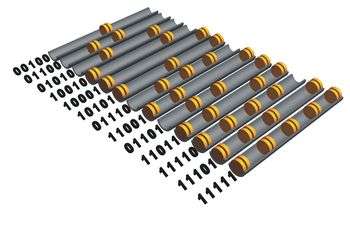
Physical binary codes formed by nanodisks carved out of nanorods. Image courtesy Chad Mirkin.

Researchers at Northwestern University have devised a way to use billionth-of-a-meter-sized disks to create codes that could be used to encrypt information, serve as biological labels, and even tag and track goods and personnel.

The nanodisks can form a physical pattern, similar in concept to a barcode, as well as a spectroscopic code, meaning it can exhibit a specific, unique response to electromagnetic radiation, or light, depending on the type of molecule (or molecules) attached to the disks—in other words, how the disks are “functionalized.”

Nanostructures can be ideal for encoding. Their small size allows them to be hidden easily in a variety of materials and objects, and scientists' ability to easily tailor their physical and chemical properties makes it possible to design nanostructures for specific coding functions.

In a paper describing this work, published in a recent edition of Nano Letters, the researchers, led by Northeastern chemist Chad Mirkin, describe how the nanodisks can form physical binary codes. The group started with nanorods made of gold and nickel and, using a method they developed, carved disks out of each rod. The disks are created in twos, with up to five pairs created per rod.

Each of the five disk-pair locations along the rod can correspond to a “0” or a “1,” depending on whether that location is occupied by a disk pair. For example, if only one disk pair is present, and it is situated at the third location, that code is read as 00100. If two disk pairs are present, at the fourth and fifth locations, the code is 00011.

“This is a rapid, low cost way of making many unique nanostructures that can identified and read based upon high sensitivity spectroscopic techniques,” Mirkin said to PhysOrg.com. “It's a beautiful example of how the ability to shape and control the size and surface composition of a nanostructure can translate into significant technological advantages.”

The group has made nanodisk arrays as long as 12 micrometers (millionths of a meter), which can support as many as 10 disk pairs, yielding 287 physical nanodisk codes.

The researchers increased the codes' usefulness by functionalizing them with a class of dye molecules called chromophores. This makes the codes spectroscopically active, allowing each to emit a unique light spectrum when illuminated by an exterior light source, typically a laser beam.

Due to the physical and spectroscopic codes they can exhibit, the nanodisks are particularly suited for biological tagging, a method of tracking and detecting individual biological materials, such as DNA. The researchers proved this by attaching pieces of single-stranded DNA to the surfaces of the nanodisks in a 11011 code. Each of these strands was complementary to half of a “target” DNA strand—the strand being tagged. The other half of the target strand was complementary to a “reporter” strand, rendered spectroscopically active with dye. The overall structure formed a three-strand “sandwich,” with the target strand in the middle.

The group also created a similar sandwich structure using a different reporter strand and a 10101 code, and then mixed the two samples. They were able to successfully detect and distinguish between the unique spectrums emitted by both reporter molecules.

Citation: Nano Lett., 7 (12), 3849-3853, 2007

Copyright 2007 PhysOrg.com.
All rights reserved. This material may not be published, broadcast, rewritten or redistributed in whole or part without the express written permission of PhysOrg.com.


print this article email this article download pdf blog this article bookmark this article     Digg this Stumble it share on Facebook share on Reddit add to delicious save to Yahoo! bookmarks
4/5 after 50 votes

Rank Filter

Move the slider to adjust rank threshold, so that you can hide some of the comments.


Display comments: newest first

  • fizz - Dec 30, 2007
    • Rank: not rated yet
    I think physorg messed up this story.. check out this related blog post: http://1stedition...k-codes/
  • LearmSceince - Jan 02, 2008
    • Rank: not rated yet
    How do you figure 287 possible codes?
  • Quantum_Conundrum - Jan 10, 2008
    • Rank: not rated yet
    10 disk pairs equates to 20 "flags" each corresponding to 1 or 0.

    last time I checked,

    2^20 = 1024^2 = 1,048,576

    unique combinations.

    In any case, it is binary, and 287 is absolutely the wrong number no matter how many discs are possible.

December 27th, 2007 all stories
Nanotechnology / Nanophysics

Comments: 3
Rank: 4/5 after 50 votes

  • Stumble this up

  • Digg this

  • Share it:
  • share on Facebook
  • share on MySpace
  • share on Slashdot
  • rss-newsfeed
  • share on Google
  • share on Reddit
  • add to delicious
  • save to Yahoo! bookmarks
  • share on Windows Live
  • Add to Mixx!
Rating: 4/5 after 50 votes

  • Related Stories

  • Backtracking on DNA
    created Jun 23, 2009 | popularity not rated yet | comments 0
  • A new way to assemble cells into 3-D microtissues
    created Mar 05, 2009 | popularity not rated yet | comments 0
  • Can genetic information be controlled by light?
    created Oct 10, 2008 | popularity not rated yet | comments 0
  • Researchers make first direct observation of 3-D molecule folding in real time
    created Feb 14, 2008 | popularity not rated yet | comments 0
  • Physicists create first robust DNA building blocks
    created Dec 09, 2005 | popularity not rated yet | comments 0

Tags


  • Physicists Demonstrate Quantum Memory with Matter Qubits
    Physicists Demonstrate Quantum Memory with Matter Qubits
    Physics / General Physics
    created 21 hours ago | popularity 4.5 / 5 (11) | comments 1
  • 'Holey' Nanosheets for Wastewater Dye Removal
    Nanotechnology / Nanomaterials
    created Jul 01, 2009 | popularity 5 / 5 (5) | comments 1
  • Jellyfish Robot Swims Like its Biological Counterpart
    Jellyfish Robot Swims Like its Biological Counterpart
    Electronics / Robotics
    created Jun 26, 2009 | popularity 4.4 / 5 (7) | comments 1
  • Could Maxwell's Demon Exist in Nanoscale Systems?
    Could Maxwell's Demon Exist in Nanoscale Systems?
    Physics / General Physics
    created Jun 24, 2009 | popularity 4.4 / 5 (18) | comments 29
  • Living Safely with Robots, Beyond Asimov's Laws
    Living Safely with Robots, Beyond Asimov's Laws
    Electronics / Robotics
    created Jun 22, 2009 | popularity 4.6 / 5 (51) | comments 39
  • Other News

    Harnessing Nanoparticles To Track Cancer Cell Changes

    Nanotechnology / Bio & Medicine

    created 20 hours ago | popularity not rated yet | comments 0

    The more dots there are, the more accurate a picture you get when you connect them. Cancer researchers adopting that philosophy have developed a new imaging technology that could give scientists the ability to simultaneously ...


    A 'quantum of sol' -- how nanotechnology could hold the key to a solar-powered future

    A 'quantum of sol' -- how nanotechnology could hold the key to a solar-powered future

    Nanotechnology / Nanomaterials

    created Jun 30, 2009 | popularity 3.5 / 5 (11) | comments 16

    (PhysOrg.com) -- A new generation of 'nano-structured' millimetre-sized solar cells that could convert the sun's energy to electricity more than twice as efficiently as current technology, is the subject of ...


    Australian researchers are set to begin human trials of a tiny nano-cell that acts as a "Trojan horse" against cancer

    Hi-tech 'Trojan horse' can kill cancer cells: researchers

    Nanotechnology / Bio & Medicine

    created Jun 29, 2009 | popularity 4.6 / 5 (11) | comments 7

    Australian researchers are set to begin human trials of a tiny nano-cell that acts as a "Trojan horse" against cancer cells, a breakthrough they say may curb the need for debilitating chemotherapy.


    'Holey' Nanosheets for Wastewater Dye Removal

    Nanotechnology / Nanomaterials

    created Jul 01, 2009 | popularity 5 / 5 (5) | comments 1

    (PhysOrg.com) -- Researchers have discovered that extremely thin sheets of nickel oxide with hexagonally shaped holes can absorb hazardous dyes from wastewater nearly as well as the best traditional methods, but are recyclable. ...


    Implant bacteria, beware: Researchers create nano-sized assassins

    Implant bacteria, beware: Researchers create nano-sized assassins

    Nanotechnology / Bio & Medicine

    created Jun 26, 2009 | popularity 4.9 / 5 (7) | comments 0

    Staphylococcus epidermidis is quite an opportunist. Commonly found on human skin, the bacteria pose little danger. But S. epidermidis is a leading cause of infections in hospitals. From catheters to prosthetic ...