New process builds electronic function into optical fiber
March 16th, 2006 New process builds electronic function into optical fiber

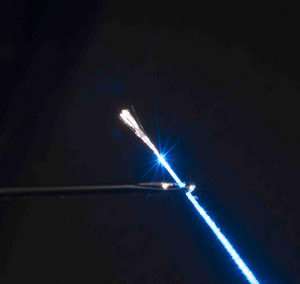
These photos show a glass fiber with a bundle of semiconductor wires emanating from it. Each wire is just 2 microns in diameter--20 times smaller than a human hair. The glass fiber is glowing from blue laser light. One of the images shows the wire-packed glass fiber passing through the eye of a needle. Credit: Neil Baril, Penn State.

Optical fiber helped bring us the Internet, and silicon/germanium devices brought us microelectronics. Now, a joint team from Penn State University and the University of Southampton has developed a new way to combine these technologies. The team has made semiconductor devices, including a transistor, inside microstructured optical fibers. The resulting ability to generate and manipulate signals inside optical fibers could have applications in fields as diverse as medicine, computing, and remote sensing devices.

Optical fiber has proved to be the ideal medium for transmitting signals based on light, while crystalline semiconductors are the best way to manipulate electrons. One of the greatest current technological challenges is exchanging information between optics and electronics rapidly and efficiently. This new technique may provide the tools to cross the divide. The results of this research will be published in the 17 March edition of the journal Science.
New process builds electronic function into optical fiber

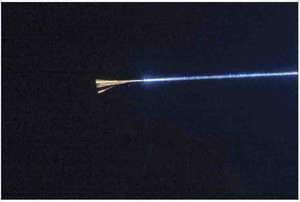
These photos show a glass fiber with a bundle of semiconductor wires emanating from it. Each wire is just 2 microns in diameter--20 times smaller than a human hair. The glass fiber is glowing from blue laser light. One of the images shows the wire-packed glass fiber passing through the eye of a needle. Credit: Neil Baril, Penn State.

"This advance is the basis for a technology that could build a large range of devices inside an optical fiber," said John Badding, associate professor of chemistry at Penn State University. While the optical fiber transmits data, a semiconductor device allows active manipulation of the light, including generating and detecting, amplifying signals, and controlling wavelengths. "If the signal never leaves the fiber, then it is faster, cheaper and more efficient," said Badding. "

"This fusion of two separate technologies opens the possibility of true optoelectronic devices that do not require conversion between optical and electronic signals," said Pier Sazio, senior research fellow in the Optoelectronics Research Centre at the University of Southampton (UK). "If you think of the fiber as a water main, this structure places the pumping station inside the pipe. The glass fiber provides the transmission and the semiconductor provides the function."

Beyond telecommunications, optical fibers are used in a wide range of technologies that employ light. "For example, in endoscopic surgery, by building a laser inside the fiber you might be able to deliver a wavelength that could not otherwise be used," said Badding.

The key breakthrough was the ability to form crystalline semiconductors that nearly fill the entire inside diameter, or pore, of very narrow glass capillaries. These capillaries are optical fibers--long, clear tubes that can carry light signals in many wavelengths simultaneously. When the tube is filled with a crystalline semiconductor, such as germanium, the semiconductor forms a wire inside the optical fiber. The combination of optical and electrical capabilities provides the platform for development of new optoelectronic devices.
New process builds electronic function into optical fiber

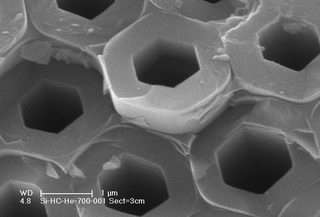
Scanning electron micrograph (SEM) of the cross section of a partially silicon filled holey fiber. Credit: Neil Baril, Penn State

The crystals were formed using chemical vapor deposition (CVD) to deposit germanium and other semiconductors inside the long, narrow pores of the hollow optical fiber. In the CVD process, a germanium compound is vaporized and then forced through the pores of the fiber at pressures as high as 1000 times atmospheric pressure and temperatures up to 500°C. A chemical reaction within the fiber allows germanium to coat the interior walls of the hollow fiber and then form crystals that grow inward. "The process works so perfectly that you can get a germanium tube that has an opening in the center of only 25 nanometers through the length of the fiber," said Sazio. "This is only a tiny fraction of the diameter of the fiber pore, so it is essentially a wire." This is the first demonstration of building crystalline structures, which are best for semiconductor devices, inside the pores of the capillaries.

The team has built a simple in-fiber transistor, and they point to the success of the Erbium Doped Fiber Amplifier, which was invented at Southampton in the late 1980s, to illustrate the transformational possibilities of this technology. By incorporating the chemical element erbium into the fiber, the Erbium Amplifier allows efficient transmission of data signals in transoceanic optical fibers. "Without that kind of device, it would be necessary to periodically convert the light to an electronic signal, amplify the signal, and convert it back to light, which is expensive and inefficient" said Sazio. " Since its inception, the Erbium Amplifier has made the internet possible in its current form."

Beyond the simple devices that this research has demonstrated, the research team sees the potential for the embedded semiconductors to carry optoelectronic applications to the next level. "At present you still have electrical switching at both ends of the optical fiber," says Badding. "If we can get to the point where the signal never leaves the fiber, it will be faster and more efficient. If we can actually generate signals inside a fiber, a whole range of optoelectronic applications become possible."

Source: Penn State


print this article email this article download pdf blog this article bookmark this article     Digg this Stumble it share on Facebook share on Reddit add to delicious save to Yahoo! bookmarks
4/5 after 15 votes


March 16th, 2006 all stories
Physics /

Comments: 0
Rank: 4/5 after 15 votes

  • Stumble this up

  • Digg this

  • Share it:
  • share on Facebook
  • share on MySpace
  • share on Slashdot
  • rss-newsfeed
  • share on Google
  • share on Reddit
  • add to delicious
  • save to Yahoo! bookmarks
  • share on Windows Live
  • Add to Mixx!
Rating: 4/5 after 15 votes

  • Related Stories

  • Big Bear Solar Observatory captures sun's magnetic field
    created May 19, 2009 | popularity not rated yet | comments 0
  • Shedding some light on Parkinson's treatment
    created Apr 16, 2009 | popularity not rated yet | comments 0
  • Low-tech tools take out phones in Silicon Valley
    created Apr 11, 2009 | popularity not rated yet | comments 0
  • Silicon optical fiber made practical
    created Oct 28, 2008 | popularity not rated yet | comments 0
  • Mayo Clinic estimates new, tiny, super-sensitive probe could cut colon polyp removal in half
    created Oct 07, 2008 | popularity not rated yet | comments 0

Tags


  • Physicists Demonstrate Quantum Memory with Matter Qubits
    Physicists Demonstrate Quantum Memory with Matter Qubits
    Physics / General Physics
    created Jul 03, 2009 | popularity 4.4 / 5 (17) | comments 1
  • 'Holey' Nanosheets for Wastewater Dye Removal
    Nanotechnology / Nanomaterials
    created Jul 01, 2009 | popularity 5 / 5 (5) | comments 1
  • Jellyfish Robot Swims Like its Biological Counterpart
    Jellyfish Robot Swims Like its Biological Counterpart
    Electronics / Robotics
    created Jun 26, 2009 | popularity 4.4 / 5 (8) | comments 1
  • Could Maxwell's Demon Exist in Nanoscale Systems?
    Could Maxwell's Demon Exist in Nanoscale Systems?
    Physics / General Physics
    created Jun 24, 2009 | popularity 4.4 / 5 (18) | comments 29
  • Living Safely with Robots, Beyond Asimov's Laws
    Living Safely with Robots, Beyond Asimov's Laws
    Electronics / Robotics
    created Jun 22, 2009 | popularity 4.6 / 5 (52) | comments 40
  • Other News

    UQ researchers break the law -- of physics

    Physics / General Physics

    created 1hour ago | popularity 4.3 / 5 (3) | comments 0

    (PhysOrg.com) -- Two UQ Science researchers have proved two famous physical laws that have been widely used for the past 25 years do not always work.


    Scientists create first electronic quantum processor

    Scientists create first electronic quantum processor

    Physics / General Physics

    created Jun 28, 2009 | popularity 4.8 / 5 (54) | comments 41

    A team led by Yale University researchers has created the first rudimentary solid-state quantum processor, taking another step toward the ultimate dream of building a quantum computer.


    Science journals

    How to Spot an Influential Paper Based on its Citations

    Physics / General Physics

    created Jul 04, 2009 | popularity 4 / 5 (9) | comments 6

    (PhysOrg.com) -- At first it may seem that the number of citations received by a published scientific paper is directly related to that paper's quality of content. The higher the quality, the more people read ...


    Fermilab's CDF observes Omega-sub-b baryon

    Fermilab's CDF observes Omega-sub-b baryon

    Physics / General Physics

    created Jun 29, 2009 | popularity 4.7 / 5 (17) | comments 7

    (PhysOrg.com) -- At a recent physics seminar at the Department of Energy’s Fermi National Accelerator Laboratory, Fermilab physicist Pat Lukens of the CDF experiment announced the observation of a new particle, ...


    New insights, and a new angle, on high-temperature superconductivity

    New insights, and a new angle, on high-temperature superconductivity

    Physics / Superconductivity

    created Jun 29, 2009 | popularity 4.8 / 5 (13) | comments 6

    (PhysOrg.com) -- A Princeton-led research team has revealed surprising information about how electron behavior influences the conduction of electricity in a class of high-temperature superconductors. An increased ...