Carbon sink capacity in northern forests reduced by global warming
January 2nd, 2008 Carbon sink capacity in northern forests reduced by global warming

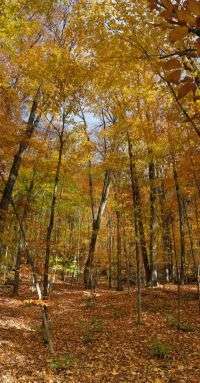
Mont Wright, a northern hardwood forest near Quebec City, Canada. Credit: Marc André Giasson

An international study investigating the carbon sink capacity of northern terrestrial ecosystems discovered that the duration of the net carbon uptake period (CUP) has on average decreased due to warmer autumn temperatures.

Net carbon uptake of northern ecosystems is decreasing in response to autumnal warming according to findings recently published January 3rd, in the journal Nature. The carbon balance of terrestrial ecosystems is particularly sensitive to climatic changes in autumn and spring. Over the past two decades autumn temperatures in northern latitudes have risen by about 1.1 °C with spring temperatures up by 0.8 °C.

Many northern terrestrial ecosystems currently lose carbon dioxide (CO2) in response to autumn warming, offsetting 90% of the increased carbon dioxide uptake during spring. Using computer modeling to integrate forest canopy measurements and remote satellite data, researchers found that while warm spring temperatures accelerate growth more than soil decomposition and enhance carbon uptake, autumn warming greatly increases soil decomposition and significantly reduces carbon uptake.

Lead author of the study, Dr. Shilong Piao from the LSCE, UMR CEA-CNRS,in France says “If warming in autumn occurs at a faster rate than in spring, the ability of northern ecosystems to sequester carbon will diminish in the future”.

Philippe Ciais also, a member of the research team and a scientist from the Global Carbon Project says “The potentially rapid decline in the future ability of northern terrestrial ecosystems to remove atmospheric carbon dioxide would make stabilization of atmospheric CO2 concentrations much harder than currently predicted”.

Source: Global Carbon Project


print this article email this article download pdf blog this article bookmark this article     Digg this Stumble it share on Facebook share on Reddit add to delicious save to Yahoo! bookmarks
3.4/5 after 5 votes

Rank Filter

Move the slider to adjust rank threshold, so that you can hide some of the comments.


Display comments: newest first

  • NotParker - Jan 02, 2008
    • Rank: 1 / 5 (1)
    Most mature forests are net producers of carbon.

January 2nd, 2008 all stories
Space & Earth / Environment

Comments: 1
Rank: 3.4/5 after 5 votes

  • Stumble this up

  • Digg this

  • Share it:
  • share on Facebook
  • share on MySpace
  • share on Slashdot
  • rss-newsfeed
  • share on Google
  • share on Reddit
  • add to delicious
  • save to Yahoo! bookmarks
  • share on Windows Live
  • Add to Mixx!
Rating: 3.4/5 after 5 votes

  • Related Stories

  • Breakthrough made in assessing marine phytoplankton health
    created May 28, 2009 | popularity not rated yet | comments 0
  • Spring agricultural fires have large impact on melting Arctic
    created May 26, 2009 | popularity not rated yet | comments 0
  • Efforts to save salmon may be undone by climate change
    created May 12, 2009 | popularity not rated yet | comments 0
  • Fire influences global warming more than previously thought
    created Apr 23, 2009 | popularity not rated yet | comments 0
  • Forests could flip from sink to source of CO2: study
    created Apr 17, 2009 | popularity not rated yet | comments 0

Tags


  • Physicists Demonstrate Quantum Memory with Matter Qubits
    Physicists Demonstrate Quantum Memory with Matter Qubits
    Physics / General Physics
    created Jul 03, 2009 | popularity 4.4 / 5 (17) | comments 1
  • 'Holey' Nanosheets for Wastewater Dye Removal
    Nanotechnology / Nanomaterials
    created Jul 01, 2009 | popularity 5 / 5 (5) | comments 1
  • Jellyfish Robot Swims Like its Biological Counterpart
    Jellyfish Robot Swims Like its Biological Counterpart
    Electronics / Robotics
    created Jun 26, 2009 | popularity 4.4 / 5 (8) | comments 1
  • Could Maxwell's Demon Exist in Nanoscale Systems?
    Could Maxwell's Demon Exist in Nanoscale Systems?
    Physics / General Physics
    created Jun 24, 2009 | popularity 4.4 / 5 (18) | comments 29
  • Living Safely with Robots, Beyond Asimov's Laws
    Living Safely with Robots, Beyond Asimov's Laws
    Electronics / Robotics
    created Jun 22, 2009 | popularity 4.6 / 5 (53) | comments 40
  • Other News

    China environmental phenomena monitored from space

    Space & Earth / Earth Sciences

    created 1hour ago | popularity not rated yet | comments 0

    China is in a very seismically active area and has had many catastrophic earthquakes during its history. A joint European-Chinese team is using satellite radar data to monitor ground deformation across major continental faults ...


    California to require sun-blocking car windows

    Space & Earth / Environment

    created 2 hours ago | popularity 2.3 / 5 (3) | comments 4

    New cars sold in California must include windshields that block or absorb the sun's rays beginning in 2012, the state's Air Resources Board recently ruled.


    Scientists: Silent tremors may foretell next Big One

    Space & Earth / Earth Sciences

    created 3 hours ago | popularity not rated yet | comments 0

    The seismometer is snugged in its hole and tamped over with dirt. Now it's time for the stomp test.


    Steam billows from the cooling towers at a nuclear power generating station in Byron

    Tropical zone expanding due to climate change: study

    Space & Earth / Earth Sciences

    created 5 hours ago | popularity 3 / 5 (4) | comments 1

    Climate change is rapidly expanding the size of the world's tropical zone, threatening to bring disease and drought to heavily populated areas, an Australian study has found.


    The least sea ice in 800 years

    The least sea ice in 800 years

    Space & Earth / Earth Sciences

    created Jul 01, 2009 | popularity 4.1 / 5 (65) | comments 60

    New research, which reconstructs the extent of ice in the sea between Greenland and Svalbard from the 13th century to the present indicates that there has never been so little sea ice as there is now. The ...