New Wrinkle in the Mystery of High-Tc Superconductors
March 16, 2006
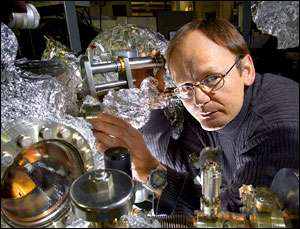
Tonica Valla
In the twenty years since the discovery of high-temperature (Tc) superconductors, scientists have been trying to understand the mechanism by which electrons pair up and move coherently to carry electrical current with no resistance. “We are still at the beginning,” says Tonica Valla, a physicist at the U.S. Department of Energy’s Brookhaven National Laboratory, who will give a talk on his group’s latest results at the American Physical Society meeting in Baltimore, Maryland on Thursday, March 16, 2006. “If anything,” he adds, “it looks like the story is getting more complicated.”
In 1999, Valla’s group was the first to observe a “kink” in the energy level of electrons in high-Tc superconductors just as they went through the transition temperature from their normal to superconducting state. The kink was the first clue to explaining what the mechanism of electron pairing might be.
“The kink gave us the hope that we could identify the interaction that was responsible for the electron pairing,” said Valla. Some groups hold that the mechanism is the same as in conventional superconductors — that is, that phonons, or vibrations in the crystal lattice, are responsible for electron pairing. Other scientists believe that changes in the spin alignment, or magnetic polarity, of adjacent electrons — known as magnons — are responsible. “The problem is that there are both phonons and magnons in the crystal with the energy where we see the kink, so it is still not clear,” Valla says.
The latest wrinkle uncovered by Valla’s group is the observation of similar energy scales and gaps in a material that is not a superconductor. The material is a special form of a compound made of lanthanum, barium, copper, and oxygen, where there is exactly one barium atom for every eight copper atoms. With less or more barium, the material acts as a high-Tc superconductor (in fact, this was the very first high-Tc superconductor discovered). But at the 1:8 ratio, the material momentarily loses its superconductivity.
“The fact that this system, which is not a superconductor, has similar properties to the superconducting system is not helping to solve the mystery,” Valla says. But then he notes that 20 years since the discovery of high-Tc superconductors is still not that long. “For conventional superconductors,” he says, “it took about 50 years to come up with a good explanation for the behavior.”
Valla’s talk is part of a session on the use of angle-resolved photoemission spectroscopy in the study of high-Tc superconductors. It will include a discussion of advances in this technique. His group uses bright beams of ultraviolet light at the National Synchrotron Light Source, one of Brookhaven Lab’s premiere research facilities, to emit electrons from the samples they are studying. Using high-resolution spectrometers, the scientists measure the energy and the angle at which the electrons exit the crystal, allowing them to reconstruct the electrons’ state while in the crystal — their energy level and whether they had any interactions with phonons/magnons.
Source: Brookhaven National Laboratory
-
Engineers build first sub-10-nm carbon nanotube transistor
Feb 01, 2012 |
4.9 / 5 (31) |
30
-
Something old, something new: Evolution and the structural divergence of duplicate genes
Jan 31, 2012 |
4.6 / 5 (7) |
1
-
The hidden nanoworld of ice crystals: Revealing the dynamic behavior of quasi-liquid layers
Jan 30, 2012 |
5 / 5 (3) |
1
-
Stock market network reveals investor clustering
Jan 27, 2012 |
3.9 / 5 (23) |
8
-
Of microchemistry and molecules: Electronic microfluidic device synthesizes biocompatible probes
Jan 26, 2012 |
5 / 5 (1) |
0
More news stories
Explained: Sigma
It's a question that arises with virtually every major new finding in science or medicine: What makes a result reliable enough to be taken seriously? The answer has to do with statistical significance -- but ...
Feb 09, 2012 |
5 / 5 (18) |
59
Quantum physicist explains $100K offer for proof scaled-up quantum computing is impossible
(PhysOrg.com) -- MIT researcher Scott Aaronson has certainly riled the physics community with his offer this past Friday, of $100,000 to anyone who can prove that scaled-up quantum computing is impossible. ...
Diamond light, brighter than the sun
Its the size of five football pitches and generates light 10 billion times brighter than the sun. As the Diamond Light Source celebrates its tenth anniversary this year, Penny Bailey visits one of the ...
Feb 07, 2012 |
4.3 / 5 (7) |
15
|
Physicists 'record' magnetic breakthrough
An international team of scientists has demonstrated a revolutionary new way of magnetic recording which will allow information to be processed hundreds of times faster than by current hard drive technology.
Feb 07, 2012 |
4.5 / 5 (39) |
14
|
Hints of the Higgs - papers are submitted
Back in December 2011, the ATLAS and CMS experiments at CERN presented some exciting results that provided tantalising hints of the Higgs boson.
Feb 08, 2012 |
4.7 / 5 (6) |
10
Walney offshore wind farm is world's biggest (for now)
(PhysOrg.com) -- The Walney wind farm on the Irish Sea--characterized by high tides, waves and windy weather--officially opened this week. The farm is treated in the press as a very big deal as the Walney ...
GPS court ruling leaves US phone tracking unclear
A US Supreme Court decision requiring a warrant to place a GPS device on the car of a criminal suspect leaves unresolved the bigger issue of police tracking using mobile phones, legal experts say.
Europeans protest controversial Internet pact
Tens of thousands of people marched in protests in more than a dozen European cities Saturday against a controversial anti-online piracy pact that critics say could curtail Internet freedom.
Anonymous briefly knocks CIA website offline (Update 2)
The website of the Central Intelligence Agency was briefly inaccessible on Friday after the hacker group Anonymous claimed to have knocked it offline.
Study finds that anti-diabetic medication can prevent the long-term effects of maternal obesity
In a study to be presented today at the Society for Maternal-Fetal Medicine's annual meeting, The Pregnancy Meeting, in Dallas, Texas, researchers will report findings that show that short therapy with the anti-diabetic medication ...
Europe stakes billion-dollar bet on new rocket
A pencil-slim rocket is scheduled to lift into space from South America on Monday, carrying a billion-dollar bet that Europe can grab a juicy slice of the market to place satellites in low orbit.