Daily alcohol use causes changes in sexual behavior, new study reveals
January 2, 2008
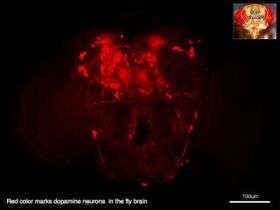
The dissected fly brain is stained for tyrosine hydroxylase immunoreactivity to visualize dopamine neurons. Tyrosine hydroxylase is a rate-limiting enzyme for dopamine biosynthesis and is present in dopamine neurons. Dopamine neurons comprise only about 0.1 percent of all the neurons in the fly brain. Credit: Young-Cho Kim, Penn State
A team of researchers at Penn Sate has used an animal model to reveal, for the first time, a physiological basis for the effect of alcohol on male sexual behavior, including increased sexual arousal and decreased sexual inhibition. The research, which will be published on 2 January 2008 in the scientific journal PLoS ONE, resulted in four novel findings with broad importance for further addiction research.
It is the first study to characterize the effects of chronic alcohol exposure in fruit flies. "Physiological evidence supporting various theories about the effect of alcoholic drinks has been lacking, so our now having a suitable animal model makes it possible to conduct much-needed laboratory research on this issue," explains research-team-leader Kyung-An Han, associate professor of biology and a neuroscientist at Penn State. Information from this research can serve as a baseline for similar studies in other animals, including humans.
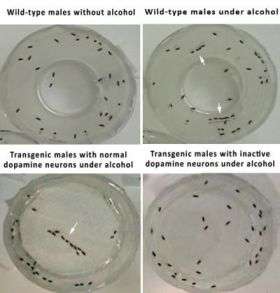
The wild-type male flies in the absence (left) or presence (right) of ethanol vapor in the Flypub experimental chamber. Bottom: The transgenic TH-GAL4/UAS-Shits male flies with (left) or without (right) dopamine neuronal activities during ethanol exposure. Credit: Hyun-Gwan Lee, Penn State.
In contrast to previous studies in other labs, which subjected fruit flies to short-term doses of ethanol -- the intoxicating ingredient in alcoholic drinks -- Han's team administered to fruit flies a daily dose of ethanol to more closely mimic the drinking habits of alcoholics and chronic alcohol abusers. The team investigated several factors that influence the physiological effects of ethanol, including genetic and cellular components, age, and prior experience.Among the team's discoveries is that male fruit flies, which typically court females, also actively court males when they are given a daily dose of ethanol. "We identified three molecules that are crucial for "ethanol-induced courtship disinhibition," Han said. In one of the team's experiments, Han and her students generated transgenic flies whose brain activities regulated by the neurotransmitter dopamine could be turned off temporarily by changing the temperature to 32-degrees C. "Without a temperature change, the transgenic males showed conspicuous inter-male courtship under the influence of ethanol; however, they exhibited negligible inter-male courtship when we changed the temperature to block the transmission of dopamine neurons in the brain," Han said. "This result suggests that dopamine is a key mediator of ethanol-induced inter-male courtship."
A second discovery is that repeated exposure to ethanol causes male flies to engage in more inter-male courtship, a phenomenon known as "behavioral sensitization." "If a behavior like alcohol consumption becomes more pleasurable the more often you do it, you are more likely to keep doing it," Han explained. Because the researchers suspect that behavioral sensitization results from adaptive changes in the brain's cells and molecules induced by chronic alcohol consumption, they plan to use behavioral sensitization as a model for further physiological studies of alcohol-associated behavior and addiction. "This part of our study demonstrates that sexual behavior is not determined only during an organism's development, but it also can be influenced by a post-developmental environmental factor; in this case, recurring exposure to ethanol," Han said. "These findings represent the first demonstration of enduring behavioral changes induced by recurring ethanol exposure in a fly model."
A third achievement of the team's research is its demonstration that daily ethanol exposure induces chronic tolerance to the sedative effect of ethanol in flies, as it does in other animals. Han and her students also made a fourth discovery -- that ethanol-induced intermale courtship is affected by aging. "As flies get older, their cognitive capacities decline, making them more susceptible to the negative effect of ethanol on cognition," Han reports. The research revealed that, under the influence of ethanol, middle-aged and old male flies (2- to 4-weeks old) have a higher propensity for uninhibited inter-male courtship compared to fully mature male flies (4-days old).
"As a result of our research with the fruit fly, we are now just beginning to discover the molecular and cellular mechanisms underlying neural changes in the brain that result from the chronic use of alcohol and that result in alcohol addiction and other behavior changes in our fly model," Han said. Taken together, the studies described by Han's team provide novel insights into the physiological effects of chronic ethanol exposure on sexual behavior and adaptive physiological changes within the brain, plus a foundation for future research on the effect of alcohol consumption on sexual behavior in mammals and other species.
Source: Penn State
-
Flies like us: They can act like addicts, too
Dec 10, 2009 |
5 / 5 (1) |
0
-
'Happy hour' gene discovery suggests cancer drugs might treat alcoholism
May 21, 2009 |
4.8 / 5 (4) |
1
-
Probing Question: Fishhooks of addiction
Jul 16, 2008 |
4 / 5 (2) |
1
-
'Drunk' fruit flies could shed light on genetic basis of human alcohol abuse
Oct 20, 2006 |
5 / 5 (1) |
0
-
Tiny amounts of alcohol dramatically extend a worm's life, but why?
Jan 20, 2012 |
4.8 / 5 (18) |
13
-
Engineers build first sub-10-nm carbon nanotube transistor
Feb 01, 2012 |
4.9 / 5 (32) |
30
-
Something old, something new: Evolution and the structural divergence of duplicate genes
Jan 31, 2012 |
4.6 / 5 (7) |
1
-
The hidden nanoworld of ice crystals: Revealing the dynamic behavior of quasi-liquid layers
Jan 30, 2012 |
5 / 5 (4) |
1
-
Stock market network reveals investor clustering
Jan 27, 2012 |
3.9 / 5 (23) |
8
-
Of microchemistry and molecules: Electronic microfluidic device synthesizes biocompatible probes
Jan 26, 2012 |
5 / 5 (2) |
0
-
Classical and Quantum Mechanics via Lie algebras
Apr 15, 2011
- More from Physics Forums - Independent Research
More news stories
Starve a virus, feed a cure? Findings show how some cells protect themselves against HIV
A protein that protects some of our immune cells from the most common and virulent form of HIV works by starving the virus of the molecular building blocks that it needs to replicate, according to research published online ...
46 minutes ago |
5 / 5 (1) |
0
|
Injured boomers beware: Know when to see doctor
(AP) -- It happened to nurse Jane Byron years after an in-line skating fall, business owner Haralee Weintraub while doing "men's" push-ups, and avid cyclist Gene Wilberg while lifting a heavy box.
2 hours ago |
5 / 5 (1) |
0
FDA-approved drug rapidly clears amyloid from the brain, reverses Alzheimer's symptoms in mice
Neuroscientists at Case Western Reserve University School of Medicine have made a dramatic breakthrough in their efforts to find a cure for Alzheimer's disease. The researchers' findings, published in the journal Science, show t ...
Medicine & Health / Neuroscience
Feb 09, 2012 |
4.9 / 5 (54) |
21
|
Green tea found to reduce disability in the elderly
(Medical Xpress) -- A lot of research has been done over the past several years looking into the health benefits of green tea. As a result, scientists have found that regular consumption of the beverage leads ...
Teen school drop-outs three times as likely to be on benefits in later life
Teen school drop-outs are almost three times as likely to be on benefits in later life as their peers who complete their schooling, indicates research published online in the Journal of Epidemiology and Community Health.
Feb 06, 2012 |
not rated yet |
13
Scientists discover molecular secrets of 2,000-year-old Chinese herbal remedy
For roughly two thousand years, Chinese herbalists have treated Malaria using a root extract, commonly known as Chang Shan, from a type of hydrangea that grows in Tibet and Nepal. More recent studies suggest that halofuginone, ...
New method to examine batteries -- MRI from the inside
There is an ever-increasing need for advanced batteries for portable electronics, such as phones, cameras, and music players, but also to power electric vehicles and to facilitate the distribution and storage of energy derived ...
A mitosis mystery solved: How chromosomes align perfectly in a dividing cell
Although the process of mitotic cell division has been studied intensely for more than 50 years, Whitehead Institute researchers have only now solved the mystery of how cells correctly align their chromosomes during symmetric ...
Researchers find extensive RNA editing in human transcriptome
In a new study published online in Nature Biotechnology, researchers from BGI, the world's largest genomics organization, reported the evidence of extensive RNA editing in a human cell line by analysis of RNA-seq data, demons ...
The proteins ensuring genome protection
Researchers from the University of Geneva (UNIGE), Switzerland, have discovered the crucial role of two proteins in developing a cell 'anti-enzyme shield'. This protection system, which operates at the level of molecular ...
Lab study raises questions over nano-particle impact
Tests involving chickens have raised questions about the impact on health from engineered nano-particles, the ultra-fine grains commonly used in drugs and processed foods, scientists said on Sunday.