2 explosive evolutionary events shaped early history of multicellular life
Scientists have known for some time that most major groups of complex animals appeared in the fossils record during the Cambrian Explosion, a seemingly rapid evolutionary event that occurred 542 million years ago. Now Virginia Tech paleontologists, using rigorous analytical methods, have identified another explosive evolutionary event that occurred about 33 million years earlier among macroscopic life forms unrelated to the Cambrian animals. They dubbed this earlier event the "Avalon Explosion."
The discovery, reported in the January 4 issue of Science, suggests that more than one explosive evolutionary event may have taken place during the early evolution of animals.
The Cambrian explosion event refers to the sudden appearance of most animal groups in a geologically short time period between 542 and 520 million years ago, in the early Cambrian Period. Although there were not as many animal species as in modern oceans, most (if not all) living animal groups were represented in the Cambrian oceans. "The explosive evolutionary pattern was a concern to Charles Darwin, because he expected that evolution happens at a slow and constant pace," said Shuhai Xiao, associate professor of geobiology at Virginia Tech. “Darwin’s perception could be represented by an inverted cone with ever expanding morphological range, but the fossil record of the Cambrian Explosion and since is better represented by a cylinder with a morphological radiation at the base and morphological constraint afterwards.”
Darwin reckoned that there should be long and hidden periods of animal evolution before the Cambrian Explosion, Xiao said.
But paleontologists have not found such evidence, and recently scientists have learned that biological evolution has not been moving on a smooth road. “Accelerated rates may characterize the early evolution of many groups of organisms,” said Michal Kowalewski, professor of geobiology at Virginia Tech.
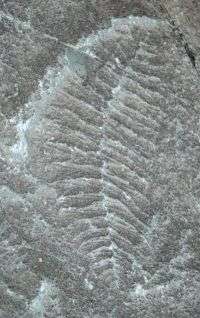
To test whether other major branches of life also evolved in an abrupt and explosive manner, Virginia Tech graduate students Bing Shen and Lin Dong, along with Xiao and Kowalewski, analyzed the Ediacara fossils: the oldest complex, multicellular organisms that had lived in oceans from 575 to 542 million years ago; that is, before the Cambrian Explosion of animals. "These Ediacara organisms do not have an ancestor-descendant relationship with the Cambrian animals, and most of them went extinct before the Cambrian Explosion," said Shen. “And this group of organisms – most species – seems to be distinct from the Cambrian animals.”
But how did those Ediacara organisms first evolve, Shen asked. Did they also appear in an explosive evolutionary event, or is the Cambrian Explosion a truly unparalleled event"
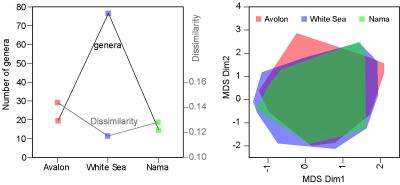
“We identified 50 characters and mapped the distribution of these characters in more than 200 Ediacara species. These species cover three evolutionary stages of the entire Ediacara history across 33 million years,” said Shen.
The three successive evolutionary stages are represented by the Avalon, White Sea, and Nama assemblages (all named after localities where representative fossils of each stage can be found). The earliest Avalon stage was represented by relatively few species.
Surprisingly, however, as shown by Shen and colleagues, these earliest Ediacara life forms already occupied a full morphological range of body plans that would ever be realized through the entire history of Ediacara organisms. "In other words, major types of Ediacara organisms appeared at the dawn of their history, during the Avalon Explosion," Dong said. "Subsequently, Ediacara organisms diversified in White Sea time and then declined in Nama time. But, despite this notable waxing and waning in the number of species, the morphological range of the Avalon organisms were never exceeded through the subsequent history of Ediacara."
Kowalewski said their research team had not anticipated the discovery. “Using the scientific literature, we were trying to create a more rigorous reconstruction of the morphological history of Ediacara organisms,” he said.
The process involved adapting quantitative methods that had been used previously for studying morphological evolution of animals, but never applied to the enigmatic Ediacara organisms. “We think of diversity in terms of individual species. But species may be very similar in their overall body plan. For example, 50 species of fly may not differ much from one another in terms of their overall shape – they all represent the same body plan. On the other hand, a set of just three species that include a fly, a frog and an earthworm represent much more morphological variation. We can thus think of biodiversity not only in terms of how many different species there are but also how many fundamentally distinct body plans are being represented. Our approach combined both those approaches,” said Kowalewski.
“In addition, the method relies on converting different morphologies into numerical (binary) data. This strategy allows us to describe, more objectively and more consistently, enigmatic fossil life forms, which are preserved mostly as two-dimensional impressions and are not understood well in terms of function, ecology, or physiology,” Kowalewski said.
Scientists are still unsure what were the driving forces behind the rapid morphological expansion during the Avalon explosion, and why the morphological range did not expand, shrink, or shift during the subsequent White Sea and Nama stages.
"But, one thing seems certain -- the evolution of earliest macroscopic and complex life also went through an explosive event before to the Cambrian Explosion,” Xiao said. “It now appears that at the dawn of the macroscopic life, between 575 and 520 million years ago, there was not one, but at least two major episodes of abrupt morphological expansion."
Source: Virginia Tech


