U of M physicist reads the history of the solar system in grains of comet dust
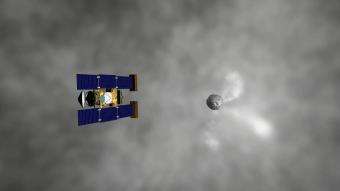
Four years ago, NASA's Stardust spacecraft chased down a comet and collected grains of dust blowing off its nucleus. When the spacecraft Comet Wild-2 returned, comet dust was shipped to scientists all over the world, including University of Minnesota physics professor Bob Pepin. After testing helium and neon trapped in the dust specks, Pepin and his colleagues report that while the comet formed in the icy fringes of the solar system, the dust appears to have been born close to the infant sun and bombarded by intense radiation from these and other gases before being flung out beyond Neptune and trapped in the comet. The research appears in the Jan. 4 issue of the journal Science.
The finding opens the question of what was going on in the early life of the solar system to subject the dust to such intense radiation and hurl them hundreds of millions of miles from their birthplace.
The studies of cometary dust are part of a larger effort to trace the history of our celestial neighborhood.
"We want to establish what the solar system looked like in the very early stages," said Pepin. "If we establish the starting conditions, we can tell what happened in between then and now." One early event was the birth of Earth's moon, about 50 million years after the solar system formed.
Also, the gases he studies have relevance even closer to home. "Because some scientists have proposed that comets have contributed these gases to the atmospheres of Earth, Venus and Mars, learning about them in comets would be fascinating," he said.
Comet Wild-2 (pronounced Vilt-two) is thought to have originated in the Kuiper Belt, a comet-rich region stretching from just inside the orbit of Neptune to well beyond Pluto. As it grew in this roughly -360 F region, it incorporated grains of dust and ambient gas.
The comet received a visit from the Stardust spacecraft in early January 2004, two years after its launch. Veering as close as 149 miles to the comet nucleus, Stardust used a spongy, ultralight glass-fiber material called aerogel to trap the dust. At the moment of encounter, the spacecraft exposed a sheet of aerogel -- supported by a framework -- to the stream of particles blowing off the nucleus.
"It looked like a tennis racket," said Pepin. "It was exposed for approximately 20 minutes."
The aerogel trapped aggregates of fine particles that hit at 13,000 miles per hour and split on impact. The collisions left drumstick-shaped trails pointing inward from the surface of the aerogel.
After the collection, the spacecraft headed home and parachuted its payload safely back to Earth in January 2006. A few months later, Pepin received three sub-samples of particles and colleagues at Nancy University, France, received two others, all from the same particle "hit."
Their task was to analyze gases locked in tiny dust grains about a quarter of a billionth of a gram in weight. As a first step, the researchers heated the grains to about 1,400 degrees C., liberating gases imprisoned for eons.
"The particles probably came from the first million years or even less, of the solar system's existence," Pepin said. That would be close to 4.6 billion years ago. If our middle-aged sun were 50 years old, then the particles were born in the first four days of its life.
Source: University of Minnesota


